IN Brief:
- Flex Power Modules has introduced the BMR353 eighth-brick intermediate bus converter.
- The non-isolated digital DC/DC converter delivers 860W continuous power and 1200W peak power.
- Target applications include AI data centres and high-density 48V power architectures.
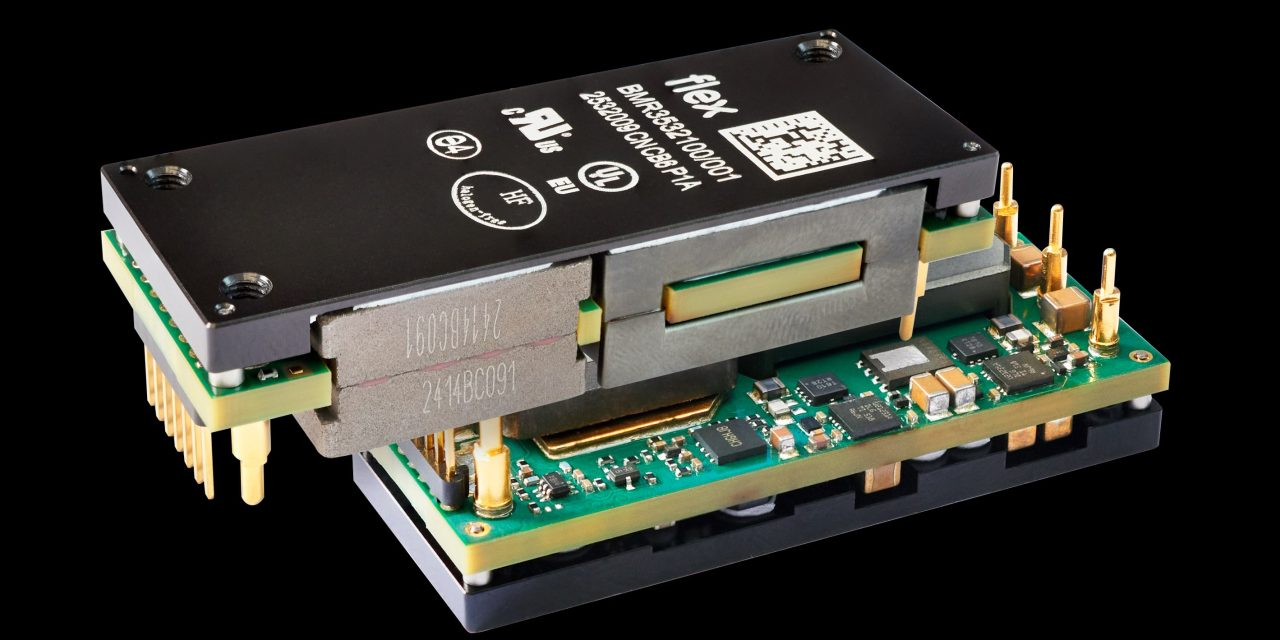
Flex Power Modules has introduced the BMR353 eighth-brick intermediate bus converter for high-power AI data-centre applications.
The non-isolated digital DC/DC converter provides a regulated 12.2V output, 860W continuous output power, and 1200W peak power in an eighth-brick footprint measuring 58.4mm by 22.7mm by 12.8mm. The device supports PMBus configuration, remote controls, paralleling with active current sharing, and use with Flex Power Designer software.
Efficiency is central to the launch, with the converter reaching around 97.8% in reported coverage and 97.4% in Flex’s broader data-centre power material. In AI infrastructure, conversion losses, thermal management, airflow, rack density, and serviceability all influence whether compute hardware can be deployed economically.
The BMR353 is aimed at intermediate bus conversion in high-density power systems, where 48V distribution is increasingly used to reduce current and loss before local conversion stages feed processors, accelerators, memory, and networking hardware. As accelerator power rises, each conversion stage has to handle higher load transients, tighter regulation, and greater thermal stress without consuming excessive board area.
At higher voltage levels, Microchip’s 3.3kV SiC modules for medium-voltage power conversion show how data-centre power architectures are being reconsidered from the building down to the rack. At board level, converters such as the BMR353 sit closer to the compute hardware, where dense, fast-changing loads place different demands on conversion efficiency and thermal design.
The power problem is becoming architectural. AI clusters are not simply adding more servers; they are changing how power is brought into buildings, converted, distributed, monitored, cooled, and backed up. Higher rack power pushes conventional low-voltage distribution harder, while accelerator load profiles increase the need for efficient conversion close to the point of use.
Digital control helps manage that environment. PMBus support allows telemetry, configuration, fault reporting, and system-level monitoring, which become more valuable as operators try to understand power behaviour across large deployments. Active current sharing supports parallel operation where higher load or redundancy is required, while software design tools can shorten the evaluation route for engineers balancing efficiency, derating, layout, and thermal constraints.
The eighth-brick form factor also carries practical value. Data-centre hardware is already competing for space between processors, memory, high-speed I/O, power stages, cooling hardware, and service access. A compact converter package gives designers another route to increase power without pushing the system toward more disruptive mechanical changes.
Thermal performance remains one of the hardest parts of the design. Even high efficiency leaves meaningful heat at these power levels, and that heat must be removed reliably across operating conditions. Converter placement, copper area, airflow, baseplate or heat-spreader options, and surrounding component temperatures all shape real-world performance.
The BMR353 extends Flex Power Modules’ data-centre DC/DC portfolio into a load profile increasingly shaped by AI. Its value will depend not only on headline wattage and efficiency, but on how easily designers can integrate it into 48V architectures that have to remain serviceable, monitored, thermally stable, and repeatable at scale.