IN Brief:
- Infineon and LS Electric will develop power converters, solid-state transformers, and semiconductor circuit breakers.
- Infineon will provide power semiconductors, microcontrollers, and control technology for the systems.
- Rising data-centre power density is accelerating work on higher-voltage DC distribution and faster fault protection.
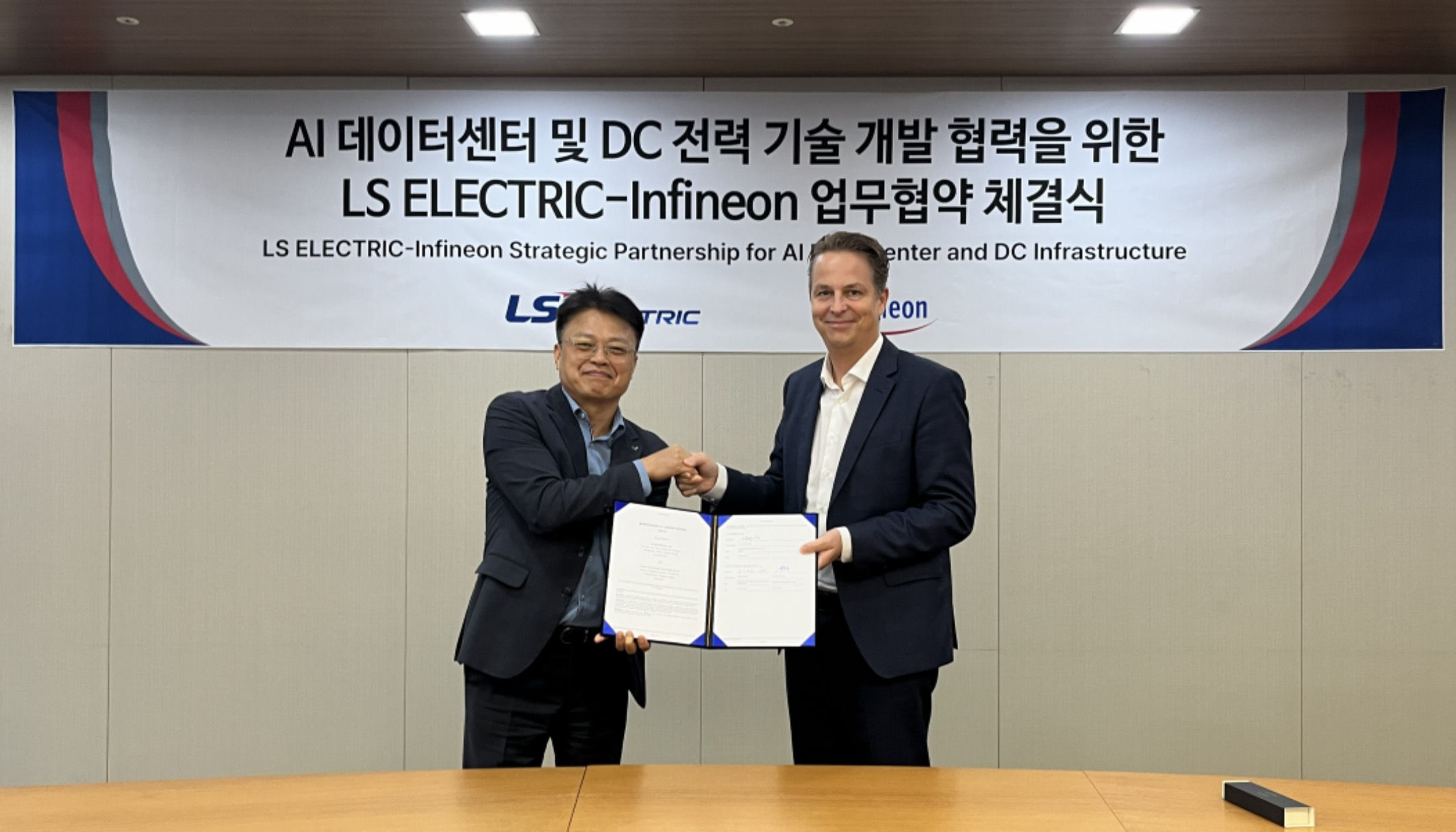
Infineon and LS Electric have agreed to develop high-efficiency direct-current power infrastructure for AI data centres, energy-storage systems, and next-generation electricity networks.
The collaboration covers power-conversion systems, solid-state transformers, and solid-state circuit breakers. Infineon will contribute power semiconductors, microcontrollers, and control technologies, while LS Electric will apply its experience in power systems, industrial automation, and system-level integration.
AI computing is raising power density throughout the data-centre electrical chain, from the grid connection and backup systems to the power shelves, racks, accelerator boards, and cooling equipment. Each conversion stage adds loss, heat, physical equipment, and another potential failure point.
Direct-current distribution can remove selected conversions where energy storage and electronic loads already operate internally on DC. Transformation, regulation, isolation, and protection remain necessary, but their placement and architecture can be changed to reduce repeated conversion between AC and DC domains.
Solid-state transformers combine high-frequency magnetic components with semiconductor conversion stages, replacing or supplementing conventional low-frequency transformers. Infineon and LS Electric are targeting equipment that can be up to 30% smaller and lighter while adding controllable voltage conversion, monitoring, and grid-interaction functions.
Higher switching frequency allows magnetic and filter components to shrink, although the resulting system becomes more dependent on semiconductor performance, gate control, insulation design, electromagnetic compatibility, and thermal engineering. High-voltage switches, sensors, isolated drivers, controllers, and cooling hardware must operate as one coordinated platform.
Solid-state circuit breakers introduce a different set of trade-offs. Semiconductor switches can interrupt current on a microsecond timescale, limiting fault energy before it damages sensitive power electronics or conductors, whereas conventional mechanical devices generally operate more slowly.
Continuous conduction through semiconductor switches creates losses that must be removed under normal operation, while voltage blocking, surge tolerance, short-circuit behaviour, and fail-safe operation still have to be guaranteed during abnormal conditions. Protection speed is valuable only when the device can distinguish a genuine fault from inrush current, load steps, switching events, or temporary control instability.
As batteries, converters, DC buses, and electronic breakers become more closely connected, protection coordination increasingly relies on software and communications. A rapidly operating device without adequate selectivity can disconnect healthy sections of a power system and reduce availability rather than improve it.
Infineon’s work supplying silicon-carbide devices for modular megawatt converters forms part of the same move towards higher-voltage, bidirectional, and more power-dense infrastructure. Semiconductor selection is becoming inseparable from decisions about facility layout, energy storage, protection, and cooling.
Wide-bandgap devices can reduce switching and conduction losses, but their fast voltage edges place greater demands on PCB layout, busbar geometry, gate-drive control, isolation, common-mode behaviour, and EMC. Silicon, SiC, and GaN are likely to coexist because the preferred technology changes with voltage, current, frequency, cost, and reliability requirements.
Data-centre scale amplifies relatively small changes in efficiency. A fractional reduction in converter loss can save substantial energy across hundreds of megawatts, although operators also place a high value on serviceability, redundancy, and proven field performance.
Architectures based on 800VDC and other higher-voltage rails have consequently moved closer to deployment as rack loads increase. Higher power density is already reshaping conversion, protection, and cooling systems, since lower-voltage distribution requires heavier conductors, greater current, and more elaborate management of fault energy.
Solid-state devices can make protection and conversion more programmable, but they also increase dependence on firmware, sensing accuracy, cybersecurity, and validated control algorithms. Updates and configuration changes must be governed with the same discipline applied to conventional protection settings, particularly where equipment operates alongside the public grid.
Infineon and LS Electric must now convert the agreement into defined converter platforms, device selections, control architectures, and demonstration systems. Efficiency will need to be measured across the complete power chain rather than at an isolated semiconductor or conversion stage.
Adoption will follow only where the new equipment can demonstrate predictable fault behaviour, maintainability, service life, and integration with established electrical standards. The semiconductor content may be central to the architecture, but the completed system will be judged as power infrastructure rather than as a collection of advanced components.