IN Brief:
- Four IEEE 802.3bt ports deliver up to 95W each, accompanied by four 30W PoE ports.
- Four dual-rate SFP slots provide fibre uplinks for longer-distance and electrically isolated connections.
- G.8032 Ethernet Ring Protection Switching supports network recovery in less than 50ms.
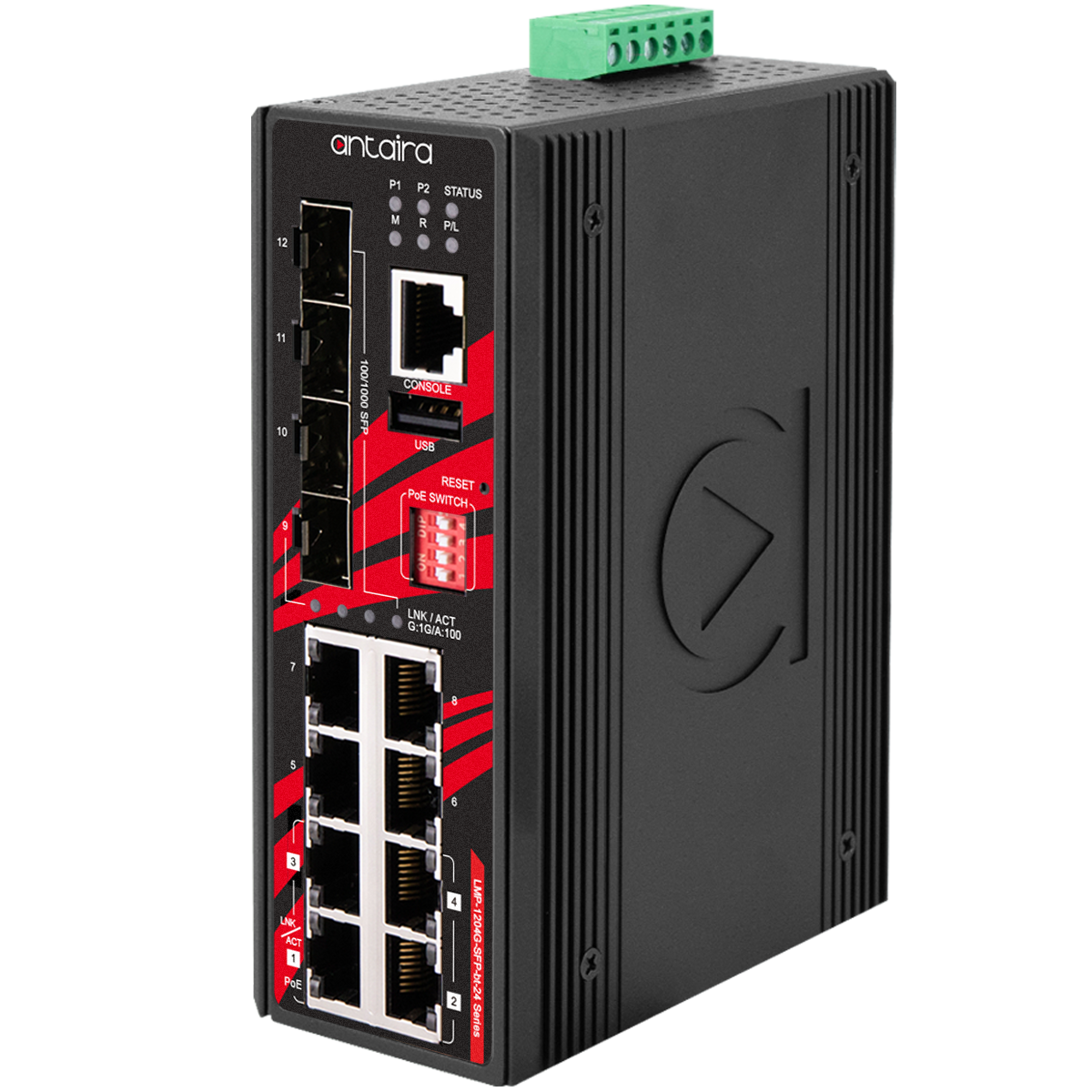
Antaira Technologies has introduced a 12-port managed industrial Ethernet switch combining high-power PoE++, conventional PoE, fibre uplinks, and ring-network redundancy.
The LMP-1204G-SFP-bt-24-T-BOS provides four 10/100/1000Base-T ports supporting IEEE 802.3bt power delivery up to 95W per port. A further four Gigabit copper ports supply up to 30W through IEEE 802.3af and 802.3at.
Four dual-rate 100/1000 SFP slots provide fibre connectivity for longer links, electrical isolation, and connections between buildings, cabinets, or remote areas of an industrial site.
Accepting a 12V to 55VDC input, the Light Layer 3 switch incorporates a web-management console alongside VLAN, quality-of-service, IGMP, SNMP, RMON, Modbus TCP, authentication, and secure management functions.
Support for ITU-T G.8032 Ethernet Ring Protection Switching allows traffic to recover in less than 50ms following a link failure. Rapid reconvergence can preserve communications between cameras, controllers, wireless access points, sensors, and SCADA equipment when a cable or path is interrupted.
The IP30 enclosure can be mounted on a DIN rail or wall and operates from −40°C to 75°C. Elevated EFT and ESD protection is intended for factory automation, utilities, water treatment, oil and gas, mining, transport, surveillance, and outdoor infrastructure.
High-power PoE allows devices that once required a local electrical supply to operate through one Ethernet cable. PTZ cameras can include heaters, wipers, infrared lighting, and analytics, while multi-radio wireless access points and edge processors increasingly exceed the limits of earlier 15.4W and 30W standards.
The 95W rating represents the maximum power available at the switch port rather than the energy arriving at the endpoint. Cable resistance creates loss, particularly over long runs, while conductor size, cable category, connector condition, ambient temperature, and bundle density influence voltage drop and heating.
Network design therefore requires a total power calculation rather than a count of available sockets. Four high-power devices operating near maximum load can demand substantially more input capacity than a cabinet originally designed for conventional communications equipment.
The upstream DC supply, protective devices, wiring, terminals, and thermal design must accommodate that demand. A redundant ring provides limited protection when both switches depend on one undersized supply, share an unprotected cable route, or draw from the same vulnerable circuit.
Mixing four 95W and four 30W ports allows high-demand endpoints to share one switch with sensors and conventional cameras. It also avoids fitting maximum-power circuitry to every connection, although port assignments and expected load need to remain documented during commissioning and service.
Fibre uplinks add electrical separation across longer routes and avoid ground-potential differences between buildings or remote installations. Copper can remain at the powered endpoint, while fibre connects the edge switch to the core or forms part of the protected ring.
Industrial deployment of IEEE 802.3bt is expanding alongside edge processing and higher-power cameras. Where an existing non-PoE switch must be retained, 90W industrial midspans provide an alternative migration route.
Managed power becomes more useful as endpoint count rises because ports can be monitored, prioritised, and remotely cycled. Traffic segregation, quality of service, and multicast control can also prevent one device class from consuming the bandwidth required by control or alarm functions.
Those management features create another security boundary. Default credentials, unused protocols, weak access control, and unmanaged firmware revisions can expose the operational network, particularly when remote administration is allowed across wider corporate or public connections.
A sub-50ms ring-recovery figure describes the network layer, while the application may take longer to resume if a camera, controller, or higher-level protocol drops its session. Commissioning tests need to measure the response of the complete system rather than the switch transition alone.
The LMP-1204G-SFP-bt-24-T-BOS consolidates power and communications within one rugged edge device. Fewer local supplies and cable routes simplify installation, but DC capacity, thermal behaviour, cybersecurity, and operational resilience must be engineered as one network.