IN Brief:
- PCOM-BC00 uses Intel Atom x7000E and x7000RE processors with as many as eight cores.
- The SMARC 2.2 module includes dual 2.5GbE, MIPI-CSI, PCIe, and optional CAN.
- Selected configurations support industrial temperatures, time-sensitive networking, and deterministic control.
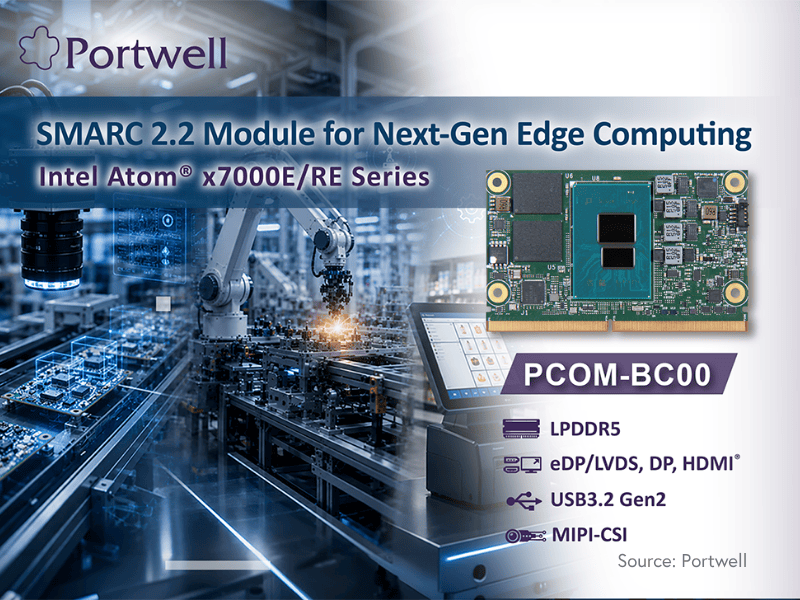
Portwell has expanded its SMARC computer-on-module range with the PCOM-BC00, an Intel Atom platform for industrial automation, machine vision, autonomous mobile robots, and compact edge systems. The 82mm × 50mm module uses x7000E and x7000RE processors, offering configurations with as many as eight cores.
Processor power can be configured across a 6–15W thermal design range, allowing developers to trade compute performance against cooling capacity and available electrical power. Up to 16GB of LPDDR5 memory and 256GB of eMMC 5.1 storage sit on the module, reducing carrier-board complexity where removable storage is unnecessary.
Connectivity includes four PCIe Gen 3 x1 interfaces, two USB 3.2 Gen 2 ports, six USB 2.0 connections, SATA, two UARTs, dual 2.5GbE, three display outputs, MIPI-CSI camera input, and optional CAN. Selected variants operate from -40°C to +85°C and support Intel Time Coordinated Computing and time-sensitive networking functions.
Those interfaces place the module between a conventional embedded controller and a compact industrial PC. One system can handle local vision, user interface, machine networking, data logging, and supervisory control, provided that operating-system behaviour and workload contention remain compatible with the required response times.
By separating the processor and memory from the application-specific carrier board, SMARC 2.2 supports staged upgrades across longer-lived equipment platforms. Power conditioning, field I/O, connectors, transceivers, safety circuitry, and machine interfaces can remain with the product while its compute layer changes to follow processor availability, security requirements, or software support.
That modularity is valuable in equipment whose mechanical and electrical platform may remain in service for a decade, although it does not make upgrades automatic. Pin assignments, power sequencing, signal voltage, firmware, high-speed layout, heat spreading, and optional interface use must still be checked whenever a new module replaces an earlier design.
Portwell’s Intel platform complements Arm-based developments such as Variscite’s i.MX 95 SMARC roadmap, which combines application processing, real-time control, security, and neural acceleration. PCOM-BC00 instead favours x86 compatibility, established industrial software stacks, and development practices closer to those used for conventional PCs.
Machine vision will place the heaviest combined load on the module’s camera, memory, processor, and network resources. Local inference can prevent raw images from flooding an upstream connection, but continuous capture and analysis also concentrate heat inside a sealed or fanless edge enclosure.
Native MIPI-CSI supports compact camera integration, while PCIe and USB provide routes to frame grabbers, storage, additional networking, or dedicated accelerators. The final architecture will depend on resolution, frame rate, model size, latency, and whether the processor must run control or visualisation tasks alongside the vision pipeline.
Dual 2.5GbE ports give designers several network arrangements without adding a separate controller. One port can serve the machine network while the second connects cameras, storage, maintenance equipment, or a segregated operational domain, and time-sensitive networking can coordinate traffic where devices share a deterministic clock.
Bandwidth requirements continue to rise as edge systems combine several cameras and sensors. The appearance of 10GbE modules for industrial edge platforms shows how quickly conventional links can become restrictive; 2.5GbE offers more headroom than standard Gigabit Ethernet without imposing the power and routing burden of a server-class interface.
Although wide-temperature processor options support harsh-environment designs, they address only one part of complete environmental qualification. Storage endurance, connector reliability, vibration, condensation, supply transients, electromagnetic compatibility, and throttling at temperature extremes remain properties of the complete carrier, enclosure, and cooling assembly.
Software lifecycle may prove equally decisive because embedded x86 hardware often remains available longer than the operating systems and application frameworks initially chosen for it. Secure boot, update mechanisms, device identity, and recovery after a failed update need to be designed before the module becomes inaccessible inside deployed equipment.
PCOM-BC00 gives manufacturers a compact route to consolidate processing, vision, networking, and gateway duties around a standards-based module. Its production appeal will rest on long-term availability, carrier compatibility, thermal performance, and whether the selected processor can sustain mixed workloads without compromising control behaviour.