IN Brief:
- The third generation MRDIMM chipset increases maximum DDR5 transfer rates by 25% to 16,000MT/s.
- A new clock driver and data buffer support faster server memory within the standard DIMM format.
- Samples are reaching platform and DRAM partners ahead of production planned for the second half of 2027.
Renesas Electronics has introduced a third generation DDR5 multiplexed rank dual inline memory module chipset capable of supporting transfer rates of up to 16,000MT/s in future artificial intelligence and high performance computing servers.
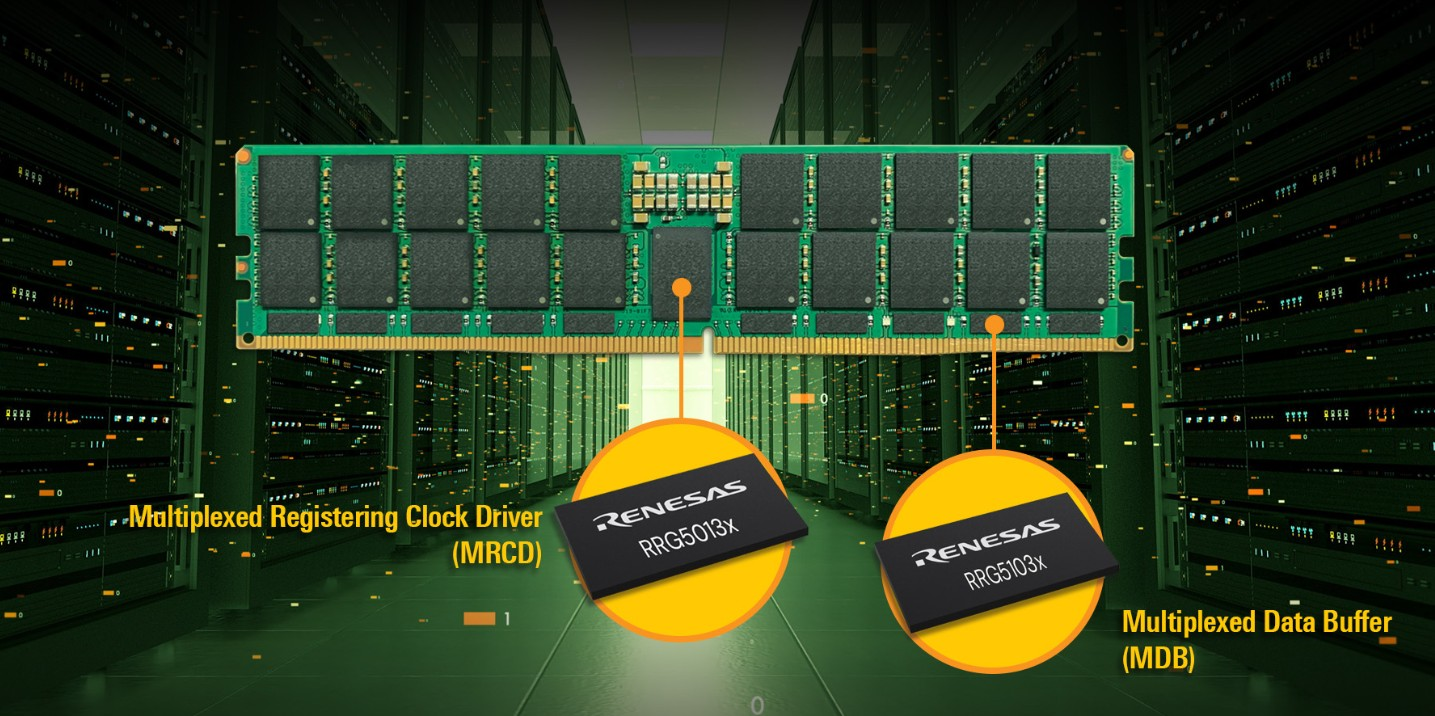
Combining the RRG5013 multiplexed registering clock driver with the RRG5103 multiplexed data buffer, the chipset raises peak bandwidth by 25% over Renesas’ second generation MRDIMM components while retaining the established DDR5 interface and standard server DIMM format. Samples are now being supplied to selected customers, including major DRAM manufacturers, with production availability scheduled for the second half of 2027.
MRDIMM technology increases the effective data rate between a server processor and main memory by multiplexing data from two physical ranks. Each rank can operate at a lower internal speed while the module presents a faster interface to the host processor, widening the available memory channel without requiring a new class of DRAM.
Within the new chipset, the RRG5013 manages command, address, and clock signals between the host and the memory ranks, while the RRG5103 buffers and multiplexes the data paths. Renesas is supporting the pair with power management integrated circuits, serial presence detect hubs, and temperature sensors, giving module manufacturers access to the principal interface and management devices from one portfolio.
A Device Equalisation Self Train Mode quality indication function has also been added, providing status information during receiver equalisation and timing training. More detailed feedback should help a host establish stable links at higher transfer rates, where smaller variations in package, module, connector, and motherboard behaviour can narrow the available data eye.
Renesas is working with processor and server platform suppliers as well as DRAM manufacturers, because support depends on more than the module itself. The processor memory controller, firmware, board layout, connector, population rules, and cooling arrangement must all be validated as a complete channel before 16,000MT/s operation can be deployed reliably.
Bandwidth rises alongside integration demands
As processors add cores and accelerator systems move larger datasets between storage, host memory, and attached computing devices, conventional server memory has become a more prominent system constraint. High bandwidth memory remains the preferred option beside advanced accelerators, although its cost, packaging requirements, and limited capacity preserve an important role for higher performance DIMMs within the wider memory hierarchy.
That pressure is already pulling module suppliers towards faster MRDIMM designs, with Innodisk developing 12,800MT/s modules for AI and data centre systems. Renesas’ 16,000MT/s interface extends the same architecture further, using the familiar DIMM format to raise bandwidth without forcing server builders into a wholesale mechanical redesign.
Compatibility at the form factor level does not imply unrestricted interchangeability. Faster edge rates increase sensitivity to impedance discontinuities, crosstalk, insertion loss, and timing skew, while the additional multiplexing circuitry introduces its own power and thermal load. Motherboard trace lengths, socket loading, and the number of populated modules will therefore influence the highest stable operating speed.
Training and equalisation become correspondingly more important as margins contract. A server must establish workable settings across manufacturing variation, supply voltage movement, and temperature changes, then preserve those margins throughout its service life. Status information from the new self training function gives platform firmware another source of evidence when adjusting receiver behaviour rather than treating link initialisation as a simple pass or fail event.
Power creates a second constraint, since wider memory bandwidth only improves system performance when processors and accelerators can use it efficiently. Extra interface logic may reduce the time spent moving a dataset, yet a poorly balanced platform can consume more energy without producing a comparable increase in completed workloads. Thermal design must account for the memory devices, buffers, clock drivers, power management components, and airflow around densely populated sockets.
The long interval between sampling and volume production reflects the coordination required across this ecosystem. Processor vendors must support the interface in their memory controllers, DRAM suppliers need compatible devices and reference designs, while module and server manufacturers must complete signal integrity, firmware, thermal, and reliability qualification.
By preserving the DDR5 infrastructure around the faster interface, Renesas is pursuing an evolutionary route through a stubborn bandwidth problem. The approach leaves the server memory hierarchy intact, but pushes its conventional tier closer to the throughput required by increasingly data intensive AI and high performance computing workloads.