IN Brief:
- Enterprise SSDs accounted for 48% of global NAND bits shipped in Q2 2026, according to Counterpoint Research.
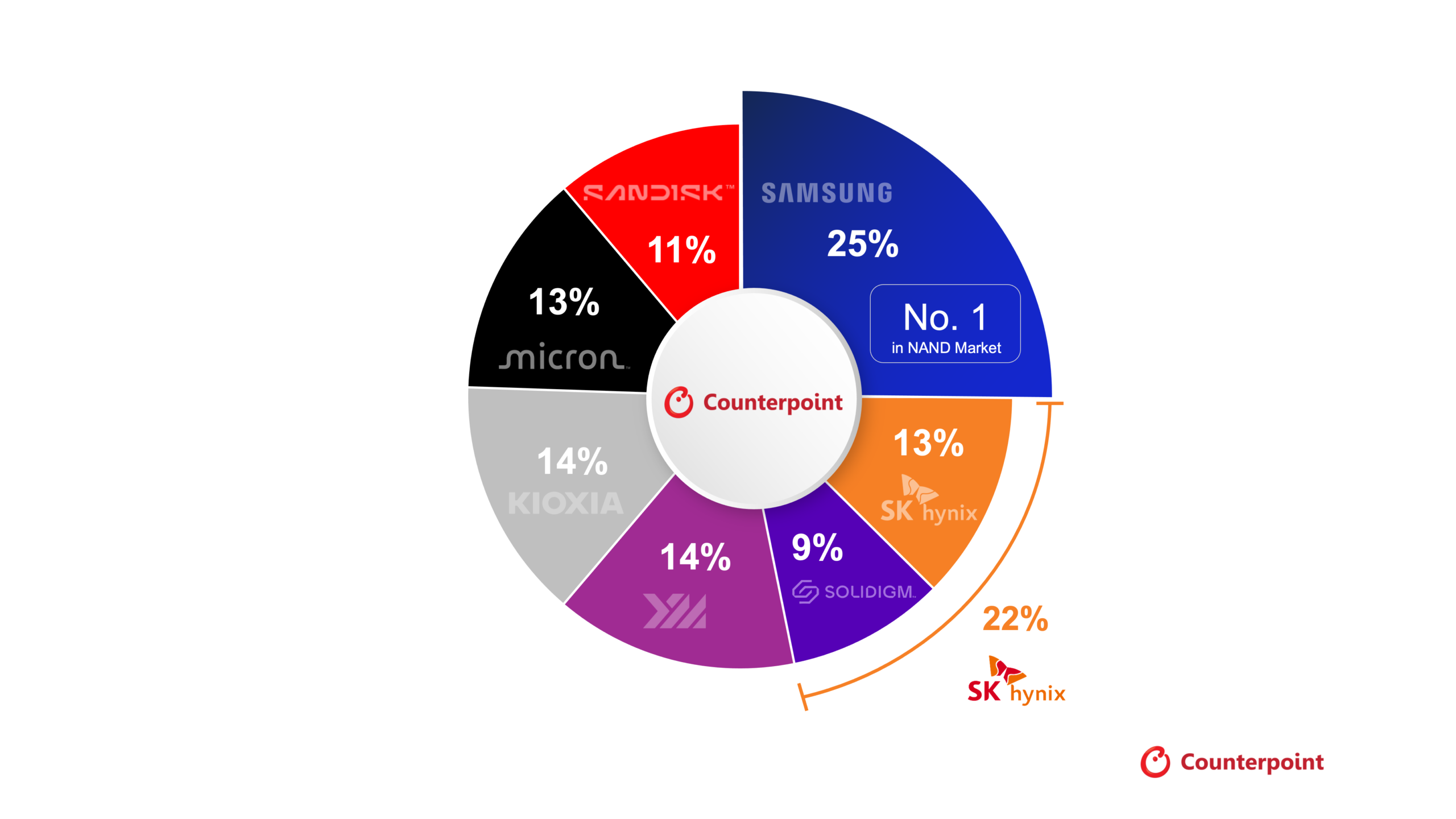
- Samsung led NAND shipments with 25%, followed by SK hynix at 22%, while YMTC reached 14% and moved into third place.
- Counterpoint expects enterprise SSDs to absorb more than half of NAND bits before the end of 2026.
Counterpoint Research says enterprise SSDs accounted for 48% of global NAND bits shipped during the second quarter of 2026, up from 26% a year earlier as AI inference systems absorbed a growing share of flash-memory output.
The shift is changing both the product mix and competitive structure of the NAND market. Counterpoint puts Samsung first by shipment volume with 25%, followed by SK hynix at 22%, while China’s YMTC reached 14% and moved into third place ahead of Kioxia. Micron completed the top five.
Shipment share alone does not describe the commercial change. Enterprise SSDs consume large quantities of NAND while carrying substantially more value than storage supplied into many consumer devices, so suppliers increasingly have to balance total bit output against the margins available in different product classes.
Counterpoint attributes much of the movement to the transition of AI workloads from training towards inference. Large inference environments need persistent access to model data, key-value caches, and other datasets that cannot all remain in the highest-cost volatile memory tiers, increasing the role of fast enterprise storage alongside DRAM and high-bandwidth memory.
The result is a rapid reallocation of NAND capacity towards servers. Counterpoint expects enterprise SSDs to absorb more than half of global NAND bits before the end of 2026, which would leave PCs, smartphones, consumer electronics, and other established markets competing for a smaller proportion of industry output.
Samsung remains the largest NAND manufacturer, but Counterpoint says its shipment share has fallen from 32% in the second quarter of 2024 to 25% two years later. The researcher links part of that movement to capacity constraints and Samsung’s prioritisation of higher-value memory products, illustrating how production decisions increasingly span NAND and DRAM rather than being made within each market independently.
SK hynix has benefited from enterprise demand through Solidigm. Counterpoint reports that Solidigm’s bit shipments increased 40% quarter on quarter, supporting the wider group’s second-place position as server storage became a larger part of the market.
YMTC has followed a different route. Counterpoint reports that its NAND shipments increased 22% year on year and 5% sequentially, taking the Chinese manufacturer into third place by bit shipments. Its manufacturing roadmap includes 267-layer 3D NAND based on the company’s Xtacking architecture, while development is continuing beyond 300 layers.
That volume position has not yet translated into the same revenue ranking. YMTC remained fifth by revenue during the quarter because its product mix is still more heavily exposed to consumer applications, while suppliers with greater enterprise-SSD exposure generate more value from a similar or smaller quantity of NAND.
The distinction becomes more important as server storage expands. Increasing layer counts can improve density and manufacturing economics, but a NAND die intended for an enterprise SSD must sit behind controllers, firmware, error management, qualification, and endurance characteristics capable of supporting sustained workloads and large fleets.
AI infrastructure places particular pressure on those requirements. Server storage can remain active for long periods, while operators need predictable latency, power consumption, endurance, data integrity, and failure behaviour across thousands of drives. Competitive NAND density therefore remains only one part of winning high-value enterprise business.
Kioxia already directs a substantial proportion of its shipments towards servers, although Counterpoint says higher enterprise-storage prices moderated some customer purchases during Q2. That slower growth helped YMTC overtake it by shipment volume without establishing the same enterprise revenue mix.
The capacity shift can also affect buyers well outside the data centre. NAND manufacturers have a straightforward incentive to allocate production towards stronger margins, and sustained enterprise demand can tighten the amount of output available to consumer and industrial markets even where their own end demand has changed little.
For electronics manufacturers, the important development is therefore not simply that enterprise SSDs reached 48%. Server demand is beginning to determine where NAND capacity goes. If Counterpoint’s forecast is borne out and enterprise storage moves beyond half of all shipped bits this year, much of the memory market will be taking its production cues from data-centre economics.