IN Brief:
- SUSTRONICS involved 45 research and industry partners across 11 European countries and ten demonstrators.
- Redesigning a glucose-monitoring patch around an optical sensor reduced that demonstrator's carbon footprint by around 65 per cent.
- Alternative substrates, conductive materials, and early life cycle assessment were tested alongside reliability requirements.
Fraunhofer IZM has reported substantial reductions in the environmental impact of medical electronics developed through the European SUSTRONICS research project, using life cycle assessment during design rather than after products were complete. The programme brought together 45 research and industry partners from 11 European countries under the coordination of Philips Nederland and tested material, process, and design changes across ten demonstrators.
Medical and diagnostic electronics formed a significant part of the work, including EEG equipment, smart wound dressings, wearable sensors, and glucose-monitoring technologies. Fraunhofer IZM concentrated on reliability testing and life cycle assessment, examining impacts from raw material extraction and manufacturing through product use and end-of-life. The assessments were fed back into development while engineers could still change materials, sensor architectures, and production processes.
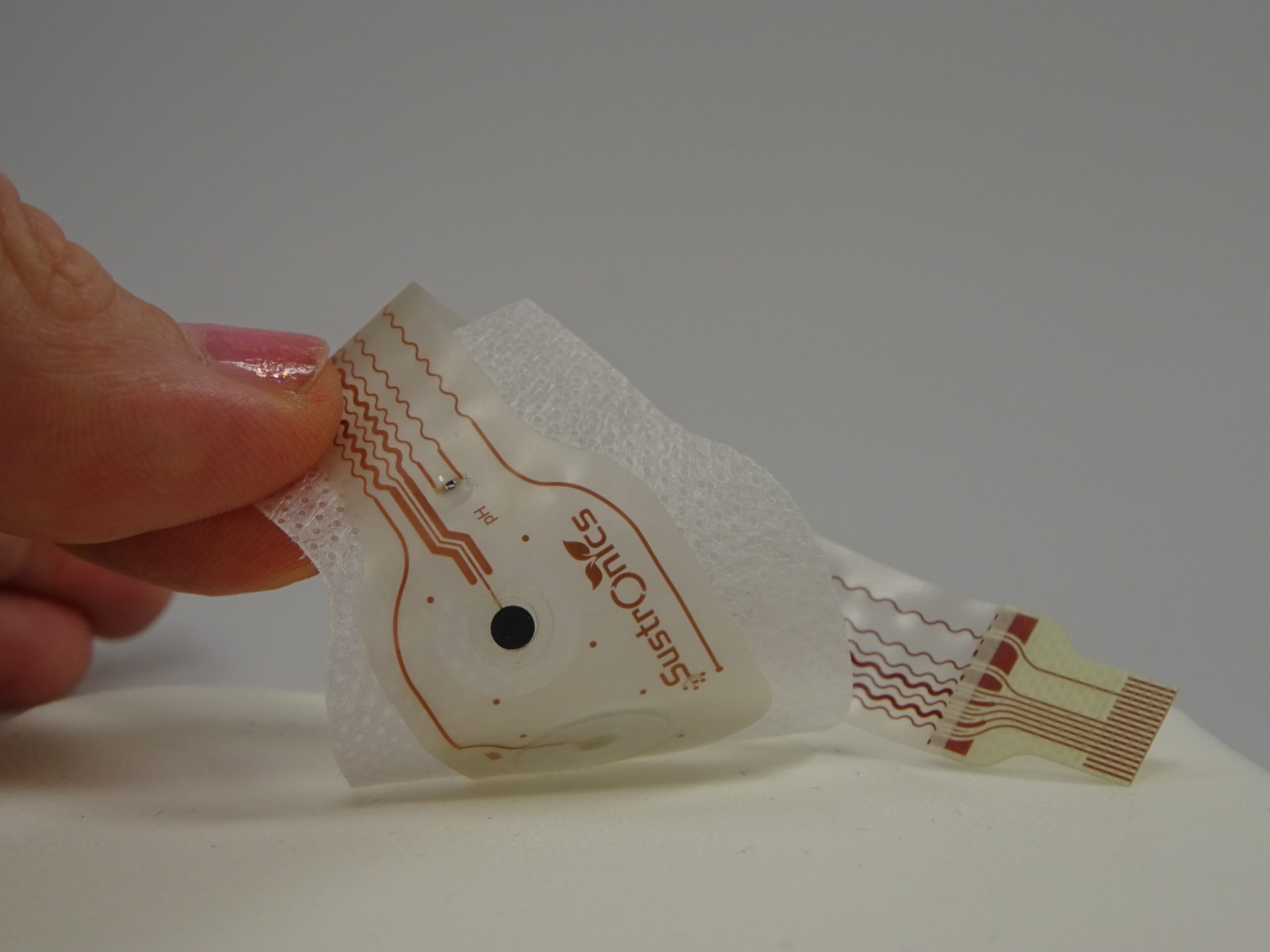
One glucose-monitoring patch shows how strongly a single design choice can affect the result. Life cycle analysis identified the electrodes as a dominant environmental hotspot, leading project partner Onalabs to implement an optical sensor in the patch. Fraunhofer IZM reports that the redesign reduced the demonstrator’s overall carbon footprint by around 65 per cent.
Material selection produced a larger reduction in another demonstrator. For flexible electronics in a smart wound dressing, the researchers compared alternative substrates and conductive inks with a conventional PET-and-silver combination. Using materials including Thinstar, carbon in place of silver, and recycled content reduced the assessed environmental impact of the flexible electronic modules by as much as 95 per cent.
Those figures apply to the specific demonstrators and material combinations assessed; they are not generic reduction factors for medical electronics. They do, however, show how a relatively small number of components or process choices can dominate a product’s life cycle profile. Flexible and disposable medical electronics are particularly sensitive because electrical performance, biocompatibility, reliability, manufacturing yield, and waste treatment all have to be considered alongside material consumption.
SUSTRONICS also worked on resource-efficient materials, printed electronics, lower-energy manufacturing processes, and concepts for reuse, repair, and recycling. Feeding environmental data into R&D makes it possible to compare those options before tooling, qualification, and supply arrangements make changes more expensive. A conductive material, substrate, or sensor principle can then be evaluated against both its technical performance and its contribution to the complete product footprint.
Reliability remains a constraint on any substitution. A lower-impact material is of limited value if it shortens service life, destabilises measurements, or introduces a new failure mode, particularly in medical hardware. Combining environmental assessment with reliability testing is therefore necessary to establish whether a redesigned module still meets its electrical, mechanical, and application requirements.
The work also illustrates how early many environmental consequences are fixed in electronics development. Conductor choice, substrate, interconnect, sensor architecture, and assembly method influence embodied emissions and critical-material demand, while also determining how easily a product can be repaired, separated, or recycled later. Once those choices are embedded in a qualified design and supply chain, the scope for improvement narrows sharply.
SUSTRONICS ran from June 2023 to May 2026 and was supported through the Chips Joint Undertaking, with additional national funding from participating countries. German support included €1.71 million from the Federal Ministry of Research, Technology and Space, while Swiss participation received support from the State Secretariat for Education, Research and Innovation.
The consortium’s 11-country structure also matters for transfer into production because materials, component suppliers, medical-device developers, and research institutes were represented across the same programme. That does not guarantee commercial adoption, but it gives the methods a broader test than a single laboratory demonstrator.
The demonstrator results leave a practical manufacturing question rather than a purely research one. The largest reductions came from changing materials and architectures before products were fixed, not from attempting to compensate for their impact at end-of-life. Whether the project has lasting value will depend on how routinely electronics development teams use that evidence while component, process, and qualification decisions are still open.