IN Brief:
- Teledyne FLIR OEM has been selected for the US Army's Delivering Unmatched Thermal Capability Hastened initiative.
- DUTCH targets improved uncooled infrared performance while reducing size, weight, power, and cost.
- High-volume domestic production and a secure thermal-sensor industrial base sit alongside the programme's performance targets.
Teledyne FLIR OEM has been selected to support a US Army programme intended to improve uncooled thermal imaging while reducing the size, weight, power consumption, and cost of infrared sensor systems. The Delivering Unmatched Thermal Capability Hastened initiative, or DUTCH, also makes manufacturing scale and domestic production capability part of the development brief.
The programme is being led with the US Army Combat Capabilities Development Command C5ISR Center and focuses on next-generation uncooled infrared sensing for defence applications. Teledyne FLIR will contribute detector and system expertise as the Army evaluates technologies suitable for future modernisation programmes and compact platforms.
Uncooled infrared detectors avoid the cryogenic cooling systems required by higher-performance cooled detector technologies. That can reduce equipment size, weight, power demand, maintenance requirements, and start-up time, making the architecture attractive for systems where payload and available electrical power are constrained.
The compromise is that uncooled detectors have traditionally offered lower sensitivity and different range performance than cooled alternatives. Improving their capability therefore depends on more than shrinking a camera module: detector materials, pixel pitch, readout circuitry, optics, calibration, processing, and thermal stability all influence the image available to the end system.
DUTCH is intended to push that balance towards higher performance while retaining the characteristics that make uncooled systems attractive. The Army has identified applications including uncrewed aircraft, loitering munitions, thermal binoculars, and weapon sights, where sensor mass and electrical consumption compete directly with batteries, communications equipment, processing hardware, and other payload elements.
Pixel scaling is one of the technical routes available to detector designers. A smaller pixel pitch can reduce the physical size of a focal plane array for a given resolution and support smaller optics, but each pixel also receives less infrared energy. Maintaining useful sensitivity as pixel dimensions fall places greater demands on detector uniformity, readout electronics, signal processing, and fabrication control.
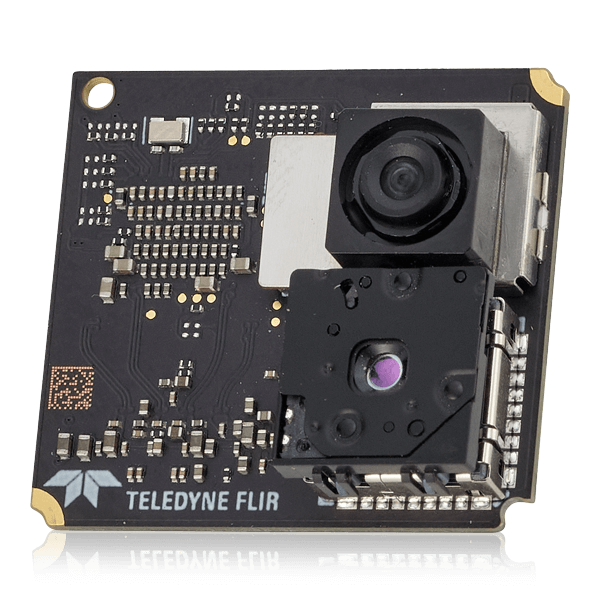
Teledyne FLIR already supplies compact uncooled thermal cores and integrated modules for embedded equipment. Products such as its Hadron family illustrate the level of integration now expected, combining thermal and visible sensors with interfaces suitable for embedded processor platforms. Those existing products are not specifications for the DUTCH programme, but they show how the detector has become one element in a tightly packaged sensing and computing system.
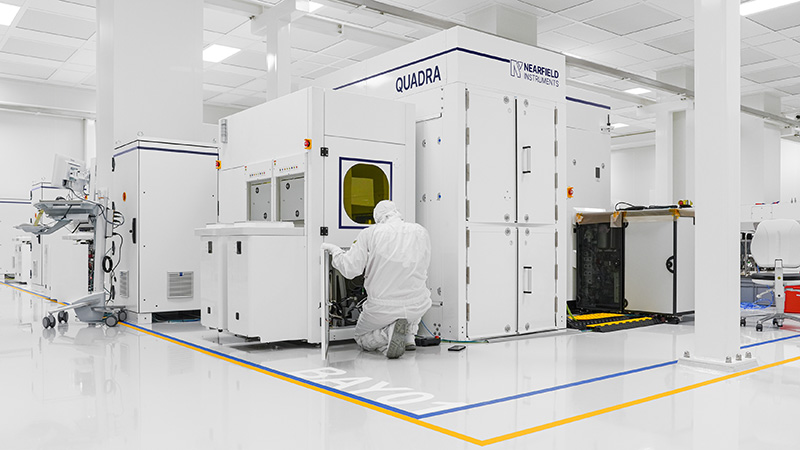
Manufacturing is unusually prominent in the programme language. The company says technologies developed under DUTCH are intended to be scalable to high-volume production, while the award also supports a domestic thermal-imaging industrial base. That places yield, repeatability, packaging, calibration, and test alongside improvements in laboratory detector performance.
Infrared sensors pass through several specialist manufacturing stages before becoming useful camera modules. Detector fabrication and readout electronics have to be combined with packaging, optics, calibration, processing hardware, and final system integration. A smaller or more sensitive focal plane has limited programme value if it cannot be produced consistently at the quantities, cost, and reliability level required by the customer.
Supply resilience is part of the same equation. Defence electronics programmes increasingly treat access to specialist components and manufacturing processes as an engineering constraint rather than a procurement issue that can be solved after qualification. Once a sensor design is embedded in a platform, replacing a detector, package, or readout architecture can trigger substantial requalification work.
Teledyne FLIR has not disclosed a contract value, final detector specification, or production quantity for DUTCH, leaving those as later programme milestones. The useful measure of progress will be whether the programme can improve uncooled detector performance without allowing package size, thermal demand, manufacturing complexity, or cost to rise fast enough to remove the advantages of the architecture.
The result will ultimately be judged at module and production level rather than by detector sensitivity alone. For compact military sensing systems, an improved focal plane still has to survive integration with optics, electronics, processing, power supplies, and the platform carrying it — and then emerge from a repeatable manufacturing process in useful numbers.