IN Brief:
- Infineon reported FY2026 revenue of €16.353 billion, up 12%, with a Segment Result Margin of 19.7%.
- Fourth-quarter revenue reached €4.706 billion, producing a Segment Result Margin of 23.8%.
- FY2027 guidance anticipates approximately €20 billion in revenue, including close to €4 billion from data centre power supply applications.
Infineon Technologies expects revenue of approximately €20 billion in its 2027 financial year, supported by demand for power semiconductors used in data centres, energy infrastructure, and automotive electronics. The German chipmaker forecasts that semiconductors for data centre power supplies will contribute close to €4 billion, making the application a substantial part of its anticipated growth.
The outlook follows annual revenue of €16.353 billion in FY2026, an increase of 12% from the previous year. Infineon reported a Segment Result of €3.223 billion and a Segment Result Margin of 19.7% for the year ended 30 September 2026. Fourth-quarter revenue reached €4.706 billion, with a Segment Result of €1.119 billion and a margin of 23.8%.
The company's forecast represents revenue growth of more than 20% in FY2027, although its guidance remains subject to market demand, manufacturing output, and currency movements. Infineon has assumed a euro-to-dollar exchange rate of 1.15 in preparing the outlook, which also anticipates a Segment Result Margin in the mid-twenties percentage range.
Data centre electrical infrastructure has become an important application for the company's power semiconductor portfolio. Computing racks require electrical energy to pass through several conversion and distribution stages before reaching processors, memory, networking devices, and supporting electronics. Each stage introduces electrical losses and generates heat, affecting the efficiency and physical arrangement of the completed installation.
Power transistors perform much of the high-frequency switching within these conversion systems. Their electrical characteristics influence the losses experienced while conducting current and while changing between switching states. Driver circuits, controllers, magnetic components, and the surrounding power architecture determine how effectively those device characteristics translate into converter performance.
At high currents, resistive losses can become particularly significant. The energy dissipated through a conductive path increases with the square of current, making distribution voltage and conductor resistance important design parameters. Higher-voltage power distribution can reduce the current needed to transfer a specified amount of power, although it also introduces requirements for insulation, protection, and equipment safety.
Infineon has been developing devices and reference designs for higher-voltage computing infrastructure, including approaches to 800V data centre power distribution. Such architectures seek to change where electrical conversion takes place and how energy is transported between the facility's power infrastructure and individual computing loads. Their practical efficiency depends on the complete system rather than the performance of any one semiconductor.
The company's portfolio includes conventional silicon power devices, silicon carbide components, gallium nitride semiconductors, and supporting control electronics. These technologies offer different combinations of voltage capability, switching behaviour, conduction resistance, thermal characteristics, and manufacturing cost. Selecting between them requires consideration of the operating conditions and converter topology.
Silicon carbide devices are particularly relevant to higher-voltage conversion, while gallium nitride can support high-frequency switching in suitable applications. Neither material guarantees a superior result in every circuit: packaging, gate driving, magnetic design, electromagnetic interference, and cooling can change the system-level outcome.
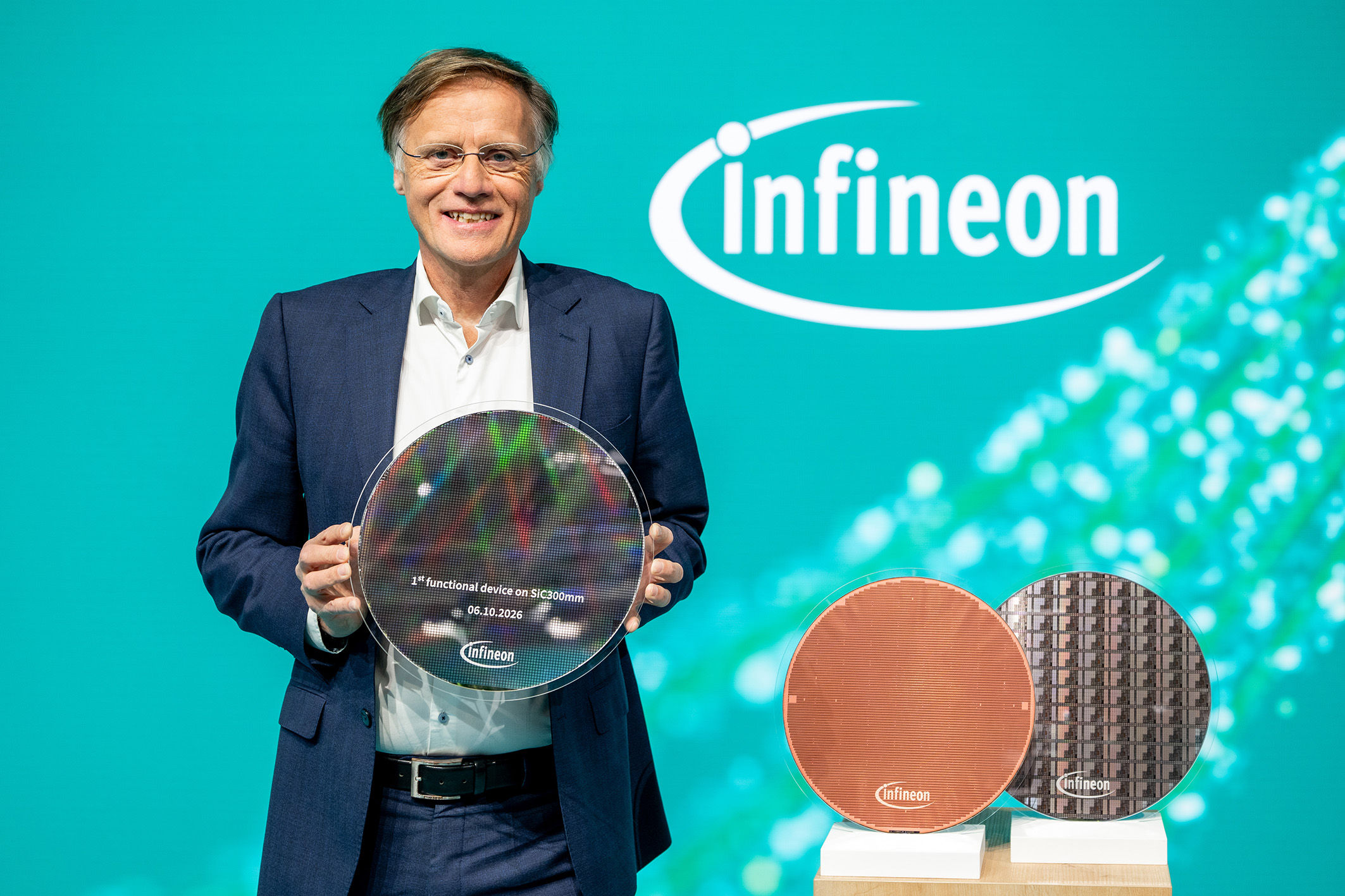
Manufacturing capacity will influence how much of the forecast demand Infineon can fulfil. The company recently demonstrated functional power silicon carbide devices on 300mm wafers, an additional manufacturing development that could eventually support greater production scale. That wafer milestone is separate from the latest financial results and should not be interpreted as confirmation of immediate high-volume output.
Production expansion involves more than increasing wafer diameter or installing additional equipment. Semiconductor yields, process consistency, packaging capacity, testing resources, and customer qualification all affect the number of usable devices available for delivery. Power components intended for demanding electrical environments must also meet the relevant reliability requirements.
Infineon plans investment of approximately €3 billion to €3.5 billion during FY2027. The company has not disclosed a detailed allocation between individual manufacturing technologies or facilities in the headline guidance. Its forecast also includes Free Cash Flow of approximately €1.8 billion and Adjusted Free Cash Flow of around €2.2 billion.
For the first quarter of FY2027, Infineon expects revenue of approximately €4.6 billion and a Segment Result Margin of around 23%. These estimates follow the stronger fourth quarter and provide the next financial benchmarks against which the company's annual growth expectations can be assessed.
Demand outside data centres remains material to the outlook. Infineon identifies the modernisation of energy infrastructure, electromobility, and software-defined vehicles among the applications expected to support sales. Industrial equipment and automotive electronics have different qualification cycles and demand patterns, so growth across the portfolio will not necessarily occur at the same rate.
The company also proposes raising its dividend by €0.03 to €0.38 per share, subject to approval at its February 2027 annual general meeting. That proposal follows reported FY2026 Free Cash Flow of €993 million and Adjusted Free Cash Flow of €1.925 billion.
Infineon's projected €4 billion contribution from data centre power supplies remains a forecast rather than recognised revenue or a disclosed order backlog. Its delivery will depend on infrastructure investment, customer demand, and semiconductor supply throughout FY2027. The first-quarter results will provide an early indication of whether the stronger sales and margin expectations are being realised.