IN Brief:
- Keysight has expanded its high-power ATE portfolio with additional regenerative supplies, electronic loads, and a new DC supply family.
- Configurations include 10V operation at up to 1,020A, additional 32V and 300V options, and equipment supporting up to 1,500V.
- The portfolio provides up to 12kW in 2U, alongside PathWave software for automated power validation and battery emulation.
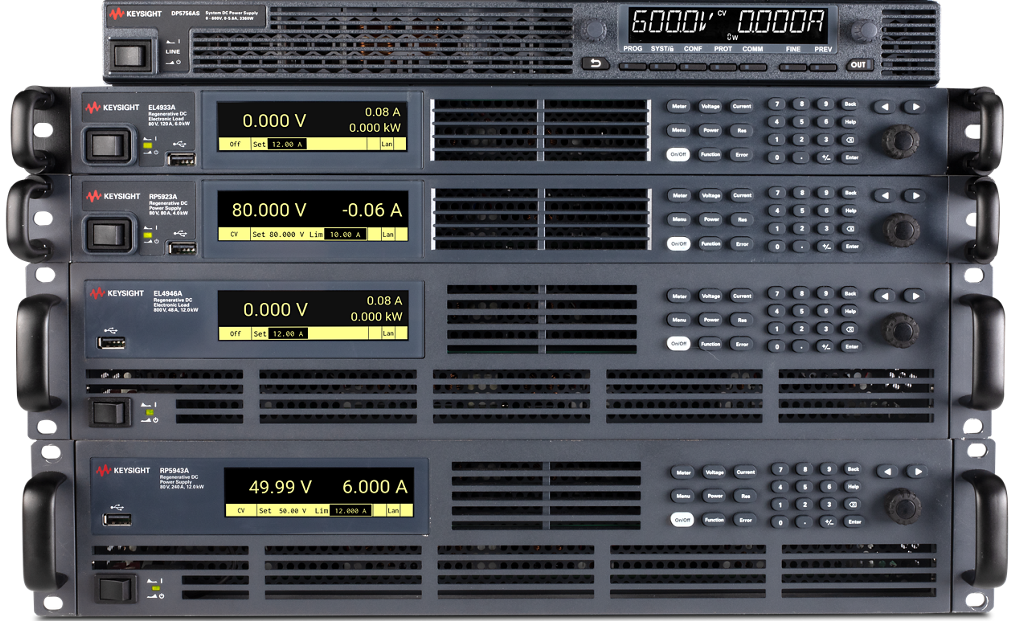
Keysight Technologies has expanded its high-power automated test equipment portfolio, introducing additional voltage and current configurations for regenerative power supplies, electronic loads, and rack-mounted DC sources. The range includes new 10V options capable of supplying up to 1,020A, alongside configurations supporting equipment operating at voltages up to 1,500V.
The expansion also includes a new family of DC power supplies delivering up to 12kW in two rack units. The equipment is intended for power converter characterisation, battery testing, charging systems, aerospace electrical equipment, and other applications requiring controlled electrical sources and loads.
High-power electrical testing requires instruments that can reproduce the operating conditions encountered by the device under test. A power converter may need to be evaluated across several input voltages and output currents, while battery-related equipment may require controlled charging, discharging, and variations in electrical load.
The required test equipment must accommodate both the electrical ratings and the operating behaviour of the device. Voltage and current range, transient response, measurement accuracy, and protection functions all influence whether a test can reproduce the intended conditions reliably.
Keysight's 10V configurations address applications requiring substantial current at relatively low voltage, including power-stage characterisation, DC bias, and burn-in. At these current levels, cable resistance, connector characteristics, and contact quality can introduce significant voltage drops and electrical losses.
Resistive losses increase with the square of current, so relatively small conductor resistance can produce considerable heat in high-current installations. The power source, cables, connectors, protection equipment, and device under test must therefore be considered together when selecting a test arrangement.
The expanded range also includes 32V options for nominal 24V and 28V applications and 300V configurations for equipment operating around 270V DC, including aerospace electrical systems. Higher-voltage options extend the coverage to 1,500V for applications involving battery modules, power converters, and charging equipment.
A supply's maximum voltage, current, and power ratings describe different operating limits. An instrument may reach its highest voltage at a lower current or its maximum current at a lower output voltage. Test system selection must therefore use the complete permissible operating envelope rather than assuming that every stated maximum can be achieved simultaneously.
Rack density is another focus of Keysight's expansion. Regenerative supplies and electronic loads provide up to 6kW in one rack unit or 12kW in two rack units. The new DC supply family also provides up to 12kW in 2U, while other available configurations deliver as much as 7.5kW in 1U.
Keysight states that the compact arrangements can provide two to three times as many test channels within the same rack footprint as previous systems. The comparison depends on the equipment configuration and the number of independently controlled channels required.
Higher equipment density reduces the physical space needed for some installations, but it also concentrates electrical connections and power handling within the rack. Cooling, cable routing, distribution capacity, protective devices, and maintenance access remain important when several instruments operate at substantial power simultaneously.
Regenerative operation allows instruments to absorb electrical energy from a device under test and return recoverable power to the electrical supply rather than dissipating all of it as heat. Battery discharge testing and validation of bidirectional converters are examples where equipment may need to absorb energy for extended periods.
The amount of energy returned depends on the operating conditions and conversion efficiency of the instrument. Regenerative testing still produces electrical losses and requires appropriate protection, but it can reduce the heat and energy waste associated with conventional resistive loading.
Automated control is provided through Keysight's PathWave Advanced Power Control and Analysis software and PathWave Advanced Battery Test and Emulation. The software supports the configuration and execution of repeatable test sequences, alongside the collection and analysis of resulting measurements.
Battery emulation allows a programmable source to reproduce selected electrical characteristics of an energy storage system. A test can then examine how a charger, converter, or other connected device responds to specified battery conditions without relying on a physical battery for every experiment.
The accuracy of an emulated battery depends on the selected model and the instrument's ability to reproduce its electrical behaviour. Real batteries exhibit characteristics influenced by temperature, state of charge, ageing, and internal electrochemical processes. Those effects may require additional models or physical testing where they influence product qualification.
Automated test sequences also need appropriate limits and fault-handling arrangements. High-power equipment can produce substantial electrical and thermal effects when a device fails or an incorrect operating condition is applied. Protection thresholds, safe operating procedures, and the behaviour of the connected instruments must be established before unattended tests are conducted.
The latest additions extend Keysight's Power Without Compromise portfolio, introduced in November 2025. Further 5kW and 7.5kW offerings followed during the first half of 2026, providing additional configurations alongside the newly expanded range.
The existing 7.5kW offering supports voltage ratings up to 1,500V and automatic paralleling of as many as 12 units, giving a combined system capability of up to 90kW. Such configurations must coordinate the connected supplies and their protection functions so that the overall output behaves as intended.
Keysight has not published a single accuracy, transient-response, or regenerative-efficiency specification applicable to every configuration in the expanded portfolio. Those parameters vary between instruments and must be checked against the relevant product documentation when designing a test system.
The expanded voltage and power options are intended to give test laboratories greater flexibility in combining sources, loads, and software for different applications. Their suitability will depend on the electrical requirements of each test, the available rack and power infrastructure, and the measurement performance required for reliable validation.