IN Brief:
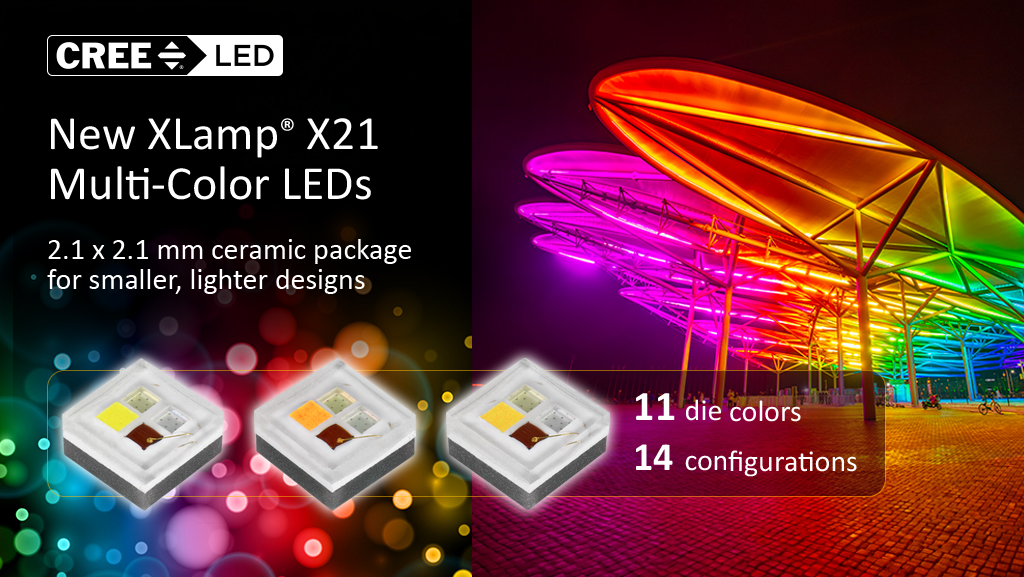
- The XLamp X21 integrates four independently controlled LED dies within a 2.1 × 2.1 × 1.0 mm ceramic package.
- Eleven available die colours support fourteen product configurations for architectural, entertainment, and specialist lighting.
- Cree LED reports improved beam control using a 38 mm secondary optic with 29% less area than its comparison arrangement.
Cree LED has introduced XLamp X21 Multi-Color LEDs, a family of compact four-die packages for lighting applications requiring independently controlled colour channels. The devices use a 2.1 × 2.1 mm ceramic package, allowing optical systems to work with a smaller light-emitting area than the company’s earlier XLamp XP-L Color devices.
The X21 portfolio contains fourteen product configurations using combinations selected from eleven available LED die colours. Each package contains four emitters with independent electrical connections, allowing lighting equipment to control their output according to the desired colour or illumination pattern.
Cree LED has made samples available, with production quantities offered under standard lead times. The intended applications include indoor directional lighting, architectural installations, entertainment equipment, aftermarket automotive lighting, and other specialist systems requiring controlled colour mixing.
The physical separation between light sources influences the optical design of a multicolour luminaire. When emitters occupy different positions, the secondary optic must combine their output while maintaining the required beam angle and colour uniformity.
Reducing the distance between those sources can simplify the optical arrangement, particularly where several colours must emerge through a compact lens assembly. The X21 places four emitters close together within a package occupying approximately 4.41 mm² of circuit-board area.
Cree LED states that the package footprint is 63% smaller than that of its XP-L Color platform. The smaller source can permit a more compact secondary optic, although the available reduction depends on the optical arrangement and the beam characteristics required by the finished product.
The company has compared X21 with its earlier XP-L Color HI device using two colour-mixing optics from LEDiL. The earlier device was paired with a Gabriella-45-S optic measuring 45 mm in diameter, while X21 was evaluated with a 38 mm Gabriella-MIDI-S optic.
The smaller optic has a stated area of 1,134 mm² compared with 1,590 mm² for the 45 mm version, representing a reduction of approximately 29%. Cree LED’s comparison also reports a beam angle of 11° for X21, against 12° for the older device and larger optic.
Measured peak intensity increased from 20.5 cd/lm to 22.9 cd/lm in the specified test arrangement. Candela per lumen indicates how strongly the available luminous flux is concentrated in a particular direction, providing one measure of the effectiveness of a directional optical system.
These values describe the particular LED and optic combinations tested by Cree LED. They should not be treated as performance guarantees for every luminaire, since optical behaviour depends on the selected emitters, lens geometry, current, temperature, and overall mechanical construction.
Colour mixing introduces additional design requirements. Each LED die emits light with a characteristic spectral distribution, and the resulting output depends on how much current is supplied to the individual channels.
By varying those currents, lighting equipment can generate different colour combinations or adjust the balance between saturated and white-light components. Achieving a consistent output may require calibration and compensation for variations between emitters and changes during operation.
The X21 package provides eight electrical pads, with separate anode and cathode connections for its four dies. This arrangement allows the emitters to be driven independently instead of sharing a single common connection inside the package.
Independent control provides flexibility when selecting current-regulation circuits and colour-mixing arrangements. However, each channel still requires suitable external drive electronics, and the complete system must accommodate differences in forward voltage and optical output between the selected LED colours.
Cree LED offers configurations using combinations of red, green, blue, royal blue, white, phosphor-converted amber, phosphor-converted lime, and other available die options. Selecting a configuration involves balancing colour gamut, luminous output, efficiency, and the intended lighting effect.
The thermal characteristics of the package are also relevant. Several emitters share a compact ceramic structure, and electrical energy not converted into emitted light becomes heat that must be transferred into the supporting circuit board and cooling arrangement.
LED junction temperature influences optical output and electrical behaviour. Thermal conditions can therefore affect both the brightness of the individual channels and the balance between them, particularly in a multicolour system operating at substantial drive currents.
The package height is 1.0 mm, providing a relatively low-profile source for compact optical assemblies. Mechanical integration still depends on the spacing between the emitter, lens, circuit board, and surrounding enclosure.
Electrical and optical validation must also account for the intended duty cycle. A lighting system operating all channels continuously may have different thermal requirements from one in which colours are switched or modulated according to a particular sequence.
The X21 family’s range of configurations allows equipment manufacturers to select emitter combinations for different applications while retaining a common package format. Samples and production quantities are available through Cree LED’s established supply channels, with product documentation and optical design data provided for integration work.