IN Brief:
- The GD32H7 range uses Cortex-M7 cores running at 600 MHz or 750 MHz, with shared memory architecture and mathematical acceleration.
- Specialist variants integrate EtherCAT, industrial encoder interfaces, graphics hardware, and analogue acquisition for different industrial applications.
- Full sampling is targeted for January 2027, with mass production scheduled for April 2027.
GigaDevice has introduced an expanded GD32H7 microcontroller portfolio built around a common Arm Cortex-M7 architecture, with configurations developed for robotic joint control, industrial human-machine interfaces, and general automation. The devices operate at frequencies of 600 MHz or 750 MHz and combine high-performance processing with peripheral functions selected for particular industrial applications.
The GD32H77x family operates at 600 MHz, while the GD32H78x devices reach 750 MHz. Both use a common architectural foundation, with the manufacturer differentiating individual variants through their communication interfaces, display capabilities, motor-control functions, and analogue peripherals.
GigaDevice is targeting full sample availability in January 2027 and mass production in April. Evaluation boards, firmware examples, functional safety documentation, motor-control references, and graphical interface development resources are being prepared alongside the processor range.
The Cortex-M7 architecture provides a processing foundation for embedded applications requiring substantial computational capability while retaining direct interaction with hardware peripherals. Its suitability for a control function depends on execution timing, memory access, interrupt handling, and the software running alongside time-critical routines.
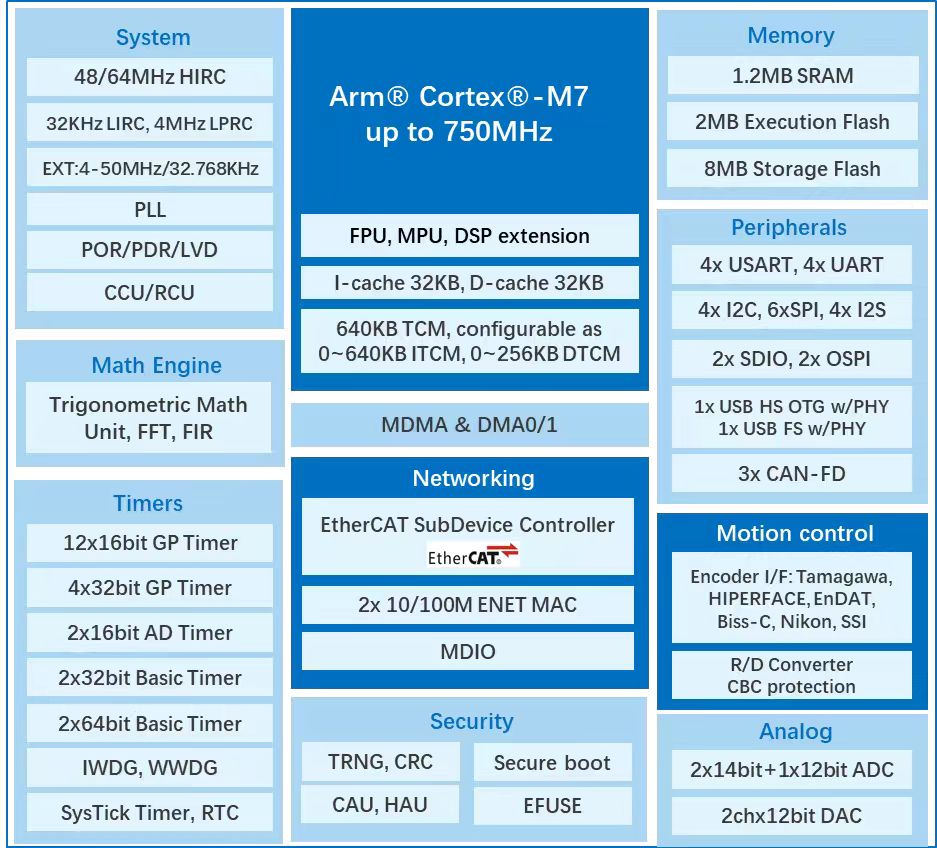
The new portfolio includes 640 KB of tightly coupled memory, or TCM. This memory can be accessed with predictable low latency, making it useful for instructions and data that must be available during closely timed control operations.
Conventional processor memory hierarchies can introduce variation in execution time when instructions or data must be retrieved from slower storage. A control loop that depends on completing calculations within a defined interval must therefore account for memory behaviour as well as processor speed.
GigaDevice also specifies 2 MB of executable flash, 8 MB of additional storage flash, and 1.2 MB of SRAM. Dual Octal SPI interfaces support external memory devices at clock frequencies up to 200 MHz with double data rate operation, providing additional storage options for applications with larger data sets or graphical resources.
The common hardware foundation incorporates acceleration for mathematical functions including trigonometric calculations, Fast Fourier Transforms, and finite impulse response filtering. These operations are frequently used in motor control, digital signal processing, and power conversion.
Hardware acceleration can reduce the processor cycles needed for selected mathematical operations. The resulting system benefit depends on the amount of time normally spent performing those calculations and whether other activities, including memory transfers and peripheral servicing, limit the application.
The GD32H7xR series targets robotic joint modules and compact servo controllers. It incorporates an EtherCAT slave controller and two 100 Mbps Ethernet physical-layer interfaces, allowing network connectivity to be integrated without separate external Ethernet PHY components.
EtherCAT is used where distributed controllers need to exchange process data in coordinated operating cycles. Robotic joints and servo systems often require position commands, feedback values, and status information to move between controllers with predictable timing.
GigaDevice specifies transmission latency below 50 ns for the integrated communication hardware and support for Safety over EtherCAT. These features contribute to the available communication architecture, but the performance and functional safety of a completed robotic system depend on its wider network, software, and hardware configuration.
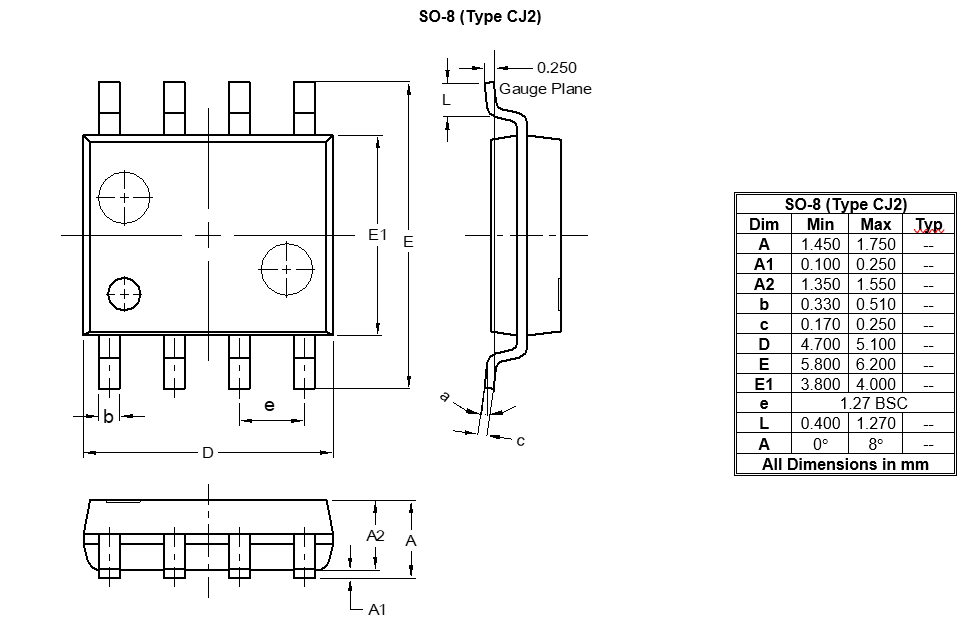
The robotic variant is housed in a 9 × 9 mm BGA169 package. Its dimensions address the space constraints of joint-drive electronics, where processing, communications, sensing, and power-control circuitry may need to fit within a restricted mechanical assembly.
For industrial displays, the GD32H7xD family includes a two-lane MIPI DSI interface and a dedicated image-processing accelerator. The devices support graphical interface development using frameworks including LVGL, emWin, Embedded Wizard, and ThreadX GUIX.
Industrial HMI equipment must manage display updates alongside operator input, communications, and application logic. Dedicated graphics resources can reduce processor involvement in some rendering operations, allowing more computing capacity to remain available for other software tasks.
The GD32H7xE variants focus on real-time motion control and incorporate EtherCAT hardware together with support for encoder protocols including EnDat, BiSS-C, Tamagawa, and HIPERFACE DSL. An integrated resolver-to-digital conversion function offers another route for obtaining motor-position information.
Motor-control systems use this feedback to estimate shaft position and speed, enabling their control algorithms to adjust electrical output according to the required motion. Integrating the interface and conversion functions can reduce the external circuitry needed to obtain these measurements.
The GD32H7x9 family addresses more general industrial control applications, including variable-frequency drives and digital power conversion. Its analogue features include a 14-bit ADC and high-speed digital filtering, supporting acquisition and processing of signals used in control algorithms.
Across the portfolio, GigaDevice includes AES, SHA-256, random-number generation, secure boot, authenticated firmware updating, and anti-rollback features. The manufacturer also identifies IEC 61508 functional safety certification support, including development documentation and diagnostic resources.
Those features can contribute to a system’s security and safety architecture, but they do not independently certify the completed machine or controller. The required risk assessment, application software verification, hardware integration, and validation remain specific to the finished equipment.
Using a common processor and software foundation across several variants may simplify reuse of established development work. However, peripheral availability differs between models, so software and hardware configurations must still be assessed when transferring an application between robotic, graphics, and general-control variants.
The planned sampling and production schedule gives equipment manufacturers time to evaluate these differences before selecting a device for a production programme. GigaDevice is positioning the expanded family as a common development base for several types of industrial controller rather than requiring a completely separate microcontroller architecture for each application.