IN Brief:
- AMD's sixth-generation EPYC 9006 SP7 processors are shipping through server manufacturers, with Microsoft Azure and Oracle Cloud instances planned.
- The Zen 6 and Zen 6c portfolio supports up to 256 cores, 512 threads, sixteen DDR5 memory channels and 96 PCIe 6.0 lanes.
- The range includes high-density and high-frequency models, while AMD's performance comparisons depend on specific benchmarks, configurations and power limits.
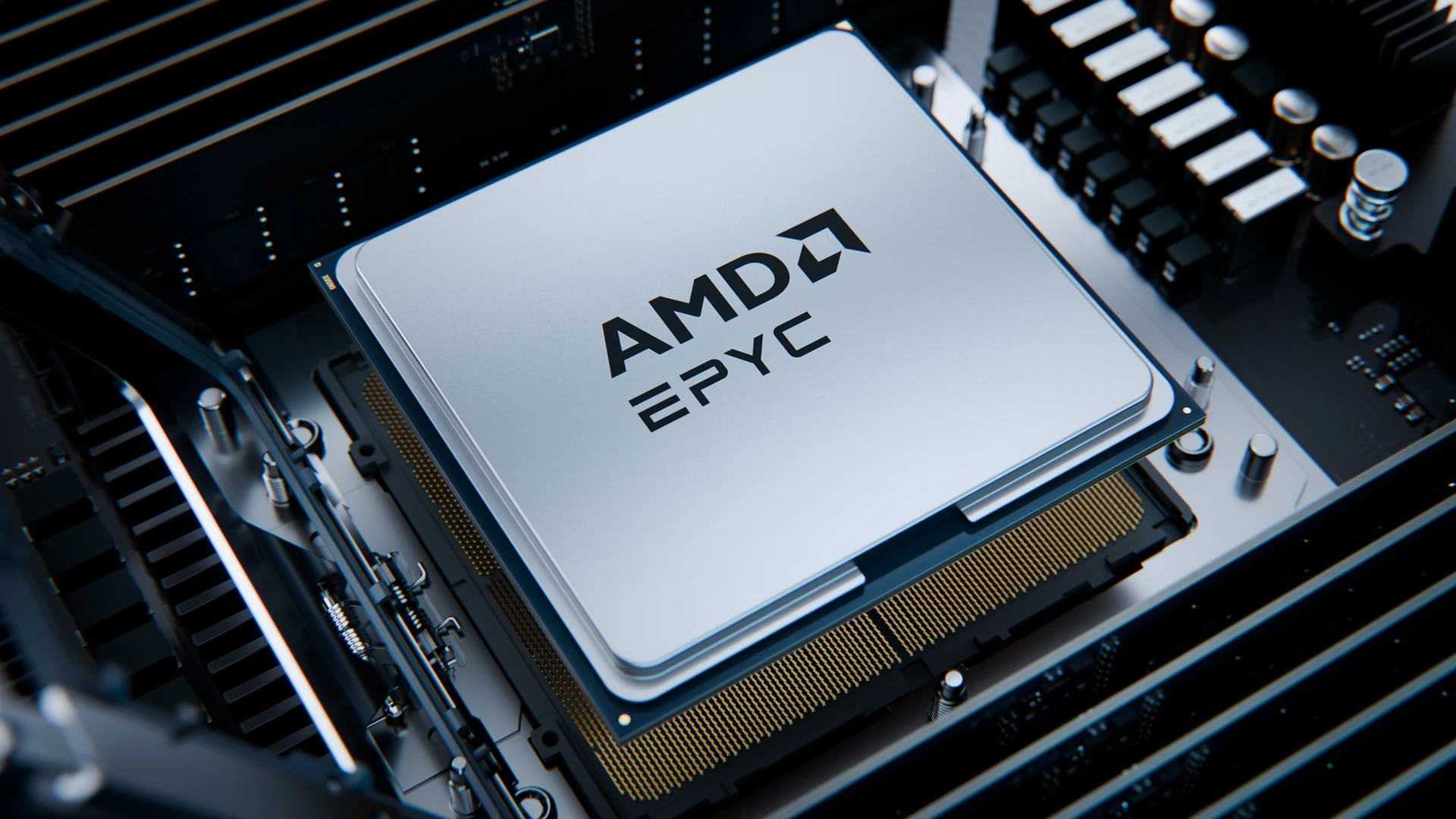
AMD has begun shipping sixth-generation EPYC 9006 SP7 server processors based on its Zen 6 architecture, extending its x86 computing portfolio with higher core density, expanded memory bandwidth and PCIe 6.0 connectivity. Systems incorporating the new processors are available through server manufacturers, with cloud deployments from Microsoft Azure and Oracle Cloud Infrastructure scheduled to follow.
The new family includes configurations with up to 256 cores and 512 processing threads, alongside models designed for higher operating frequencies. AMD is positioning the range across enterprise computing, technical workloads, high-performance computing and the CPU infrastructure used to coordinate artificial intelligence applications.
The EPYC 9006 SP7 portfolio combines Zen 6 and Zen 6c processing cores. The former targets high per-core performance, while Zen 6c provides a denser implementation intended for workloads that can use large numbers of simultaneous execution resources.
These architectures address different processing requirements. Some engineering applications rely on a limited number of demanding computation threads, while others can distribute work across hundreds of independent tasks. Memory access and communication between those tasks can influence performance as strongly as the available number of cores.
AMD’s EPYC 9996 has 256 cores and supports 512 threads through simultaneous multithreading. The processor has a base frequency of 2.55 GHz, a maximum boost frequency of 4.1 GHz and 1,024 MB of L3 cache, with a default CPU power rating of 600 W.
The company also offers a 256-core EPYC 9956 with a lower 400 W default CPU power rating. Other processors reduce core count to provide different balances of operating frequency, cache capacity and electrical power consumption.
High-frequency variants such as the EPYC 9686F provide 96 cores with maximum boost frequency reaching 5.3 GHz. This gives system designers an alternative where the performance of individual threads is more important than maximising the total number of processing cores in a socket.
Maximum boost frequency refers to the highest operating frequency achievable under specified conditions and does not mean every core operates at that speed continuously. Sustained performance depends on the workload, available cooling, electrical power limits and processor control behaviour.
Similarly, increasing core count does not guarantee a proportional increase in application throughput. Software must contain enough parallel work to use the additional cores, while shared memory resources and synchronisation between threads can impose limits on scaling.
The SP7 platform introduces sixteen DDR5 memory channels, supporting registered DIMMs and multiplexed-rank DIMMs. With supported MRDIMMs operating at 12,800 MT/s, AMD specifies a maximum theoretical memory bandwidth of approximately 1.6 TB/s per socket.
That bandwidth provides capacity for transferring information between processor cores and system memory, a requirement that becomes increasingly important as more cores operate concurrently. Applications processing large data sets can otherwise spend substantial time waiting for information rather than executing calculations.
Memory throughput depends on the installed memory type, operating speed, channel population and the application’s access patterns. The published maximum represents a platform capability under a supported configuration, not a sustained transfer rate that every workload will achieve.
The large L3 cache also contributes to memory behaviour. Data that can be served from cache may be accessed without returning to system memory, reducing some of the delays and bandwidth demand associated with repeated retrieval of frequently used information.
The effectiveness of this arrangement depends on the size and structure of the working data set. Applications with irregular memory access or data sets substantially exceeding cache capacity may behave differently from workloads that repeatedly operate on information already held near the processing cores.
External connectivity is provided through PCIe 6.0, with up to 96 lanes available per SP7 processor. The interface supports transfer rates of 64 GT/s per lane, doubling the nominal transfer rate per lane of PCIe 5.0.
Higher I/O capacity is relevant to systems containing GPU accelerators, high-speed network interfaces and storage devices. It can also support engineering applications that move substantial amounts of data between the CPU and specialist computing hardware.
The performance benefit depends on the configuration of those devices and the software using them. A faster PCIe interface cannot remove bottlenecks caused by memory access, data preparation, insufficient processing capacity or application-level coordination.
AMD is targeting three principal CPU roles within AI infrastructure: general-purpose enterprise services, host processors coordinating accelerators, and high-density execution environments for software agents.
A GPU host processor manages work associated with applications, memory transfers, data preparation and communication with accelerators. If those supporting tasks cannot keep pace, a GPU may spend time waiting for information or instructions despite having substantial available computation capacity.
AMD claims that selected high-frequency EPYC configurations can improve large-language-model output throughput by up to 1.8 times compared with earlier EPYC processors under particular CPU-offload conditions. The company’s methodology includes projected benefits from PCIe 6.0 bandwidth, rather than relying entirely on measured production deployment results.
For high-density software execution, the number of available threads influences how many independent tasks a server can support. The actual number of AI agents that can operate concurrently also depends on memory consumption, scheduling, application frameworks and the resources required by individual processes.
AMD’s agent-density comparisons use specified workload and power assumptions, including estimates that treat processor threads as a proxy for potential agent capacity. Those calculations are useful for examining the proposed architecture but do not establish a universal number of agents supported by each processor.
The company has also published performance comparisons against Intel Xeon and NVIDIA Vera systems. In selected general-purpose benchmark configurations, AMD reports performance advantages of up to 2.2 times over an Intel Xeon 6980P-based system.
These comparisons reflect the systems, benchmarks, software versions and power assumptions used in AMD’s testing. Some competing-platform figures are internal estimates, so the results should be assessed against independently measured performance and the requirements of the intended application.
The EPYC 9996’s 600 W default CPU power rating also illustrates the cooling demands of high-density server computing. Rack capacity depends on the combined power consumption of processors, memory, accelerators, networking equipment and supporting electronics, rather than processor core count alone.
AMD is extending the processor family into its Helion rack architecture, offering liquid-cooled and air-cooled designs, including configurations combining CPU execution with local GPU inference. The arrangements provide different ways to balance computing density with electrical and thermal infrastructure.
Microsoft Azure is preparing several services based on the new generation. HDv2 is in preview for AI data processing and high-performance computing, while HXv2 is intended for electronic design automation and technical computing. The ND MI455X v7 platform is associated with AMD’s wider Helios accelerated infrastructure.
Electronic design automation workloads can require substantial CPU throughput and memory resources for circuit simulation, verification and physical chip design. Their performance depends on the particular tools and whether the workload benefits more from processing frequency, parallel execution or memory capacity.
Oracle Cloud Infrastructure is preparing Compute E7 instances based on the new processors, while Meta has been validating EPYC 9006 platforms ahead of larger-scale deployment. AMD has not provided an exact general-availability date for every planned cloud service.
The company has separately introduced EPYC Embedded 9006 processors for specialised equipment, including semiconductor test, networking and storage systems. Those products share an architectural foundation with the server family but have separate availability, support and application requirements.
Sixth-generation EPYC SP7 server platforms are shipping now. Their combination of higher core density, additional memory channels and PCIe 6.0 connectivity expands the processor configurations available for engineering and data-intensive workloads, with realised performance dependent on the complete hardware and software environment.