IN Brief:
- Nano XL Link uses a 120 MHz Microchip PIC32CK2051SG01144 Cortex-M33 microcontroller with 2 MB of flash and 512 KB of RAM.
- Integrated CAN FD, RS-485, and 10/100 Ethernet transceivers provide wired industrial communication within an extended Nano design.
- A companion DIN-rail Connector Carrier provides field-wiring connections, while commercial availability dates remain unconfirmed.
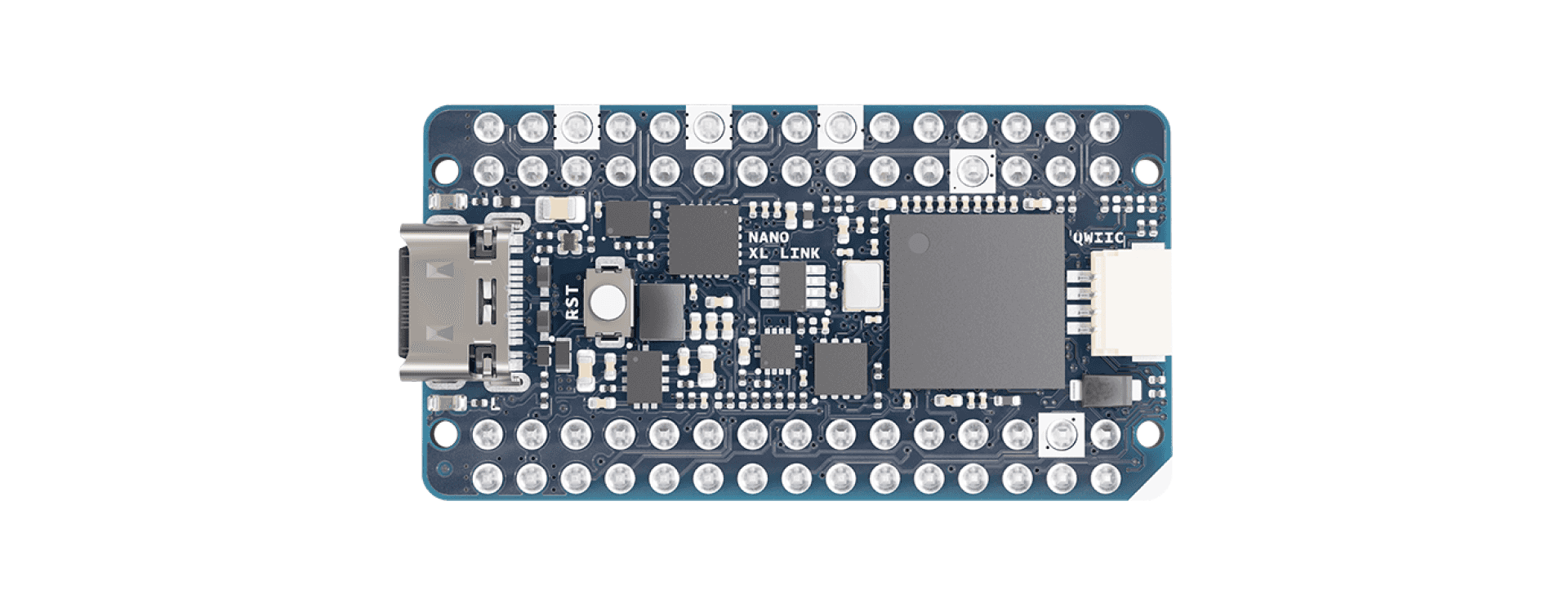
Arduino has introduced Nano XL Link, an embedded development board combining industrial networking interfaces with a Microchip Cortex-M33 microcontroller. The platform integrates CAN FD, RS-485, and 10/100 Ethernet transceivers, extending the Nano hardware family into applications involving factory control, building automation, and connected industrial equipment.
Arduino is also introducing the Nano XL Link Connector Carrier, a companion board designed for DIN-rail mounting and field wiring within industrial control enclosures. The two products were unveiled at electronica 2026, with commercial availability details to be confirmed.
Nano XL Link is based on the Microchip PIC32CK2051SG01144, a 32-bit Arm Cortex-M33 microcontroller running at 120 MHz. The device incorporates 2 MB of flash memory and 512 KB of RAM, providing resources for embedded application code, communications processing, and control tasks.
The Cortex-M33 architecture is intended for microcontroller applications requiring a combination of processing performance and controlled interaction with hardware peripherals. The timing behaviour of a completed system depends on its software configuration, interrupt handling, peripheral use, and competing processing tasks.
Industrial networking is the principal addition to the established Nano development format. Connecting an ordinary development board to factory equipment frequently requires external transceivers or interface modules, which introduce additional components, wiring, and electrical integration requirements.
Nano XL Link incorporates the physical interface hardware for three established communication arrangements. CAN FD provides communication across a shared controller network, RS-485 supports differential serial connections, and Ethernet provides a conventional wired network interface.
CAN FD extends classical Controller Area Network communication by supporting larger data payloads and a faster data phase. It is used where distributed electronic controllers must exchange information across a common network while retaining defined message arbitration and error-handling behaviour.
The protocol’s operation depends on appropriate network configuration, including bit timing, termination, message structure, and the capabilities of connected devices. Integrating the transceiver simplifies the hardware arrangement, but does not remove those requirements.
RS-485 provides a differential electrical signalling interface frequently used in industrial serial networks. It can be combined with higher-level protocols such as Modbus RTU, although the electrical standard and the communications protocol are separate elements of the system design.
Differential signalling can improve tolerance of common-mode electrical interference when the installation is correctly designed. Cable length, termination, grounding, and the voltage differences between connected equipment must nevertheless be considered, particularly in machinery environments containing high-current switching devices.
The board’s 10/100 Ethernet interface supports direct wired network connections without a separate external Ethernet transceiver module. Ethernet provides the physical and data-link foundation for various networking applications, but specific industrial Ethernet protocols require compatible software and, in some cases, additional timing or controller capabilities.
Combining these interfaces allows a single board to be evaluated for industrial gateway functions. A controller could receive information over CAN or RS-485 and communicate selected data through Ethernet, with the application software responsible for handling the different message structures and timing conditions.
Such systems must also manage buffering, error recovery, network interruptions, and the relationship between differing communication speeds. Where messages influence a physical control function, the permitted delay and the required response to communication faults must be defined for the application.
Arduino has retained compatibility with its development ecosystem while introducing an extended double-row header. The additional connections expose more I/O resources for applications that require communication interfaces alongside digital and analogue peripheral connections.
The company is positioning the platform for use with familiar Arduino software tools. That approach supports early prototyping, while a finished industrial product still requires testing of its application code, hardware configuration, electrical behaviour, and operating environment.
The Nano XL Link Connector Carrier provides a mechanical and wiring arrangement for the transition from a laboratory setup to an industrial enclosure. It offers screw terminals for CAN FD and RS-485 and an RJ45 port for Ethernet, with DIN-rail mounting compatible with the enclosure arrangements identified by Arduino.
Field-wiring connections introduce practical design considerations that are less prominent during bench development. Conductors must be secured, appropriately protected, and routed to minimise interference, while the installation must accommodate the electrical requirements of the connected equipment.
The carrier also serves as a reference design for application-specific hardware. Developers can use its interface arrangement when designing a custom carrier intended to accommodate the Nano XL Link board within a particular machine or control assembly.
Mechanical compatibility alone does not establish industrial qualification for a complete product. Electrical isolation, transient protection, electromagnetic compatibility, temperature limits, and enclosure requirements must be assessed against the intended installation and applicable standards.
Arduino identifies machine controllers, fieldbus gateways, smart lighting, HVAC zone management, and energy monitoring among the intended applications. These systems commonly combine local control functions with communication to other equipment, making the integrated wired interfaces a central feature of the new board.
Nano XL Link and the Connector Carrier are the first products in the announced Nano XL family. Arduino has not published final prices or shipping dates, with further availability information expected after the electronica introduction.