IN Brief:
- Fidelium has agreed to take a 60% stake in a joint venture for Semikron Danfoss automotive power modules.
- The proposed business includes production facilities in Flensburg and Nuremberg and around 600 employees.
- Completion is anticipated by 31 December 2026, subject to customary regulatory approvals.
Danfoss has agreed to transfer majority ownership of its automotive power module business to Fidelium Partners through a newly formed joint venture, separating a significant part of the Semikron Danfoss portfolio into an independently controlled operation. The proposed transaction encompasses manufacturing facilities in Flensburg and Nuremberg, Germany, and approximately 600 employees, with closing expected by 31 December 2026 subject to regulatory approvals.
An Austrian Federal Competition Authority notification published on 16 November sets out the proposed ownership split: a Fidelium vehicle would acquire sole control and 60% of newly established SD Automotive Power Modules GmbH, while Semikron Danfoss would retain 40%. The automotive activities would be transferred into that company before closing. This remains a notified transaction, not a completed transfer.
Danfoss identified the business during its portfolio review as needing a different structure to expand. Fidelium, a Munich investor specialising in corporate carve-outs, would take operational control while Danfoss retains a minority interest. Neither party has disclosed the consideration, future capital investment commitments, or a detailed manufacturing plan for the standalone business.
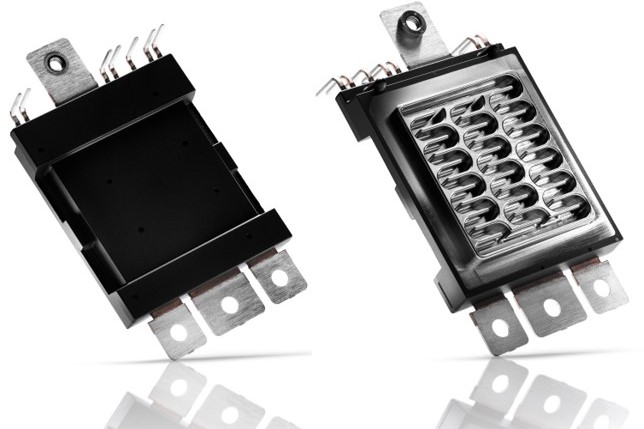
The division develops and manufactures semiconductor power modules used in electric powertrains and related applications. A power module combines switching devices and interconnections in an assembly intended to manage high electrical currents and voltages. In a vehicle traction inverter, those switches convert battery direct current into controlled alternating current for an electric motor, while onboard charging systems use power conversion stages to manage charging energy.
A module’s performance depends on more than its semiconductor die. Switching devices are mounted and connected using substrates, bonding or sintering structures, terminals, and thermal interfaces. Parasitic inductance in the electrical paths affects voltage overshoot during fast switching, while thermal resistance determines how efficiently heat can move from the devices to the cooling system. Both influence the inverter’s usable operating envelope and the durability of the package.
Semikron Danfoss’s existing automotive offering spans silicon and silicon carbide devices. Its eMPack range illustrates low-inductance module packaging and sintered assembly for 400V and 800V electric vehicle architectures, but the parties have not released an asset-by-asset schedule stating exactly which product families and intellectual property will transfer to SD Automotive Power Modules GmbH.
Silicon carbide switches can offer advantages in high-voltage, high-frequency conversion, but the material does not eliminate package-level constraints. Faster switching edges make the layout of current loops, insulation, electromagnetic compatibility, gate driving, and heat removal particularly important. A module qualified for one inverter design cannot automatically be substituted into another without assessing electrical limits, cooling arrangements, terminal geometry, and qualification evidence.
Automotive qualification depends on the finished module and its production process. Traceability, die attachment, substrate assembly, insulation, electrical testing, and thermal cycling can form part of the documented manufacturing controls. If ownership separation leads to changes in materials, suppliers, tooling, or production sites, those changes may need assessment against existing customer approvals; the companies have not stated that such process changes are planned.
Production continuity will also depend on the operations at the two German sites. Flensburg and Nuremberg are named in the transaction scope, but Danfoss has not set out plant-by-plant capacity, current utilisation, or the distribution of individual product families between them. Their future role will depend on the completed separation arrangements and the new venture’s operating plan.
The Austrian filing describes power modules for passenger cars, commercial vehicles, trucks, and onboard charging applications up to 22kW. That confirms a broader set of automotive end uses than traction inverters alone. It does not provide a forecast for order volumes or establish that any customer has committed to expanded demand after the proposed change of ownership.
The Austrian authority received the notification on 13 November and published it on 16 November. Its stated deadline for seeking a detailed merger review is 11 December 2026. The parties currently expect to close by 31 December, but that expectation remains subject to regulatory clearance and the other conditions of the transaction.
Around 600 employees and the associated facilities in Flensburg and Nuremberg are within the proposed transfer. Danfoss and Fidelium intend to maintain support for customers and suppliers through the transition, although the companies have not published plant-level investment or output plans. The eventual ownership structure will take effect only if the transaction completes.