IN Brief:
- STMicroelectronics aims to double STM32 revenue between 2025 and 2028.
- The company expects its general-purpose MCU market share to reach 25–30% by 2028, compared with approximately 23% currently.
- Data centre control systems, industrial equipment, and physical AI applications feature in the growth strategy.
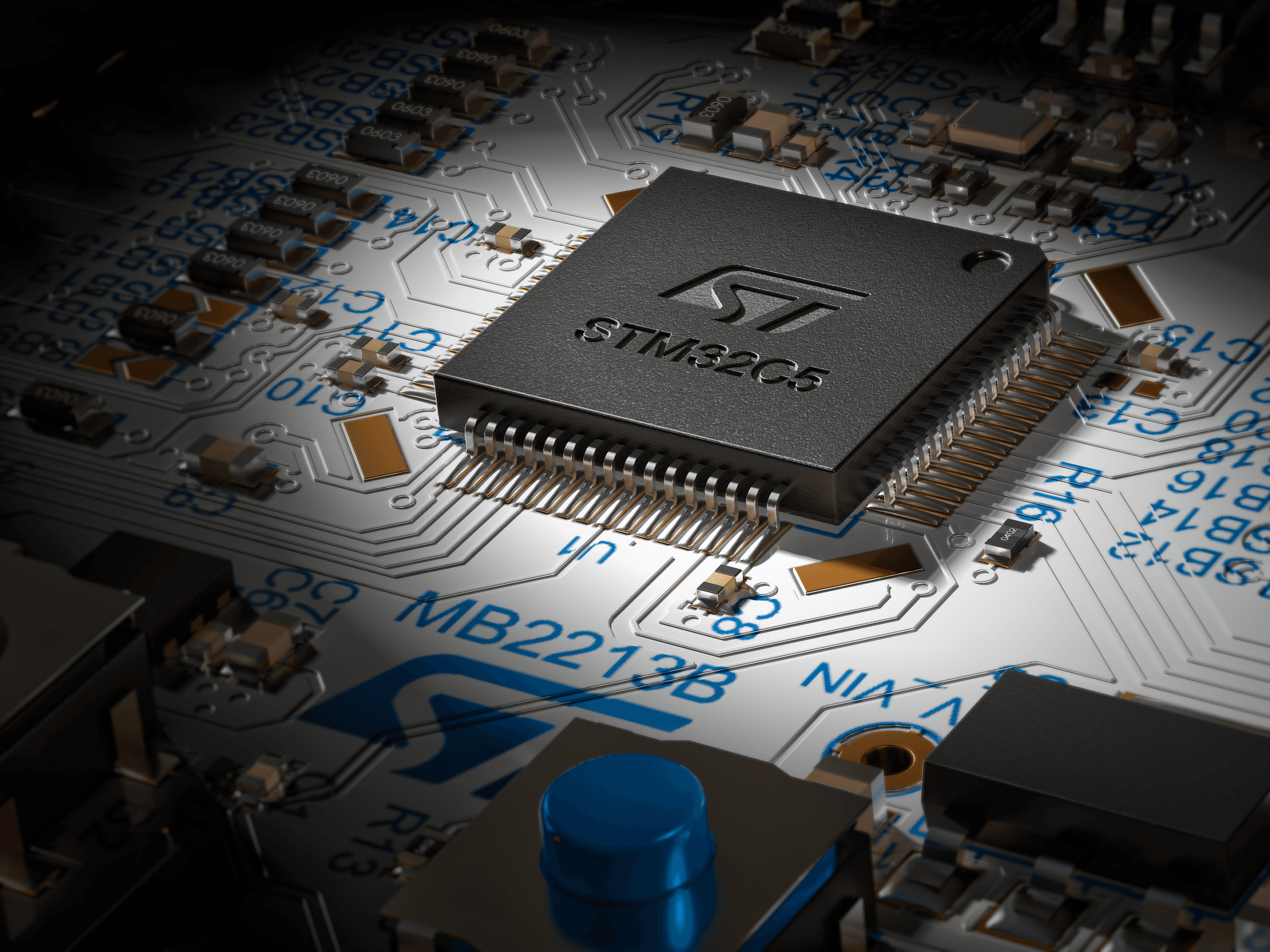
STMicroelectronics aims to double revenue from its STM32 microcontroller portfolio between 2025 and 2028, supported by anticipated market share gains and wider deployment across industrial equipment, data centre infrastructure, and embedded computing systems.
The Franco-Italian semiconductor manufacturer outlined the target during an investor presentation on 18 November, with Rémi El-Ouazzane, president of its Microcontrollers, Digital ICs and RF Products Group, detailing the company’s plans for the portfolio.
ST expects its share of the general-purpose microcontroller market to reach between 25% and 30% by 2028, compared with approximately 23% currently. The revenue objective and market share ambition are separate measures, reflecting both expected changes in overall demand and the company’s intention to secure a greater proportion of available business.
Its market share has recovered from the decline experienced during 2024, when general-purpose MCU demand was affected by inventory adjustments and weaker purchasing across parts of the electronics industry.
ST’s presentation indicates that its market share recovery has been completed ahead of its previous schedule. Distribution inventories have also fallen below standard targets, following the elevated stock levels experienced during the earlier market downturn.
Despite those improvements, general-purpose MCU revenue in the third quarter of 2026 remained approximately 25% below the peak recorded in the second quarter of 2023. The distinction between market share recovery and absolute revenue is important because a semiconductor supplier can increase its proportion of a market without immediately returning to earlier sales levels.
ST also reported book-to-bill ratios well above one during the four quarters to September 2026. This indicates that orders received exceeded sales during those periods, although the relationship between orders and subsequent revenue depends on delivery schedules, customer requirements, and the treatment of existing orders.
Microcontrollers perform control functions in equipment where deterministic operation, integrated peripherals, and manageable power consumption are important design requirements.
Their applications include motor control, sensor acquisition, industrial communication, power conversion, instrumentation, and equipment supervision. The required processing performance varies substantially, with different device families supporting everything from relatively simple control functions to more demanding connected and intelligent systems.
STM32 includes microcontrollers with different processor architectures, memory capacities, peripheral configurations, and electrical characteristics. This range allows developers to select devices according to application requirements rather than using the same computing configuration for every embedded system.
ST has been extending the portfolio through a more unified development platform covering industrial, automotive, and emerging physical AI applications. The manufacturer introduced that direction earlier in November, describing greater continuity between hardware platforms, development tools, and software components.
The common architecture is intended to support greater reuse across applications while retaining the qualification, security, and reliability requirements associated with individual markets.
Such reuse can reduce some development effort, particularly where software libraries and peripheral interfaces remain consistent. However, moving an application between microcontrollers still requires consideration of processing performance, memory behaviour, device-specific functions, and the operating conditions of the completed product.
The company’s manufacturing strategy combines established embedded memory processes with newer semiconductor technologies. ST identifies 40nm embedded non-volatile memory, 28nm and 18nm embedded phase-change memory development, and technology partnerships as part of its microcontroller platform.
Different manufacturing processes allow semiconductor designers to balance cost, memory integration, energy consumption, and processing capability. The most advanced process is not automatically the appropriate choice for an embedded controller whose principal requirements may concern analogue integration, reliability, or long-term availability.
Data centre infrastructure represents a further application area for the STM32 portfolio. Although processors and accelerators execute the main computing workloads, supporting equipment requires numerous control functions operating independently of those devices.
Microcontrollers can supervise power supplies, battery backup systems, energy storage equipment, cooling systems, and electrical monitoring. They can also support optical transceiver management and control functions on AI compute boards.
These tasks require reliable operation and communication with surrounding hardware, often under changing electrical and thermal conditions.
ST expects microcontrollers to account for more than 30% of its data centre revenue in 2026. It also forecasts that its data centre MCU revenue will double in 2027, reflecting anticipated demand for control electronics associated with expanding computing infrastructure.
Those projections concern the microcontroller contribution to the company’s data centre business and should not be confused with its separate, broader revenue forecasts for the entire application market.
Industrial automation and robotics provide other potential sources of growth. Equipment incorporating greater local processing capability still requires embedded controllers to manage actuators, sensors, interfaces, and safety-related functions.
In robotics, a central computing system may undertake perception or planning while microcontrollers perform specific real-time tasks. Motor control, position feedback, communication, and equipment monitoring can remain distributed across several embedded devices.
The resulting hardware architecture may contain multiple processing technologies because the computational requirements of each function differ. Real-time control has different timing and reliability constraints from image processing or AI inference.
ST is positioning its expanded STM32 platform to address these combinations of conventional embedded control and more advanced computing functions.
The company’s revenue ambition remains dependent on customer adoption, product availability, manufacturing execution, and overall semiconductor market conditions. Growth in data centre infrastructure and robotics may create additional opportunities, but neither guarantees the commercial performance of individual product families.
ST’s 2028 objective establishes a measurable target for the MCU business following its recent market recovery. Subsequent financial results and product adoption will determine whether the company’s wider platform strategy translates into sustained revenue growth.