IN Brief:
- Q.ANT demonstrated its NPU Gen 2+ alongside an AMD GPU at SC26 in Chicago.
- The photonic processor adds discrete Fourier transforms, using optical circuitry to perform the mathematical operation.
- Gen 2+ remains a proof-of-concept platform, with combined commercial systems planned for the second half of 2027.
Q.ANT has demonstrated a photonic processor capable of performing discrete Fourier transforms directly in optical hardware, extending the mathematical functions available through its Native Processing Unit architecture.
The Stuttgart company presented the NPU Gen 2+ at SC26 in Chicago on 17 November, demonstrating a hybrid computing arrangement that combined the optical accelerator with an AMD GPU to execute a large language model.
The demonstration incorporated optical Fourier processing into an alternative approach to the attention functions used by language models. Q.ANT is investigating how selected mathematical operations can be transferred from conventional electronic processors to photonic circuitry while the remaining workload continues on existing computing hardware.
A discrete Fourier transform converts a sequence of values into a representation of its constituent frequencies. The operation is widely used in signal processing, numerical simulation, image analysis, and mathematical methods that manipulate information according to its frequency characteristics.
Conventional digital processors calculate these transformations through arithmetic operations, with optimised algorithms reducing the work needed for large datasets. Their performance depends on processor architecture, memory access, numerical precision, and the implementation of the chosen algorithm.
Q.ANT’s approach uses the physical behaviour of light to implement the transformation. Optical signals pass through structures designed to produce the required mathematical relationship between the inputs and outputs, allowing the operation to take place within the photonic circuit.
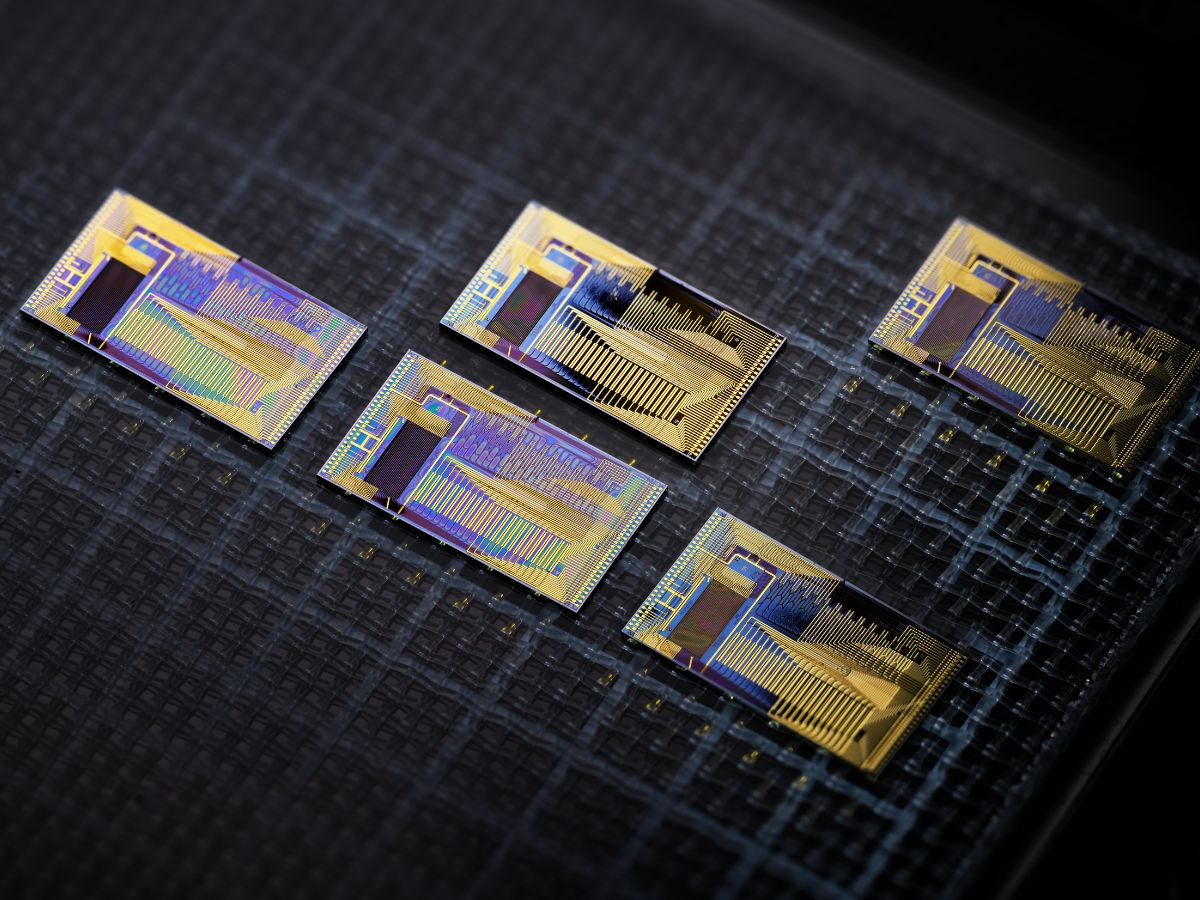
The Gen 2+ architecture builds on the company’s earlier Native Processing Unit, which uses thin-film lithium niobate photonic integrated circuits to carry out selected mathematical functions. The previous generation concentrated on matrix multiplication and nonlinear operations, while the latest version introduces Fourier transforms.
Q.ANT lists 16 optical cores for Gen 2+, compared with eight for Gen 2. The additional cores expand the hardware resources available for optical processing, although core count alone does not establish the performance of a complete computing system.
The new Fourier functionality broadens the types of algorithms that developers can consider for photonic acceleration. It does not mean that existing software can automatically transfer every computational operation to optical hardware.
The distinction becomes important in hybrid computing environments. Electronic systems must still manage memory, data preparation, numerical control, communication, and the sequencing of different operations. Transferring information between electronic and optical processing elements also introduces engineering requirements.
The potential benefit therefore depends on the proportion of the workload executed optically and the costs associated with preparing, transferring, and recovering data. A fast optical operation may offer little system-level advantage if surrounding processing or communication dominates execution time.
At SC26, Q.ANT demonstrated the processor working alongside an AMD GPU in a language-model inference workload. Supporting technical information identifies an AMD Instinct MI210 and a model containing approximately one billion parameters.
The demonstration used Fourier-based processing as an alternative to a computationally demanding attention operation. Attention mechanisms are used in language models to establish relationships between elements of an input sequence, but different model architectures can implement those relationships through different mathematical methods.
Fourier-based approaches offer one possible alternative to conventional attention calculations. Their suitability depends on the model structure, training method, numerical accuracy, and the tasks the model must perform.
The demonstration establishes that photonic processing can participate in this type of hybrid inference system. It does not establish that an equivalent production language model will necessarily provide higher accuracy, lower latency, or reduced total energy consumption.
Q.ANT has not supplied a complete independently verified comparison of the demonstrated workload against an equivalent GPU-only implementation, including data conversion, communication, and the power consumed by the surrounding equipment.
The company is also extending its software development kit to support the new functionality. Its open-source tools provide C and Python interfaces, examples, documentation, and a simulation environment that allows developers to investigate photonic applications without immediate access to optical hardware.
Adding Fourier transforms to that environment will allow software developers to test algorithms that use the new operation, although the behaviour of a simulated application must ultimately be compared with execution on the physical processor.
The hardware retains PCI Express integration with conventional computing systems. Q.ANT’s Native Processing Server architecture provides a route for incorporating photonic processors alongside CPUs and GPUs rather than requiring a wholly optical computing platform.
Gen 2+ remains available as a proof-of-concept platform. Q.ANT intends to introduce commercial systems combining Gen 2 and Gen 2+ processors during the second half of 2027, with further development directed towards integrating multiple mathematical functions within photonic hardware.
Its earlier processor generation is already being evaluated in scientific and commercial computing environments, including a pilot involving IONOS. The Gen 2+ announcement introduces a separate technical capability rather than simply extending access to existing hardware.
The next development stages will involve software support, further hardware integration, and evaluation of complete application performance. The demonstrated Fourier operation provides a new building block, while the value of combining photonic and electronic processing remains dependent on the applications selected and their measured operating characteristics.