
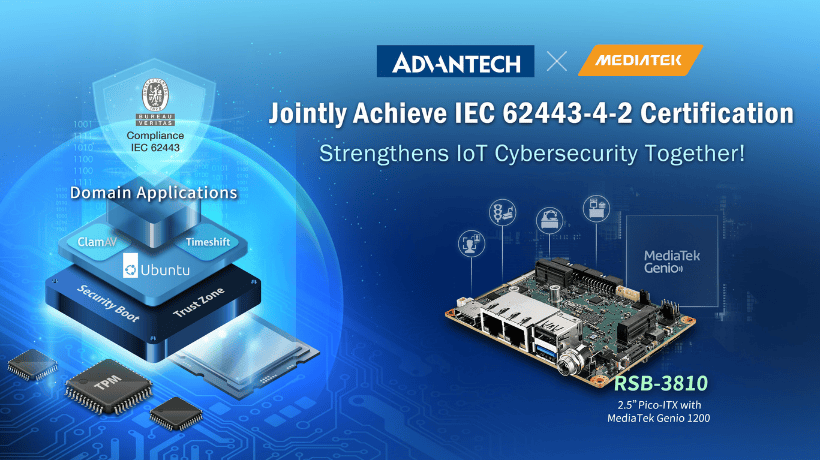
IN Brief:
- Advantech’s RSB-3810 has secured IEC 62443-4-2 certification for industrial cybersecurity.
- The Pico-ITX SBC combines MediaTek Genio 1200 compute, TSN, camera interfaces, and edge AI acceleration.
- Secure-by-design hardware is moving closer to the centre of industrial board selection as regulatory pressure rises.
Advantech has secured IEC 62443-4-2 certification for its RSB-3810 industrial single-board computer, a development that gives the 2.5in Pico-ITX platform a stronger position in industrial edge deployments where cybersecurity is now part of the hardware selection process rather than an afterthought. The board is built around MediaTek’s Genio 1200, combining four Arm Cortex-A78 cores and four Cortex-A55 cores on a 6nm-class device, with onboard AI capability aimed at vision, robotics, and connected industrial systems.
The certification matters because the RSB-3810 is not a security appliance dressed up as an embedded computer. It is a general-purpose industrial board intended for machine builders, system integrators, and OEMs that need to balance compute, power, connectivity, and lifecycle support in fielded equipment. In that context, IEC 62443-4-2 is significant because it shifts security assurance closer to the hardware platform itself, reducing the burden on downstream developers trying to harden a design late in the cycle.
On the technical side, the RSB-3810 is pitched as an edge AI and industrial vision platform rather than a bare compute module. The board supports MIPI-CSI and USB 3.0 camera interfaces, a starlight-grade ISP, 4K video processing, and multi-display support. It also includes GbE TSN for deterministic networking in automation and monitoring applications, alongside support for Ubuntu and Android. That combination places it squarely in the territory where industrial systems increasingly overlap with embedded AI — machine inspection, smart surveillance, autonomous equipment, and connected control nodes that need both imaging and time-sensitive communications.
MediaTek’s Genio 1200 gives the board a more modern balance than many legacy industrial platforms still relying on older x86 or lower-performance Arm designs. With up to 4.8 TOPS of AI inference performance and power draw cited at around 8W for the SoC platform, the architecture is designed to keep enough headroom for vision and analytics at the edge without tipping a compact system into an awkward thermal design. Advantech is also tying the board to longer software support through Ubuntu Pro, with long-term security maintenance intended to match the realities of industrial deployments that stay in service for years rather than quarters.
That lifecycle point is becoming harder to ignore. Industrial electronics has spent the past few years talking about AI acceleration, computer vision, and software-defined control, but the regulatory climate is moving just as quickly. European security regulation, including the wider pressure created by the Cyber Resilience Act, is pushing vendors to prove they can maintain products securely over the long haul. For board-level suppliers, that means a credible story on update paths, vulnerability handling, OS support, and standards alignment is starting to matter as much as raw benchmark performance.
The RSB-3810 therefore lands at an interesting point in the market. It is not a breakthrough in architecture, nor is it trying to be. Its importance is that it packages several trends into one deployable industrial platform: Arm-based edge AI, camera-led embedded systems, deterministic Ethernet, and certification that can travel with the product into regulated or security-conscious environments. For design teams weighing up new industrial platforms, the question is no longer simply whether a board has enough performance for edge inference. It is whether that board can still be supported, secured, and justified when the product is five or 10 years into its life. On that point, certification has become a design feature in its own right.

