
IN Brief:
- Aetina plans fan-cooled AIE-KT and fanless AIE-PT systems for Jetson T3000 and T2000.
- T3000 delivers up to 865 FP4 TFLOPS at 70W, while T2000 reaches 400 FP4 TFLOPS.
- The modules extend Jetson Thor into smaller, lower-power systems intended for wider production deployment.
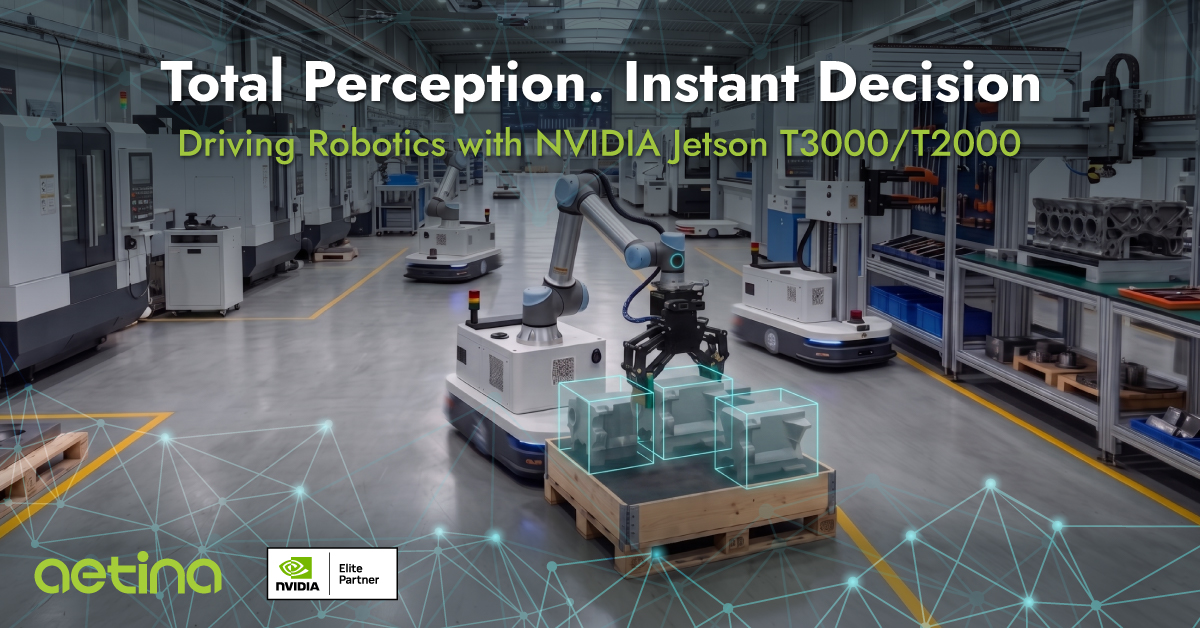
Aetina will extend its DeviceEdge industrial-computing portfolio to support NVIDIA’s Jetson T3000 and T2000 system-on-modules for robotics, machine vision, and physical-AI systems.
The company plans to add both modules to its fan-cooled AIE-KT range and a new fanless AIE-PT family. The two mechanical approaches will cover installations requiring sustained performance with greater thermal headroom and enclosed systems where silence, reduced maintenance, or protection from contaminants takes priority.
Jetson T3000 combines an NVIDIA Blackwell GPU containing 1,536 CUDA cores with an eight-core Arm Neoverse processor and 32GB of LPDDR5X memory. It delivers up to 865 FP4 TFLOPS within a 70W power envelope, with memory bandwidth specified at 273GB/s.
Jetson T2000 reduces the GPU to 1,024 CUDA cores and provides 16GB of LPDDR5X memory with bandwidth of 137GB/s. Maximum AI performance is 400 FP4 TFLOPS, placing the device below T3000 while retaining sufficient local compute for autonomous mobile robots, manipulators, visual agents, and industrial perception systems.
With availability expected during the first quarter of 2027, Aetina will release detailed system specifications, developer support, I/O options, and production schedules as its AIE-KT and AIE-PT designs move closer to launch.
Physical AI moves towards scalable hardware
Aetina already supplies Jetson Thor platforms using the higher-performance T5000 and T4000 modules. Its AIB-AT78 system can deliver up to 2,070 FP4 TFLOPS from T5000, supported by high-speed networking, camera interfaces, EtherCAT, and industrial I/O for advanced robotic platforms.
That level of compute is valuable during development and in demanding humanoid systems, but it carries power, cooling, memory, and cost burdens that cannot be justified across every production machine. T3000 and T2000 create additional design points for robots that require local multimodal inference without the maximum capability of the flagship module.
Thermal construction will distinguish Aetina’s planned systems as much as processor choice. Fan cooling can sustain higher workloads in a compact enclosure, although moving parts introduce acoustic, maintenance, and contamination concerns; fanless designs remove that failure mechanism but require heat to be conducted efficiently into the chassis and surrounding installation.
Because application conditions determine the stronger option, a robot operating in a clean, accessible warehouse may tolerate a serviceable fan, whereas a sealed inspection machine, agricultural platform, medical cart, or outdoor enclosure may favour passive cooling. Sustained performance can differ markedly from headline accelerator figures once ambient temperature, orientation, and simultaneous CPU, GPU, storage, and networking loads are included.
Software support will extend across NVIDIA JetPack and models and frameworks including Nemotron, Cosmos 3, and GR00T. Cosmos 3 is intended to support real-time, multi-view understanding and the development of world-action models, while GR00T provides a foundation for humanoid and general-purpose robotic reasoning and control.
The wider shift towards deployable edge-AI hardware for robotics and machine vision is moving development away from accelerator evaluation boards and towards systems with defined thermal, camera, networking, and software architectures. Compute modules remain central, but enclosure and interface design increasingly determine whether laboratory models can operate continuously on a machine.
Model capability alone does not produce a production robot. Deterministic motion control, functional safety, sensor synchronisation, cybersecurity, field updates, and long-term component support remain separate engineering disciplines, while physical-AI computers must connect cleanly to cameras, LiDAR, encoders, drives, safety controllers, and real-time networks.
Aetina’s fan-based and fanless products place T3000 and T2000 within that complete system. A common software family could allow developers to scale from high-end prototypes into smaller production platforms, provided memory limits, sustained thermal performance, and interface requirements are validated against the actual robotic workload rather than peak accelerator figures. Production programmes will also require stable module supply, controlled firmware baselines, and clear migration paths when individual cameras, sensors, or network interfaces change.

