IN Brief:
- Intel Core Series 3 platforms combine CPU, GPU and NPU engines with up to 40 platform TOPS.
- NUC and Mini-ITX variants support up to 64GB of DDR5-6400 memory alongside extensive storage, networking and display I/O.
- Industrial motherboard variants add wide DC input, multiple serial interfaces, remote management options and -20°C to 70°C operation.
ASRock Industrial has expanded its embedded computing portfolio around Intel Core Series 3 processors, introducing compact systems and industrial motherboards intended to bring integrated AI acceleration into mainstream edge equipment without requiring a separate accelerator in every design.
The Wildcat Lake-U range covers NUC BOX-320 and NUC BOX-304 systems, NUC-320 and NUC-304 motherboards, and the IMB-1253-WV and IMB-1254-WV Mini-ITX families. Across the range, Intel Core Series 3 combines CPU, GPU and NPU resources, with ASRock Industrial quoting up to 40 platform TOPS.
That aggregate figure needs to be read as a platform capability rather than the output of one dedicated accelerator. For equipment designers, the useful question is how workloads can be divided between the CPU, integrated graphics and NPU while leaving enough memory bandwidth, I/O and thermal headroom for the rest of the system.
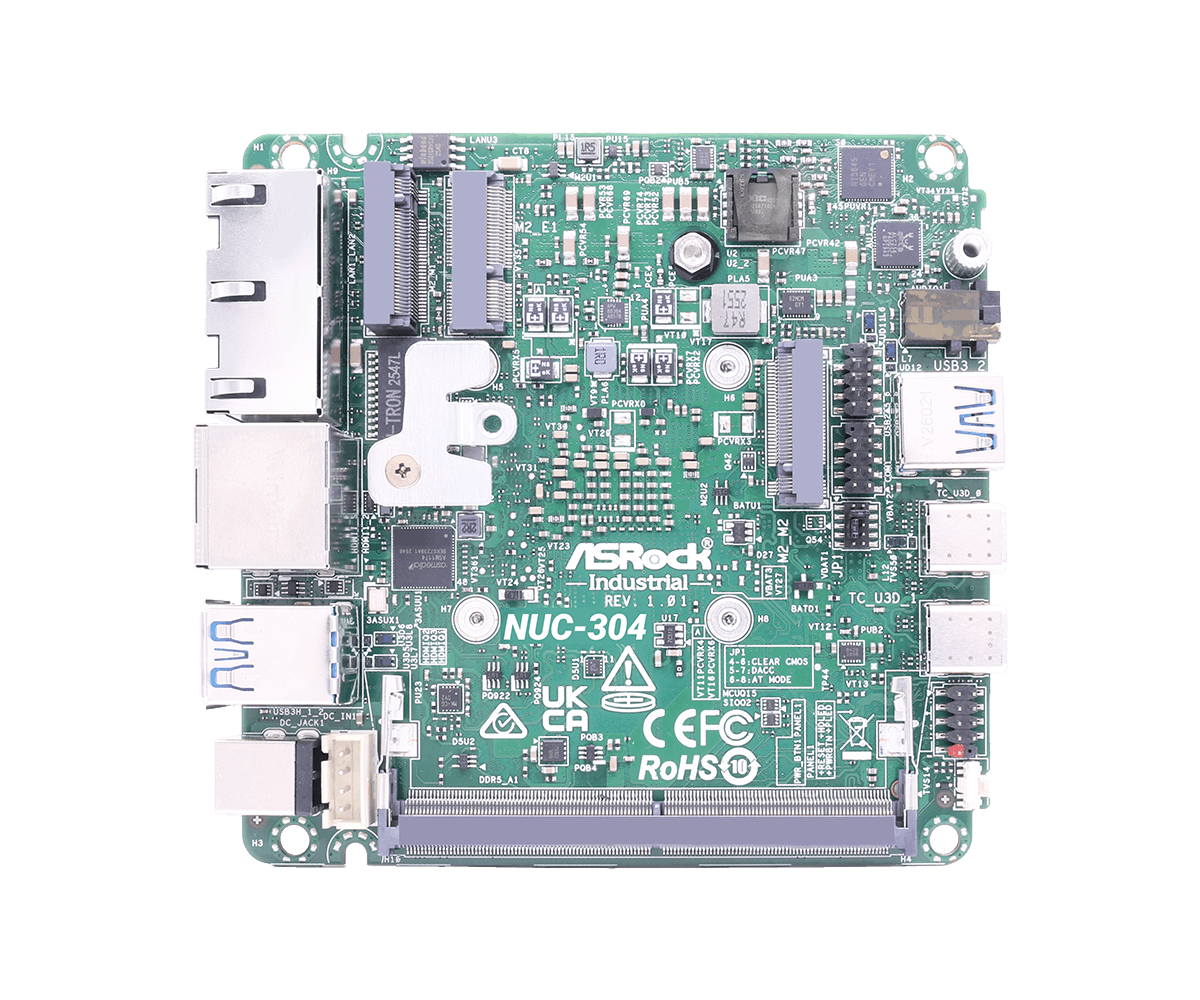
The NUC-320 and NUC-304 motherboards use Intel Core 5 320 and Core 3 304 processors respectively. Both support up to 64GB of single-channel DDR5-6400 memory with In-Band ECC and provide dual Ethernet through one Intel 2.5GbE interface and one Realtek 2.5GbE interface.
Storage support combines two M.2 Key M positions, while an M.2 Key E slot is available for wireless modules. The boards also provide USB Type-C and Type-A connectivity, one COM port and support for three simultaneous displays at up to 4K through HDMI and DisplayPort outputs.
The corresponding NUC BOX systems place the same processor family into compact fanned enclosures for applications where the equipment maker needs a finished embedded computer rather than a board-level platform. ASRock Industrial is targeting industrial control, HMI, intelligent gateways, smart retail and digital signage alongside other edge computing deployments.
The IMB-1253-WV and IMB-1254-WV extend the same processor generation into Mini-ITX boards with a broader industrial I/O mix. Both support up to 64GB of single-channel DDR5-6400 memory with In-Band ECC, while their expansion options include PCIe and M.2 connectivity.
The two boards differ around physical I/O. The IMB-1253-WV supports six USB 2.0 ports and six COM ports, while the thinner I/O IMB-1254-WV provides four of each. Both support three displays and optional out-of-band management, giving integrators a route to remote system monitoring and maintenance.
Power input is also aimed at embedded integration rather than office computing. The IMB-1253-WV supports ATX power and a 9V to 28V DC input arrangement, while the IMB-1254-WV supports 9V to 28V DC input. ASRock Industrial specifies an operating temperature range of -20°C to 70°C for both Mini-ITX platform families.
Those specifications are more consequential in industrial computing than the AI label attached to the processor generation. An edge system still has to connect to cameras, controllers, drives, storage, displays and networks, often inside equipment expected to remain in service for years. Additional compute capability only becomes useful when it can be integrated without forcing unnecessary changes to the surrounding machine.
The NPU nevertheless gives designers another option for inference workloads that would previously have required either CPU execution or a discrete accelerator. Machine vision preprocessing, classification and anomaly detection may fit within the integrated resources of the processor, particularly where the model is modest and power or board area matter more than maximum throughput.
That does not make an integrated NPU equivalent to a dedicated accelerator. Larger vision models and more demanding generative AI workloads can still exceed the compute, memory and thermal envelope of a mainstream embedded processor. The value is flexibility: the same platform can handle conventional control and interface work while retaining hardware acceleration for workloads that justify it.
Memory behaviour will also affect realised performance. The NUC platforms use a single DDR5 channel, so applications that repeatedly move large datasets between memory and several compute engines may encounter bandwidth limits before reaching the platform’s theoretical processing ceiling.
In-Band ECC also needs to be interpreted in the context of the complete memory architecture. It can improve data resilience for supported workloads, but system builders still have to validate the processor, memory modules and application together rather than treating the feature as a substitute for wider reliability engineering.
ASRock Industrial’s range therefore brings Intel’s latest mainstream edge processor generation into several deployment formats rather than betting on one fixed system design. The common CPU, GPU and NPU architecture can be packaged as a compact computer, NUC motherboard or Mini-ITX industrial board, leaving equipment developers to choose how much expansion, I/O and environmental tolerance the application actually requires.