IN Brief:
- Four Hall-based TLx49012 devices combine automatic initial calibration with continuous on-chip compensation.
- The family supports 1.5µs latency, magnetic fields from 20mT to 120mT and SPI, ABZ, UVW or PWM interfaces.
- TLE49012 variants support ISO 26262 and ASIL B automotive applications, while TLI49012 devices address industrial motor systems.
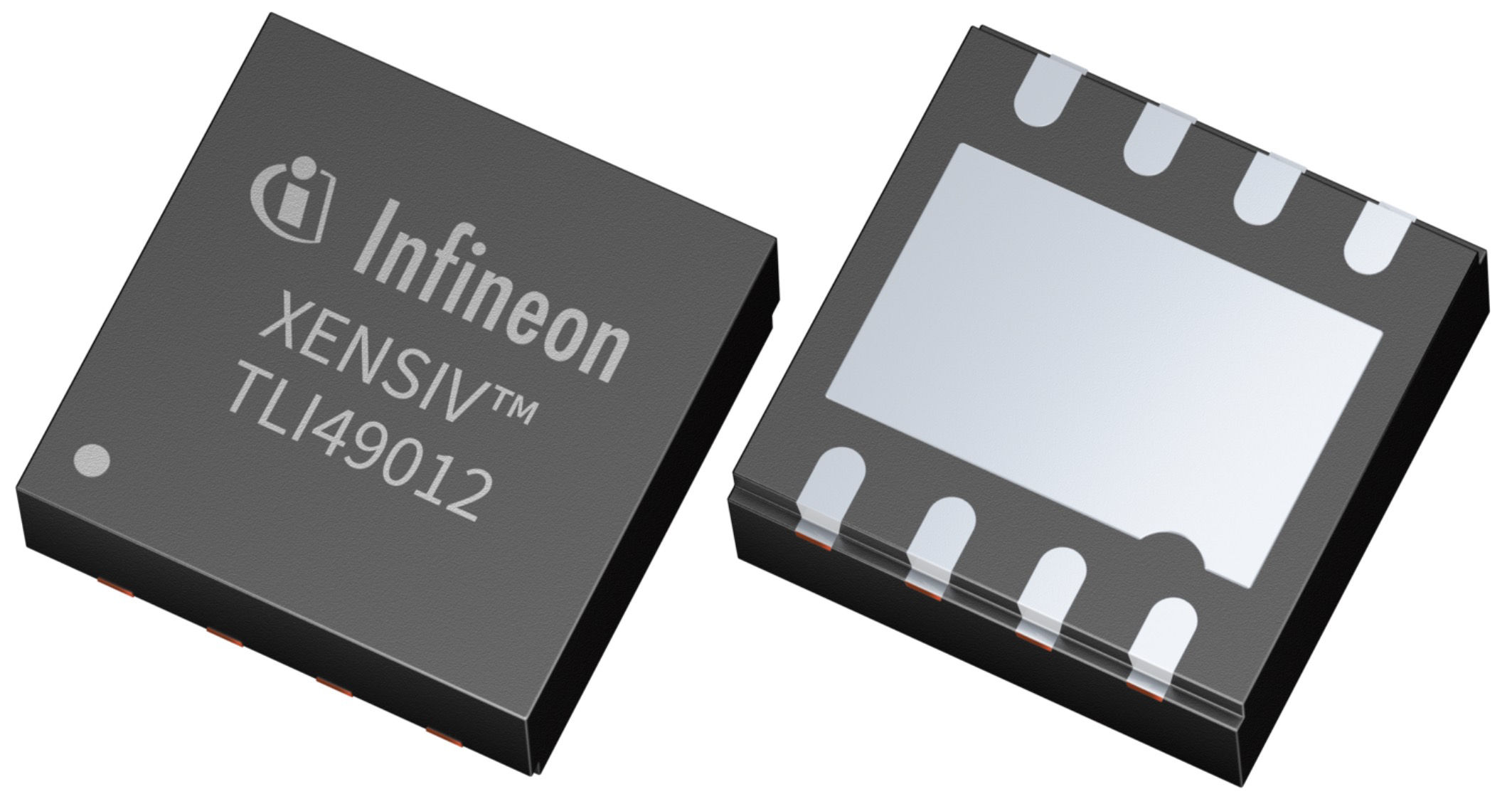
Infineon Technologies has introduced four XENSIV TLx49012 Hall-based digital angle sensors with automatic system self-calibration for automotive and industrial motor control.
The devices are designed for rotor and shaft position feedback in systems where low latency and tight angle accuracy have to be maintained despite variation in magnet placement and mechanical assembly. Infineon specifies latency of 1.5µs and angle accuracy below 0.1° under defined magnetic conditions.
The calibration architecture is the main change in the family. TLx49012 devices can perform automatic initial calibration and continue compensation on chip during operation, removing the need for a customer-developed calibration routine and an external reference encoder during system setup.
Production calibration is often required because the magnetic field seen by an angle sensor depends on more than the sensor itself. Magnet position, air gap, mechanical tolerances and assembly variation can all introduce errors between the physical shaft angle and the measured value. Those errors may otherwise have to be characterised after assembly and stored as correction data.
Moving more of that compensation into the sensor can reduce external calibration equipment and end-of-line processing, although system designers still have to keep the magnet and mechanical arrangement within the device’s specified operating conditions. Infineon supports magnetic fields from 20mT to 120mT across the new family.
Interface options include SPI, ABZ, UVW and PWM, allowing the sensors to work with several motor-control architectures. SPI can deliver digital angle information directly to a controller, while ABZ and UVW outputs support systems built around incremental position feedback or commutation signals.
The devices can also operate in on-axis and off-axis mounting arrangements. An on-axis design places the sensing system around the centre of the rotating magnetic field, while an off-axis layout can be useful when the shaft end is unavailable or the electronics have to be mounted alongside the motor.
Off-axis placement gives mechanical designers more freedom but creates a different magnetic geometry for the sensor to interpret. The combination of automatic initial calibration and continuous compensation is intended to accommodate those installation differences without requiring a separate customer calibration algorithm for each mechanical configuration.
Infineon divides the family into TLE49012 automotive variants and TLI49012 industrial devices. The automotive versions are ISO 26262 compliant and support ASIL B applications, while the industrial parts target motor drives and other equipment where the automotive qualification route is unnecessary.
Low latency becomes increasingly important as motor speed rises. A position value that arrives late represents a larger angular displacement at higher rotational speeds, adding an error that the control algorithm has to absorb. A 1.5µs sensor response is intended to limit that contribution in fast control loops.
The same timing requirement applies in rapidly changing loads. Electric power steering, active suspension, pumps, robotics and other servo systems use position feedback as part of closed-loop control, so sensor response affects how quickly the controller can react to a change in commanded or actual motor behaviour.
Accuracy alone does not determine the resulting control performance. Magnet quality, mechanical alignment, controller sampling, processing delay and power-stage behaviour all sit in the same signal chain. Reducing calibration effort at the sensor therefore removes one source of error and manufacturing complexity rather than replacing the need for complete system characterisation.
Infineon lists automotive applications including electric power steering, active suspension, pumps and fans, with industrial uses extending to motor drives, electric forklifts, humanoid robots and durable medical equipment. The spread reflects the increasing use of brushless motors in systems where electronic position feedback is part of the primary control loop.
TLE49012 and TLI49012 variants are available now. Their practical advantage will depend on whether the on-chip calibration can reduce production setup and calibration time while preserving the position accuracy required across temperature, mechanical tolerances and the operating life of the motor system.