IN Brief:
- FSWX-KM700 adds pulse and pulse-train analysis to the dual-channel phase-coherent FSWX analyser.
- Measurements cover timing, amplitude, frequency, phase, chirped signals and several pulse modulation formats.
- Rohde & Schwarz will demonstrate the option at European Microwave Week in London from 6 to 8 October.
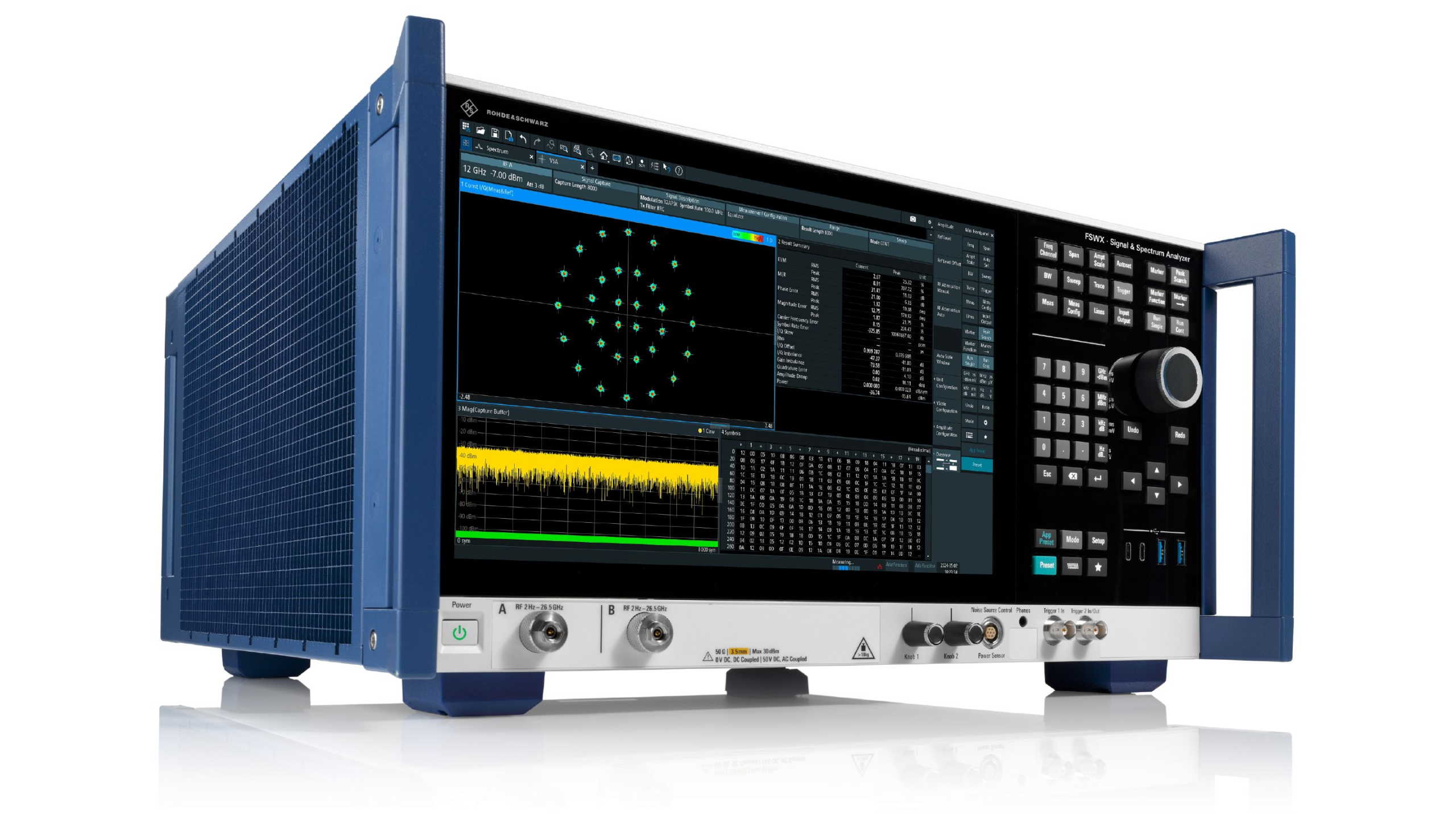
Rohde & Schwarz has added integrated multichannel pulse analysis to its FSWX signal and spectrum analyser, extending the instrument into test workflows for radar signals and Digital Radio Frequency Memory jammers.
The R&S FSWX-KM700 software option analyses individual pulses, complete pulse trains and differences between phase-coherent measurement channels. A jammer input and its resulting output can therefore be examined simultaneously rather than captured and correlated through separate measurement paths.
DRFM systems receive radar signals, digitise them and generate modified versions with controlled changes to parameters such as delay, phase or frequency. Characterising that behaviour requires more than detecting an RF output. Engineers need to establish whether the reproduced pulse has the intended timing, envelope, modulation and consistency when compared with the original signal.
KM700 measures pulse width, amplitude, rise and fall time, pulse repetition interval, duty cycle, shape and overshoot. It also handles chirped pulses, pulse width modulation, pulse position modulation and phase-modulated waveforms, covering several of the signal structures encountered in radar and electronic warfare development.
The FSWX architecture provides phase-coherent channels, preserving the relationship between the measured signal paths. Channel delta information can then show how parameters changed between a stimulus and response, making it easier to identify latency, distortion or modulation differences without reconstructing the comparison from unrelated acquisitions.
Rohde & Schwarz has added capture-versus-time displays for jammer response behaviour as well as individual pulse views for magnitude, frequency and phase. Trend displays and pulse statistics are intended to reveal changes across a sequence, including effects that may not be visible from a single event.
Trigger conditions can be based on amplitude, pulse width, pulse repetition interval or user-defined patterns. That allows an event of interest to be isolated within a longer sequence rather than forcing the analyser to treat every pulse identically. Aggregation can then be used to establish whether a timing or modulation error is persistent or intermittent.
The test problem becomes harder as radar waveforms become more agile. Frequency, phase, timing and modulation can change rapidly between pulses, while a jammer may deliberately alter several of those parameters in its response. The measurement system has to retain enough information across the channels to separate intended changes from distortion introduced by the device or test path.
Phase coherence is especially useful where small timing or phase differences carry the behaviour being measured. Independent instruments can be synchronised, but maintaining a known relationship between acquisition paths adds setup and calibration work. Integrating the measurement into one analyser reduces the number of separate data sets that later have to be aligned.
Pulse analysis also has to deal with the volume of data produced during long captures. A useful test system therefore needs ways to isolate events, calculate parameters and present trends without forcing the engineer to inspect every waveform manually. KM700 combines those functions with segmented capture and statistical analysis inside the FSWX environment.
The option is aimed principally at DRFM testing, although the same measurements can be applied to other pulsed RF systems where response timing and modulation fidelity have to be compared across channels. Radar component development, transmitter evaluation and complex stimulus-response testing can present similar requirements even without a jammer in the loop.
The addition follows wider expansion of Rohde & Schwarz RF test capability, including higher-frequency amplification and signal-analysis systems. KM700 addresses a different part of that chain by concentrating on pulse behaviour and the relationship between multiple signals rather than simply increasing available frequency or RF power.
Rohde & Schwarz will demonstrate FSWX-KM700 at European Microwave Week 2026 at Excel London from 6 to 8 October. The useful measure will be how effectively the integrated workflow reduces setup and correlation work while retaining the timing, phase and modulation detail required to diagnose complex pulsed systems.