IN Brief:
- ByteSnap surveyed 281 UK electronics and embedded systems professionals in August 2026.
- Some 33% reported increased verification, assurance and governance workloads, while 56% reported improvements in data analysis.
- Technical integration remained the most frequently identified obstacle, cited by 47% of respondents.
ByteSnap Design has found that artificial intelligence is adding verification, assurance and governance work for one-third of the UK electronics professionals surveyed, despite reported benefits in data analysis and repetitive tasks. The Birmingham electronics consultancy’s third annual study examined how AI is being used in product development and the extent to which engineering teams are prepared to delegate technical decisions.
The research involved 281 UK electronics and embedded systems professionals who responded to an online survey conducted through an independent research platform in August 2026. Participants worked in the design or manufacture of electronic and embedded products and contributed to engineering, product development, upgrades or AI-enabled features. The findings describe this respondent group rather than a representative census of the entire UK electronics workforce.
Among respondents, 33% reported increased workloads associated with verification, assurance and governance. At the same time, 56% said AI had improved data analysis, while 40% identified reductions in repetitive tasks. These responses are compatible: automation can shorten an initial activity while creating additional work to establish whether its output is correct and suitable for use in a physical product.
Verification in electronic design can involve checking generated firmware against hardware registers, memory limits, interrupt timing and peripheral behaviour. A design recommendation may also require simulation, bench testing or inspection of the finished board. Where AI contributes to safety-related functions, an apparently plausible output is insufficient without evidence that the complete system behaves within its specified operating conditions.
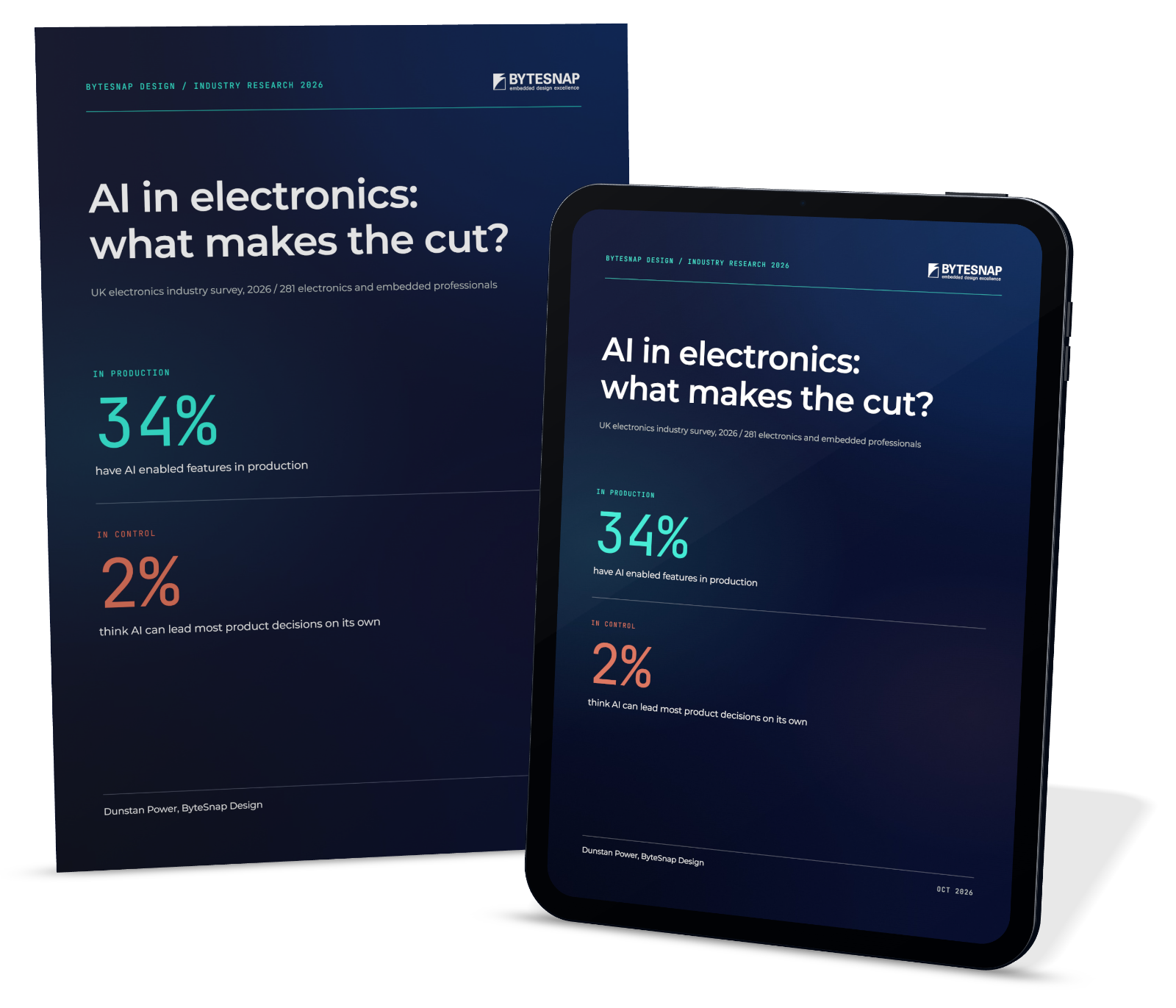
The survey found that only 2% believed AI should independently lead most product development decisions. That figure concerns the allocation of decision-making authority; it does not mean that only 2% of engineers trust AI for any purpose. Separately, 57% said safety, risk acceptance and accountability should remain human-led, and 43% identified verification, validation and engineering sign-off as responsibilities for people. Those percentages refer to distinct questions or response categories and should not be combined.
Technical integration was the most frequently identified barrier to getting AI features into production. Some 47% cited problems connecting AI to existing hardware, legacy electronics, firmware or control logic. ByteSnap recorded comparable responses of 34% in 2024 and 62% in 2025, although changes in respondent groups and the precise survey questions limit the conclusions that can be drawn from the annual comparison.
Embedded systems frequently impose restrictions that are less visible during model development on a workstation. Available processing cycles, working memory, power supply capacity and thermal headroom determine which models can run locally. Even when a model fits the hardware, engineers must establish how it receives sensor data, responds to missing or corrupted inputs and interacts with deterministic control routines that cannot tolerate arbitrary delays.
Product deployment is nevertheless becoming more common among those surveyed. Some 34% said their organisations had AI-enabled features operating in production, while a further 26% reported pilots or limited deployments. Computer vision and automated quality inspection led reported applications at 41%, followed by cyber threat detection at 39% and predictive maintenance at 37%. The last category was reported at 14% in ByteSnap’s 2024 study, although direct comparisons require the same methodological caution.
For an inspection system, an AI model may classify images more quickly than a conventional manual process, but engineers still need to understand missed defects, false alarms and changes in lighting or camera calibration. Predictive maintenance poses different problems: a model trained on equipment in one condition may be unreliable after a sensor replacement, a process change or prolonged operation outside the original training range.
Concerns about deployment extend beyond implementation effort. Respondents identified product safety and liability at 34%, customer trust at 33.5%, cybersecurity at 31% and regulatory compliance at 25%. These figures identify reported concerns, not measured failure rates or the proportion of products that fail certification. They nevertheless illustrate why testing, traceability and control of engineering changes remain necessary when AI affects equipment behaviour.
Dunstan Power, director of ByteSnap Design, said: “While AI saves time, someone still has to check the model’s output, judge whether it’s right, and take responsibility for the final decision.” The consultancy attributes part of the additional workload to the need to substantiate results produced by automation, particularly in applications where incorrect outputs could affect safety or product reliability.
Nearly one-third of respondents, 32%, expected AI to create demand for new embedded, data and systems skills, while 12% expressed uncertainty about future roles and 9% reported little change. The survey did not measure actual job creation or displacement. Its findings instead indicate which changes participants anticipate as engineering teams incorporate more AI-assisted processes.
Over the next three years, 49% expected AI to be deployed selectively rather than across entire product ranges, and only 29% expected it to become standard through most of their organisation’s portfolio. Suitable data was identified as a key influence on adoption by 42%, with commercial return cited by 40%. The figures leave product teams facing familiar engineering decisions: whether the available evidence, hardware and verification effort justify a particular function.