IN Brief:
- NI CHESS combines software-defined RF channel emulation with NI PXI VST hardware for lab-based validation of aerospace, satellite, and defence links.
- The platform models Doppler, multipath, path loss, and interference in real time to reproduce dynamic RF conditions under repeatable test scenarios.
- As satellite, airborne, and multi-domain communications become harder to validate in the field, more of the verification burden is moving into scalable laboratory environments.
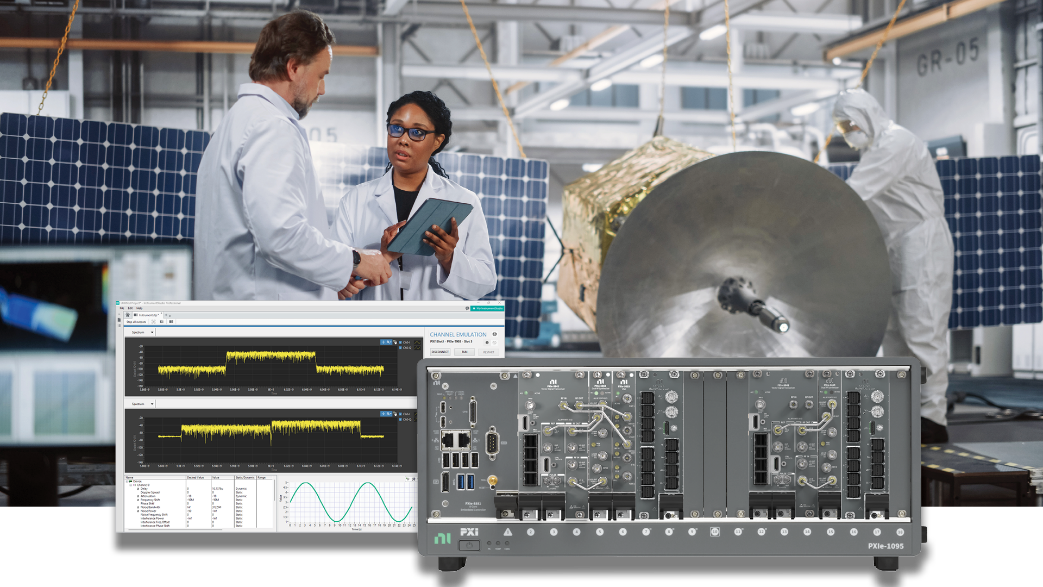
Emerson has introduced the NI Channel Emulator System Software, or CHESS, a new RF channel emulation platform intended to pull more of aerospace and defence communications validation out of the field and into the lab. The platform works with NI PXI Vector Signal Transceiver hardware and is designed to recreate dynamic radio environments in real time, giving engineering teams a repeatable way to test mission-critical links before systems move into live trials.
The immediate application space is clear enough. Satellite communications, airborne data links, and defence RF systems increasingly have to operate across fast-changing channels that are shaped by Doppler, multipath, path loss, interference, and platform motion. Those effects are not new, but the number of combinations engineers now need to evaluate has expanded sharply as systems become more software-defined, more bandwidth-hungry, and more tightly integrated with the rest of the vehicle or mission stack.
CHESS is intended to address that by combining model-based simulation with hardware-in-the-loop execution. Emerson said the platform streams real-time impairments through FPGA co-processing and can work alongside third-party scenario tools, allowing teams to reproduce ground-to-orbit, ground-to-air, and airborne link conditions under controlled laboratory settings. The proposition is less about replacing field work altogether than about shifting expensive failure discovery earlier, when design margins, waveform parameters, and integration choices can still be adjusted without programme disruption.
That shift matters because RF test is becoming harder to stage at the same pace that it is becoming more central to system performance. Aerospace teams are dealing with denser spectrum use, higher expectations around resilience, and a growing mix of satellite, terrestrial, and airborne communications paths. In many programmes, the cost of arranging representative field trials now extends well beyond travel and logistics. It also includes constrained access to airspace, range scheduling, scarce target assets, and the risk that a poor test set-up produces ambiguous results rather than useful engineering data.
What makes this launch more interesting than a routine software update is the way it reflects a broader test-and-measurement migration. Verification environments are being asked to do more system-level work before first flight or first deployment. In semiconductors, that has meant more pre-silicon validation and digital twins. In communications and radar, it increasingly means reproducing a contested or variable channel in the lab with enough realism to expose integration problems early. The pressure comes from programme cost, but also from schedule compression. Development teams are expected to close loops faster, re-run scenarios quickly, and show traceable evidence that a link budget or waveform configuration holds up under multiple operating conditions.
There is also a practical benefit for organisations already built around PXI-based validation benches. Emerson is keeping CHESS within the NI ecosystem rather than asking users to rebuild around a dedicated box-level instrument. That lowers the barrier to adoption for teams that already rely on modular RF test hardware and want to extend capability without tearing out existing infrastructure. In a market where laboratories are under pressure to scale coverage without scaling floor space, that compatibility may matter as much as the raw feature set.
The timing is notable as well. Space and defence communications programmes are pushing deeper into multi-orbit networking, software-defined payloads, autonomous systems, and more distributed mission architectures. As those designs become more adaptive, the validation problem becomes less about checking a single nominal link and more about understanding how the system behaves across a wide envelope of motion, blockage, interference, and topology change. Lab-based channel emulation is not a cure-all, but it is becoming one of the more credible ways to tighten development cycles without accepting blind spots.
For design teams, the value of a platform like CHESS will depend on fidelity, ease of scenario integration, and how well it fits existing verification workflows. Even so, the direction of travel is unmistakable. Field trials will remain essential, but the programmes that can arrive at them with cleaner waveforms, better characterised failure modes, and fewer unknowns are likely to waste less time proving out basics that should already have been settled on the bench.