
IN Brief:
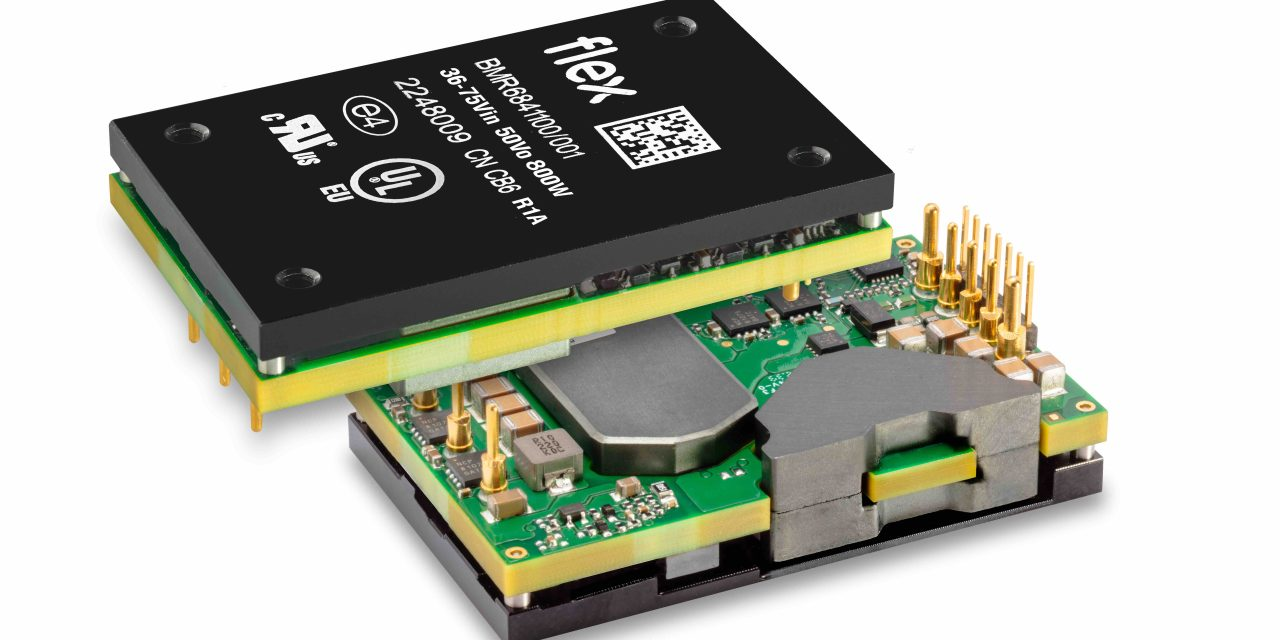
- Flex Power Modules has introduced an 800W variant of its BMR684 quarter-brick isolated DC/DC converter.
- The module operates from 36V to 75V input, delivers 50V output, and reaches up to 96% efficiency at full load.
- Telecom and datacom power architectures are demanding higher power density without larger converter footprints.
Flex Power Modules has introduced the BMR6841120/201, an 800W quarter-brick isolated DC/DC converter for telecom radio frequency power amplifier and datacom power applications.
The module provides a 50V output from a 36V to 75V input range, targeting 48V and 50V bus voltage architectures. Its 800W output represents a 14% increase over the previous generation while retaining the quarter-brick footprint, giving power-system designers higher density without moving to a larger converter format.
The BMR6841120/201 measures 58.4mm by 36.8mm by 13.3mm and is designed for through-hole mounting using a wave-solder process. Flex Power Modules specifies up to 96% efficiency at full load, with baseplate operation up to 100°C. A full-bridge topology and thermal design optimised for heat dissipation support full-power operation in demanding installations.
The module includes 1500VDC input-to-output isolation and protection features covering monotonic start-up, input under-voltage, output over-voltage, output short-circuit, and over-temperature conditions. A PMBus interface allows configuration and monitoring through the Flex Power Designer tool, supporting system-level control, telemetry, and fault reporting.
The converter is already in mass production, with samples available. Telecom RFPA systems provide the primary application space, where high output power, predictable thermal behaviour, and compact packaging are required. Datacom equipment provides another target market as rack and board-level power architectures continue to move towards higher density.
Power conversion has become one of the main constraints in modern electronics design. Compute, RF, networking, sensing, and storage systems can be limited as much by power delivery and heat removal as by the capability of processors or radio devices. A converter that raises output power inside an established package can preserve board and mechanical layouts while increasing available power.
Telecom RF power amplifier systems are especially demanding because conversion losses become heat that has to be removed from dense equipment. High efficiency reduces thermal load, but the converter also has to maintain performance under changing line conditions, ambient temperatures, and load profiles. PMBus monitoring supports equipment-level diagnostics where remote management and fault reporting are now standard expectations.
The launch also reflects wider use of 48V and 50V bus architectures in high-power electronics. Higher bus voltages reduce current for a given power level, cutting distribution losses and copper requirements. That voltage shift is visible across telecom infrastructure, data centres, robotics, industrial equipment, and vehicle subsystems, with recent MOSFET development for 24V and 48V systems showing the same transition at device level.
Higher power density does not remove the need for careful system design. Baseplate cooling, airflow, layout, filtering, mechanical attachment, and fault handling still determine how the module behaves in service. RF applications add further pressure because power integrity and electromagnetic behaviour can affect system performance beyond the power supply itself.
The BMR6841120/201 lands in a market where power supplies are becoming more intelligent and more closely integrated into equipment design. PMBus control, high-temperature operation, isolation, and built-in protection are no longer peripheral features. They form part of how manufacturers manage uptime, thermal load, and serviceability in compact electronics.
Telecom and datacom infrastructure continues to absorb higher traffic, more compute, and more RF complexity, keeping converter density high on the design agenda. Flex Power Modules’ new BMR684 variant gives engineers another way to raise board-level power without expanding the converter footprint, while reinforcing the role of the power stage as a central element in electronics packaging, monitoring, and reliability.

