IN Brief:
- The IB966 delivers up to 180 TOPS across its CPU, GPU, and NPU resources.
- Processor choices include Intel Core Ultra X7 358H and two Core Ultra 7 variants.
- Two DDR5-7200 SO-DIMM sockets support up to 128GB for industrial edge workloads.
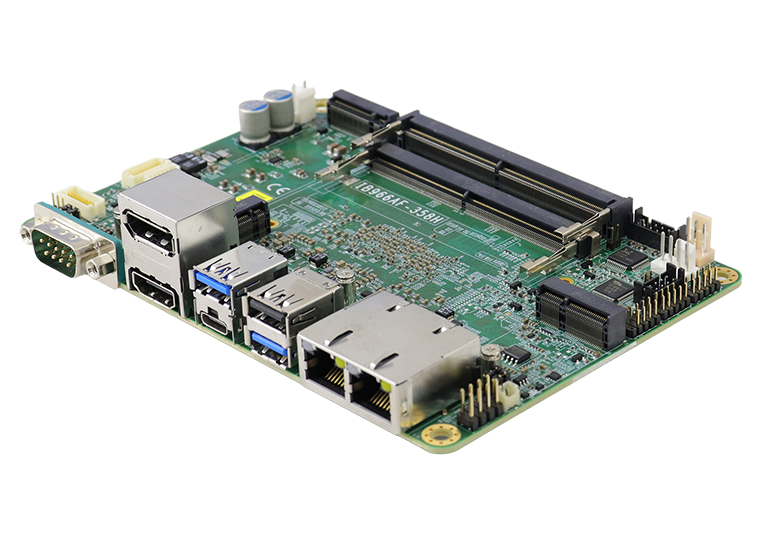
IBASE Technology has introduced a 3.5-inch single-board computer delivering up to 180 TOPS of combined AI processing for machine vision, local inference, industrial automation, and other edge applications.
The IB966 is built around Intel Core Ultra Series 3 processors, previously known under the Panther Lake codename, with Core Ultra X7 358H, Core Ultra 7 356H, and Core Ultra 7 355 options. CPU, GPU, and NPU resources are integrated on the same platform.
IBASE gives the highest configuration an aggregate AI performance figure of up to 180 TOPS. The total spans different processing engines rather than describing the output of one interchangeable accelerator, so available performance depends on how effectively the application is divided between CPU, GPU, and NPU workloads.
That heterogeneous structure is intended to keep more processing close to the sensors and equipment producing the data. General application code can remain on the CPU, suitable parallel workloads can use the GPU, and inference tasks supported by the software stack can be assigned to the NPU.
Local processing is particularly relevant in machine vision, where inspection, tracking, classification, and anomaly detection may have to operate continuously and return results within a predictable time window. Moving every image to remote infrastructure adds network traffic and makes latency and connectivity part of the inspection loop.
The board carries two DDR5-7200 SO-DIMM sockets supporting up to 128GB of non-ECC memory. The capacity is considerably greater than a conventional embedded controller requires, reflecting the larger AI models, image buffers, analytics workloads, and consolidated software functions now appearing in edge systems.
IBASE also provides a broad set of display and peripheral interfaces. The specification includes HDMI, DisplayPort, LVDS, and eDP video outputs, two 2.5G Ethernet interfaces, USB 3.2 and USB 2.0 connections, serial ports, digital I/O, and three M.2 positions for storage and expansion.
The board accepts a 12V to 24V DC input and includes hardware monitoring, watchdog functions, dTPM support, and Intel Active Management Technology. Those functions place the design closer to an industrial computing platform than a simple development board, although the finished system still requires an enclosure, power design, thermal management, storage, and environmental protection suited to its deployment.
Thermal design becomes more significant as compute density rises. A compact board may reduce overall system size, but sustained CPU, GPU, and NPU workloads still generate heat that has to be removed if the processor is to maintain its intended operating frequency over long production cycles.
Peak TOPS therefore provides only part of the selection criteria. Memory bandwidth, supported inference formats, accelerator utilisation, model precision, driver support, and the proportion of application code that can move away from the CPU all influence the performance available in the finished machine.
Software support is equally important when several compute engines share a platform. An application that keeps the NPU occupied with suitable inference while the GPU processes images and the CPU handles control can use the architecture efficiently; a workload that remains predominantly CPU-bound will see much less benefit from the aggregate accelerator figure.
Industrial deployments also place greater emphasis on lifecycle and configuration stability than short-lived desktop systems. Machine builders may need the same board or a controlled successor for years, alongside firmware maintenance, documented interfaces, and predictable behaviour as software dependencies change.
The IB966 reflects the continuing shift from attaching separate AI accelerator cards to conventional embedded processors towards processor platforms that incorporate several compute engines from the outset. Integration can reduce data movement and hardware count, but it also increases the importance of software capable of assigning each workload to the most suitable engine.
IBASE is targeting real-time inference, machine vision, analytics, and industrial automation with the board. Application-level testing will provide the more useful measure of the 180-TOPS platform, particularly where sustained thermal limits and software partitioning determine how much of the available heterogeneous compute can be used at once.