IN Brief:
- PAC1761 and PAC1861 devices measure rails up to 65V and tolerate 75V transients.
- The families add accumulated-energy thresholds, step-limit detection, and programmable voltage, current, and power alerts.
- Twelve-bit and 16-bit options are available now in VDFN and MSOP packages, including automotive variants.
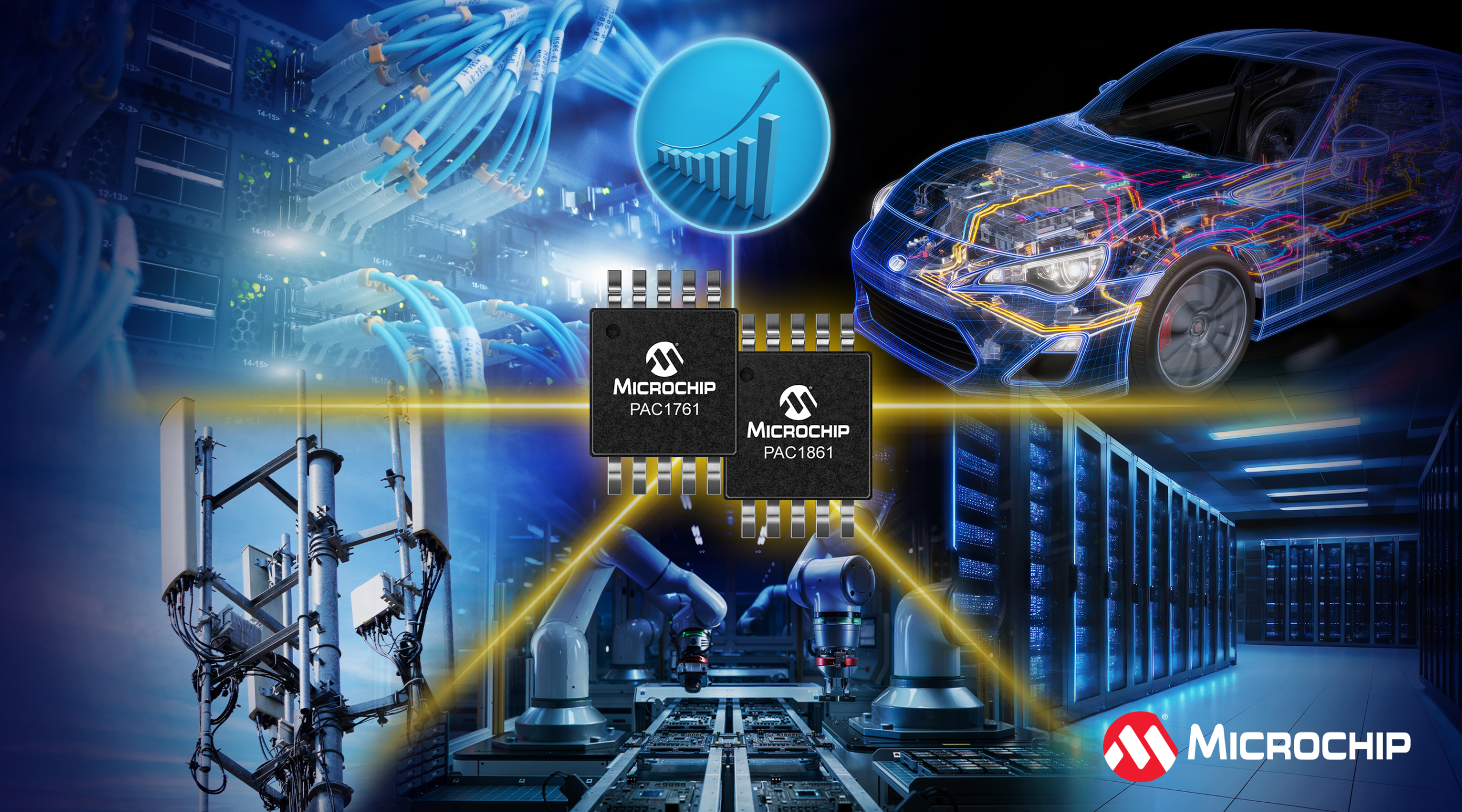
Microchip Technology has introduced the PAC1761 and PAC1861 digital power monitor families for 48V systems, combining measurement up to 65V with accumulated energy tracking and 75V transient protection. The devices target automotive, data-centre, networking, industrial, server, telecoms, and other higher voltage distribution architectures.
The two families differ primarily in measurement resolution, with the PAC1761 providing 12-bit conversion and the PAC1861 moving to 16 bits. Both monitor voltage, current, and power while also accumulating energy data over time, allowing a host controller to work with longer term consumption information rather than relying entirely on individual sampled conditions.
A 48V bus places different demands on monitoring hardware from lower voltage rails. The nominal voltage leaves less margin for devices with 50V or 60V limits, while switching events, hot plugging, motors, converters, and distribution impedance can generate short excursions above the normal operating level.
Microchip gives the PAC1761 and PAC1861 a 65V measurement ceiling together with 75V spike protection. The additional headroom is intended to keep the monitor within its operating and survival limits when a nominal 48V rail is exposed to transient conditions that would leave little margin on a lower-voltage device.
The monitors include programmable alerts for voltage, current, and power excursions, step-limit detection for sudden load changes, and configurable accumulated-energy thresholds. Moving those functions into the monitor reduces the need for the main processor to reconstruct every event from a continuous stream of raw samples.
Accumulated energy also provides a different view of system behaviour. An instantaneous reading may show that a rail is inside limits at one moment, while longer term measurement can reveal whether a branch is consuming more energy across a workload cycle, whether a repeated transient pattern is developing, or whether available energy is being depleted faster than expected.
The devices are being positioned across automotive 48V systems, AI and data-centre infrastructure, networking equipment, industrial electronics, servers, telecoms, Power over Ethernet equipment, and wider 48V distribution. Those applications increasingly use higher intermediate bus voltages to move substantial power with lower current before local converters step the supply down closer to the load.
Distributed monitoring becomes more useful as a 48V bus feeds several converters or subsystems with different duty cycles. A controller can use local power data to identify abnormal behaviour, manage power allocation, or preserve information about a changing load without polling every monitor at the highest possible rate.
Package options include VDFN-8, VDFN-10, and MSOP-10, with variants available for automotive ordering. Microchip highlights pin-compatible choices within the range, giving designers scope to change resolution or device option without automatically forcing a new board layout.
Pin compatibility does not remove the need to verify electrical behaviour, firmware configuration, qualification status, and measurement accuracy, but it can reduce the mechanical impact of changing devices during development or later sourcing decisions. That becomes valuable in long lived industrial and automotive programmes where a component substitution can otherwise trigger significant revalidation work.
Development support includes the EV12R33A evaluation board, a Python command-line interface and library, a Linux driver, and a generic C library with examples for multiple microcontrollers. The device families are available now, with selected MSOP-10 variants starting at $0.56 each in quantities of 10,000 and the evaluation board priced at $49.
The architecture moves more event detection and energy accumulation into the measurement IC while leaving system policy with the host controller. Thresholds still have to be selected appropriately for the load and operating environment, but the processor receives a richer description of rail behaviour than a stream of isolated voltage and current readings.
As 48V distribution spreads across vehicles, communications equipment, industrial systems, and high-power computing, monitor headroom becomes only one part of the design requirement. The PAC1761 and PAC1861 combine that voltage margin with transient tolerance and longer term energy data, allowing protection, diagnostics, and power management to be built around both immediate events and behaviour over time.