IN Brief:
- The SAM200 family covers 20GHz to 53GHz with up to 4W of saturation power.
- The SAM200 Advanced adds an integrated power detector, USB and LAN control, and three switchable RF paths.
- Desktop and 4U rack configurations extend the amplifier range above the existing 2GHz to 20GHz SAM100 platform.
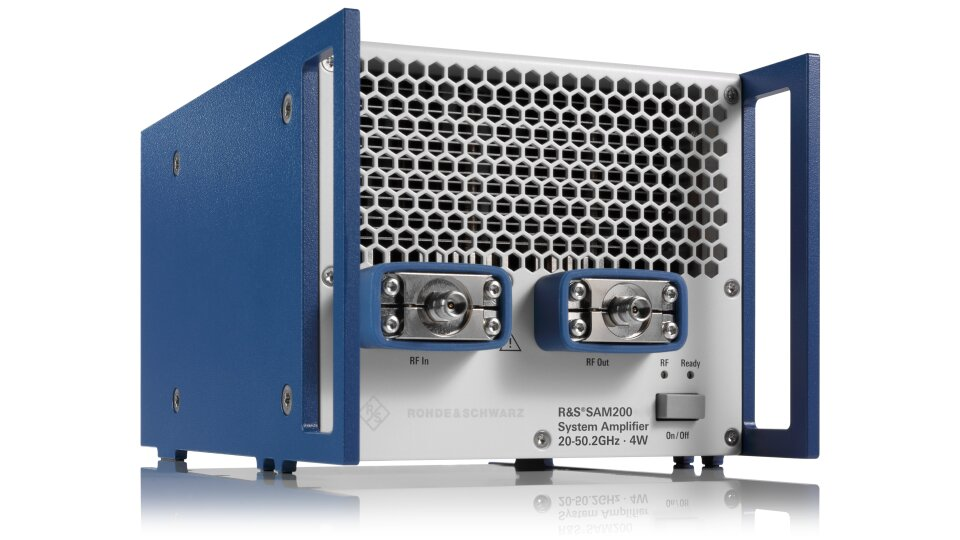
Rohde & Schwarz has extended its system amplifier range to 53GHz with the SAM200, adding a wideband solid-state platform for microwave and millimetre-wave test systems.
The new family covers 20GHz to 53GHz and provides up to 4W of saturation power. It sits above the existing SAM100, which covers 2GHz to 20GHz, extending the company’s amplifier portfolio into the Ka, Q, and V bands used across satellite communications, aerospace systems, radar, and higher-frequency telecommunications development.
Two versions are available. The standard SAM200 operates as a wideband gain block for test arrangements where a signal generator or vector network analyser cannot supply sufficient output power at the device under test. The SAM200 Advanced adds an integrated power detector, USB and LAN interfaces, browser-based control, and three selectable RF paths.
The Advanced model can switch between low-noise/high-gain, regular, and low-gain operation. This allows the amplifier behaviour to be adapted to the measurement rather than requiring engineers to rebuild the RF chain with separate amplification or attenuation for different test conditions.
Losses through cables, connectors, fixtures, switches, and other system elements become increasingly significant as operating frequency rises. Even where the signal source itself covers the required band, the available power at the device reference plane can fall below that needed for compression, modulation, gain, or distortion measurements.
Additional amplification has to provide the required drive level without introducing excessive noise or degrading the signal being measured. Rohde & Schwarz is positioning the SAM200 Advanced for use alongside vector signal generators and network analysers where modulation-sensitive measurements, including error vector magnitude, place tighter limits on the quality of the amplified signal.
The integrated detector also creates a measurement point inside the amplifier rather than leaving power monitoring entirely to external instruments. In automated setups, the USB and LAN interfaces allow the amplifier configuration to be changed under software control, reducing the amount of manual intervention required as a test sequence moves between operating conditions.
Rohde & Schwarz has demonstrated the platform in wider millimetre-wave measurement chains. At European Microwave Week 2026, the SAM200 was paired with the company’s ZNA vector network analyser for Ka-band amplifier characterisation and used with its SMW200A vector signal generator and FSW signal and spectrum analyser for broadband modulated-signal measurements.
Wide frequency coverage can also reduce the number of narrow-band amplifiers needed in a multi-band test system. Fewer amplifier changes can simplify cabling, switching, calibration states, and automated test control, although the complete RF path still has to be characterised for gain, linearity, noise, and measurement uncertainty across the frequencies being used.
The SAM200 is offered in desktop and 4U rack-mounted configurations. Rack mounting is suited to automated and production-oriented systems where the amplifier forms part of a fixed measurement chain, while the desktop version can be integrated into laboratory setups without dedicated rack infrastructure.
Output protection is incorporated for conditions where the load presented by the device or test fixture moves away from its intended impedance. Rohde & Schwarz uses mismatch protection together with gradual power foldback, reducing amplifier output as conditions become more severe rather than relying on abrupt shutdown.
That protection is relevant during component development because prototypes, fixtures, and devices operating close to compression do not always present a stable 50-ohm load. Maintaining controlled operation through a poor match can reduce the risk of damage to the amplifier while allowing the measurement system to recover without a complete restart.
The 53GHz upper frequency brings the SAM range into bands being used for higher-capacity satellite links and other broadband RF systems. Those applications are increasing the demand placed on test chains as wider modulation bandwidths, higher carrier frequencies, and more complex devices have to be characterised without allowing the amplification stage itself to dominate the measurement result.