IN Brief:
- Infineon and VinRobotics have signed an MoU covering humanoid robot development.
- The collaboration will draw on microcontrollers, power semiconductors, sensors, connectivity, safety, and security technologies.
- Humanoid robotics is turning into a system-level electronics challenge spanning power, perception, motion control, and embedded intelligence.
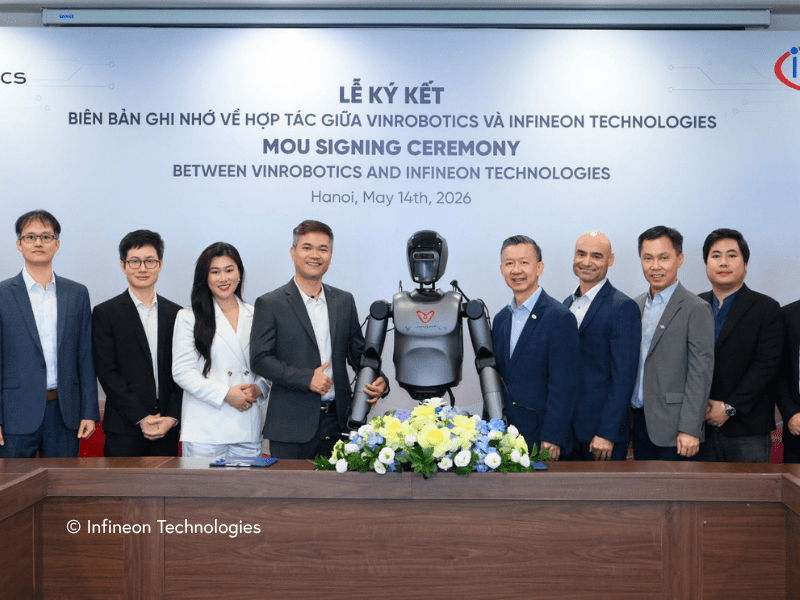
Infineon Technologies and Vietnam-based VinRobotics have signed a memorandum of understanding to collaborate on humanoid robot development, with a joint competency centre planned at VinRobotics’ headquarters in Hanoi.
The agreement brings Infineon’s semiconductor portfolio together with VinRobotics’ robotics and artificial intelligence work. The collaboration will cover microcontrollers, power semiconductors, sensors, connectivity technologies, safety devices, and security technologies used in future humanoid platforms.
Humanoid robots place unusually dense demands on electronics design. A viable platform needs perception systems to interpret its surroundings, motion-control electronics to coordinate joints and actuators, efficient power conversion to preserve mobile operation, embedded communications to connect with surrounding systems, and safety functions able to manage human interaction. These machines do not present a single processor problem; they require a tightly integrated control and power architecture.
The planned competency centre in Hanoi will support joint research, development, and innovation activity. Southeast Asia’s manufacturing base, industrial modernisation programmes, and labour-market pressures are already creating stronger demand for robotics in production, logistics, services, and infrastructure. Humanoid systems remain earlier in maturity than conventional industrial robots, but the electronics stack is now becoming more defined.
The form factor promises flexibility across environments originally built around people, while also creating difficult engineering trade-offs. Hands, joints, drives, batteries, sensors, compute modules, thermal structures, and communications hardware must fit inside a mechanically constrained body. Reliability has to be maintained through motion, load changes, heat, vibration, and contact with unpredictable environments.
Semiconductor content rises quickly as autonomy increases. Motor-control devices, gate drivers, power stages, inertial sensors, magnetic sensors, radar, time-of-flight sensors, secure elements, microcontrollers, connectivity chips, and edge processors all shape system behaviour. Greater autonomy adds more data processing and more sophisticated sensing, but it also increases the need for functional safety, diagnostics, and secure update mechanisms.
The physical AI push now running through robotics depends on hardware able to close the loop between perception and action. Simulation and model development can advance quickly, but deployment still depends on actuators, power distribution, embedded control, sensor reliability, and deterministic system behaviour. A robot that can reason but cannot manage heat, recover from faults, or maintain safe torque control remains a laboratory asset rather than a deployable machine.
Recent connected-hardware developments show the direction of travel. European-made wireless modules from u-blox and maritime drone sensing work from Robin Radar both demonstrate how sensing, communications, and local processing are moving into harsher and less predictable environments. Humanoid robotics compresses many of those requirements into a single mobile platform.
Power architecture will be especially difficult. Actuators create high peak loads, batteries impose energy limits, and compact mechanical structures restrict heat removal. Every watt used by compute, sensing, and communications competes with motion. That gives power semiconductors, converters, motor-control ICs, and thermal-aware embedded design a central role in future platform performance.
Safety and security add another layer. Networked robots operating near people need reliable fault detection, protected communications, secure identity, and controlled software maintenance. As robots become updateable and increasingly connected, cybersecurity moves from enterprise IT into physical system design. A compromised robot is not simply a data problem; it can become a machinery safety problem.
The collaboration between Infineon and VinRobotics reflects the increasing need for semiconductor suppliers to work closer to application development. Component choice now affects reference architectures, software support, safety documentation, system diagnostics, and lifecycle availability. Humanoid robotics is still some way from mass deployment, but the engineering shape is clear enough: progress will depend on the quality of the electronics platform beneath the visible machine.