IN Brief:
- HybridPACK HD targets electric trucks and buses requiring high-current traction inverters.
- The module uses 1,400V CoolSiC MOSFETs and .XT interconnection technology, with direct liquid cooling supported.
- Infineon specifies design lifetimes exceeding 1.2 million kilometres and compatibility with battery architectures up to 1,500V DC.
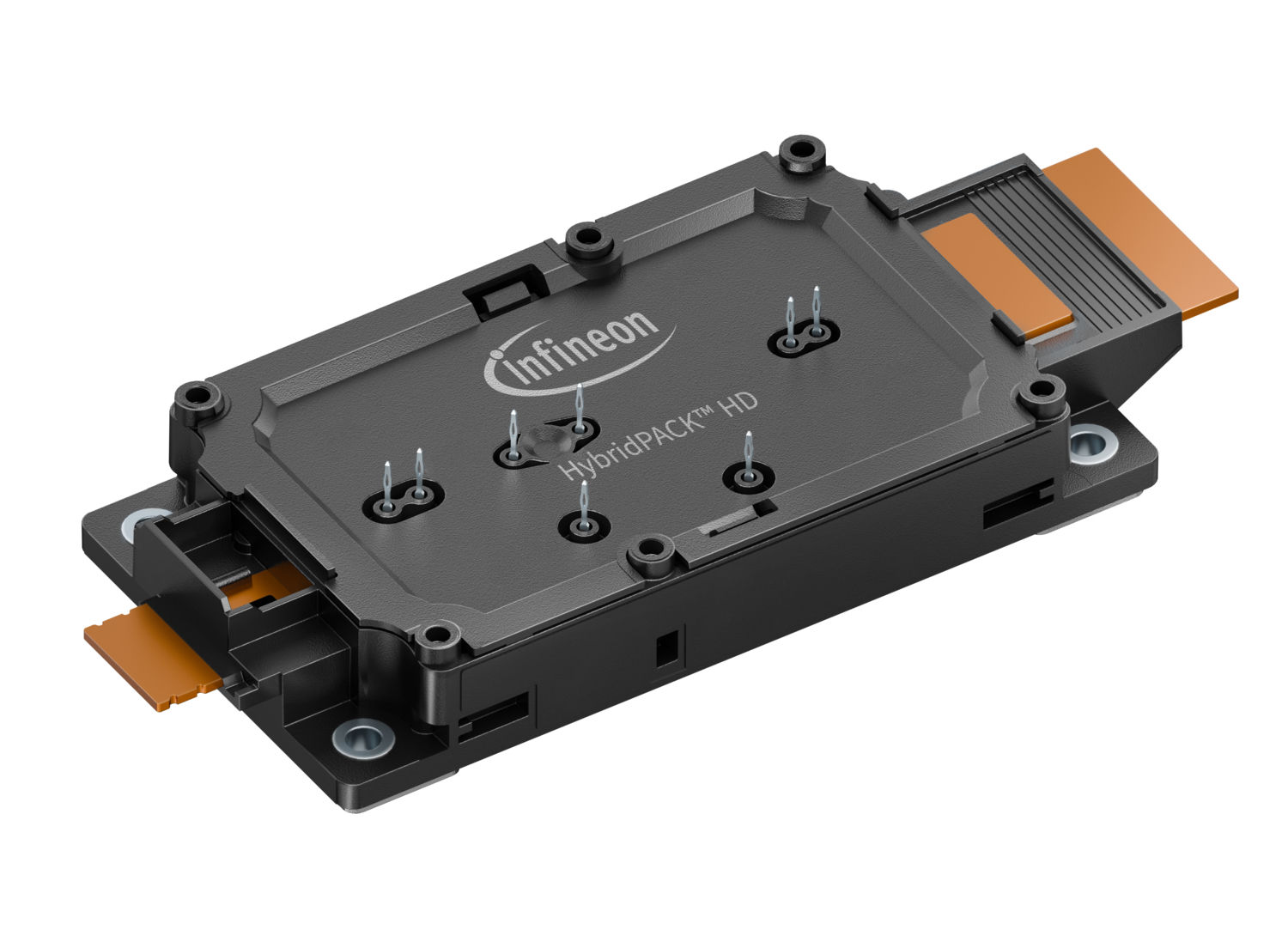
Infineon Technologies has introduced HybridPACK HD, a silicon carbide power module developed for electric commercial vehicle traction inverters, extending its automotive semiconductor range with a package designed for high current, demanding thermal conditions, and extended operating lifetimes.
The module uses 1,400V CoolSiC MOSFETs and supports output currents from 500A to 1,200A RMS across the platform. Infineon has designed it around vehicle lifetime requirements exceeding 1.2 million kilometres, reflecting the operating demands associated with electric trucks, buses, and other heavy commercial vehicles.
Commercial vehicle traction systems can be subjected to prolonged periods of high electrical load, repeated acceleration, steep gradients, and substantial variations in operating temperature. Their power electronics must maintain controlled motor operation while accommodating those conditions over years of service.
A traction inverter converts the battery’s DC supply into controlled alternating current for the electric motor. Semiconductor switches determine how electrical power is delivered to the motor phases, with their switching behaviour influencing conversion losses, thermal loading, electromagnetic interference, and the performance of the complete drivetrain.
HybridPACK HD combines its switching devices within a compact module architecture intended to provide sufficient current capability without paralleling multiple power modules. The package uses Infineon’s .XT interconnection technology, which is intended to improve reliability under repeated thermal and electrical loading.
Eliminating the need for parallel power modules in a supported inverter design can simplify the power stage, including some of the associated mechanical connections and electrical interconnections. The complete inverter still requires gate driving, DC-link capacitors, current measurement, protection circuits, and suitable cooling.
The electrical properties of silicon carbide contribute to the module’s design. SiC MOSFETs can switch efficiently at high voltage, allowing manufacturers to investigate higher switching frequencies or reduced conversion losses compared with alternative silicon-based implementations.
Actual performance depends on the device operating conditions and the surrounding circuit. Increasing switching frequency can reduce the required size of some magnetic components, but switching losses, electromagnetic interference, and the behaviour of the motor insulation must also be considered.
Infineon has combined the semiconductor devices with a package designed to limit unwanted inductance in the power switching loop. Parasitic inductance can produce voltage overshoot when current changes rapidly, potentially increasing electrical stress and requiring adjustments to the gate drive strategy.
The module’s thermal arrangement is equally important. Power losses within the semiconductor devices generate heat that must pass through the package and into the cooling system without exceeding the permitted operating temperatures.
HybridPACK HD supports direct liquid cooling, allowing the module to be incorporated into a cooling circuit capable of removing heat during sustained high-power operation. The thermal performance achieved in service will depend on the coolant, flow rate, inlet temperature, mechanical interface, and complete inverter construction.
Repeated heating and cooling also place mechanical stresses on semiconductor packages. Different materials expand at different rates, creating movement at the interfaces between chips, substrates, electrical interconnections, and structural elements.
Over many operating cycles, these stresses can affect the reliability of electrical or thermal connections. Infineon’s .XT technology is intended to address the durability requirements associated with these conditions, although service life remains dependent on the vehicle’s actual operating profile.
The manufacturer also specifies compatibility with battery voltages up to 1,500V DC, positioning the platform for future high-voltage commercial vehicle architectures and megawatt charging requirements.
Higher battery voltage can reduce the current needed to transfer a given amount of power. Lower current may reduce resistive losses in cables and electrical connections, provided the complete system is designed appropriately.
The transition also increases demands on insulation coordination, component selection, electrical clearances, and protection systems. The module’s stated 1,400V semiconductor rating and its manufacturer’s claimed compatibility with 1,500V battery architectures are different specifications and must be assessed in the context of the complete inverter design.
Infineon identifies the FF01MR14A60MA2XT as an available HybridPACK HD product. It is a half-bridge module based on the company’s second-generation CoolSiC technology, providing a defined component option for detailed inverter development.
The product’s availability allows vehicle manufacturers and drivetrain suppliers to progress from platform evaluation to electrical, mechanical, and thermal integration. Qualification of the completed inverter will still require testing under the intended voltage, current, temperature, and operating lifetime conditions.
HybridPACK HD extends Infineon’s existing traction inverter portfolio into applications where high current capability, power cycling endurance, and packaging reliability impose additional requirements on the semiconductor assembly. Its suitability for individual commercial vehicle programmes will be determined by the resulting inverter design and validation results.