IN Brief:
- The silicon nitride photonic laser remains self-injection locked across its complete tested drive-current range without active feedback-phase control.
- Researchers measured intrinsic linewidths below 10Hz and demonstrated mode-hop-free 1.5GHz frequency chirps using integrated piezoelectric actuators.
- Feedback-phase dispersion and overlapping locking ranges move part of the control requirement into the resonator design rather than a continuous electronic stabilisation loop.
EPFL researchers have demonstrated a photonic integrated laser that remains self-injection locked across its tested drive-current range without active feedback-phase control. The silicon nitride system produced intrinsic linewidths below 10Hz at all drive currents and maintained mode-hop-free frequency chirps of 1.5GHz, addressing a control problem that has limited the practical use of very narrow-linewidth integrated semiconductor lasers.
Self-injection locking uses optical feedback from a high quality factor resonator to suppress laser frequency noise. Conventional implementations can narrow semiconductor-laser linewidths dramatically, but reliable operation depends on the laser frequency, resonator detuning, and phase of the reflected light remaining inside suitable locking regions. Temperature drift, fabrication tolerances, or changes in drive current can push the system out of that state, requiring photodetectors, frequency dithering, and electronic feedback to recover or maintain lock.
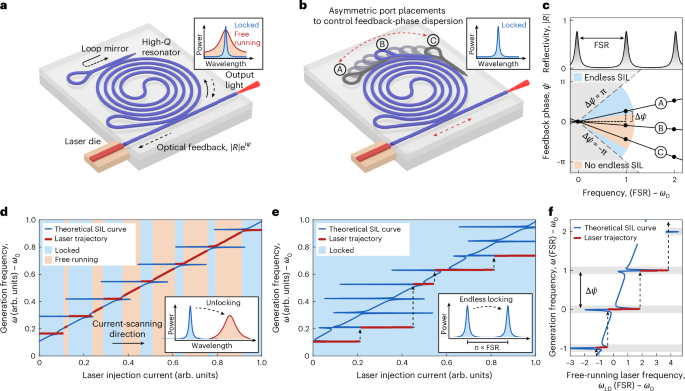
The EPFL team instead engineered the feedback-phase dispersion, controlling how the phase of back-reflected light changes between consecutive resonances. Resonator port placement and overlapping locking ranges are used to force the laser to move between locked states as injection current changes rather than entering a free-running region. The researchers call the approach endless self-injection locking and define it by maintaining a linewidth reduction factor above 1,000, or a stabilisation coefficient above 30, across the complete drive-current range.
The control parameter is comparatively tolerant of lithographic placement because the relevant phase dispersion changes on the scale set by the resonator free spectral range rather than at an optical wavelength. The paper notes that a typical 1GHz FSR corresponds to a much larger spatial scale, reducing the placement precision that would otherwise make the concept difficult to manufacture repeatably.
The experimental system couples an off-the-shelf distributed-feedback laser operating around 1,548nm to a silicon nitride photonic integrated circuit containing a spiral microresonator. A drop port and Sagnac loop mirror provide controlled optical feedback to the diode. The resonator was fabricated on a 200nm-thick silicon nitride platform using a wafer-level subtractive process based on deep-ultraviolet lithography.
Frequency agility is provided by monolithically integrated piezoelectric actuators. The researchers demonstrated mode-hop-free chirps across 1.5GHz while retaining the narrow-linewidth locked state, alongside output power of several milliwatts. Applications such as coherent ranging, fibre sensing, optical metrology, atomic clocks, and coherent communications often require both low frequency noise and controlled tuning, making lock stability during frequency movement as important as static linewidth.
Removing continuous phase stabilisation can also reduce the electronics surrounding the optical source. Detectors, control loops, calibration routines, and feedback processing add board area, power consumption, assembly steps, and operating complexity even when the photonic circuit itself is compact. Engineering more of the locking behaviour into the resonator geometry moves part of that control burden into a lithographically defined structure that can, in principle, be reproduced across devices.
The work sits alongside efforts to make integrated photonic systems easier to manufacture at scale. Recent foundry work combining indium phosphide with silicon photonics addresses the integration of active light sources with passive photonic circuitry. The EPFL research tackles a different constraint inside the laser architecture by reducing its dependence on an active stabilisation loop.
Drive-current robustness is particularly important because semiconductor lasers are commonly tuned electrically during normal operation. A design that remains locked while current moves across its operating range avoids repeated lock acquisition and reduces sensitivity to operating-point drift, although the packaged system will still have to manage temperature and optical-coupling changes.
The result remains a research demonstration rather than a qualified production device. Packaging, environmental stability, fabrication yield, long-term reliability, and scalable assembly still have to be established, and those factors can alter optical feedback conditions after the laboratory setup is replaced by a product package. The paper nevertheless identifies feedback-phase dispersion as a design parameter that can be engineered rather than continuously corrected during operation.
The authors expect the principle to extend beyond the demonstrated silicon nitride system as suitable low-loss resonators become available at other wavelengths. If the locking behaviour survives process variation and packaged operation, integrated laser designers would gain a route to hertz-level coherence and agile tuning with fewer active stabilisation functions around the source.