IN Brief:
- Melexis has launched the MLX81119, an 18-channel LIN RGB LED controller with integrated DC/DC power conversion.
- The device supports up to six RGB LEDs, 16-bit PWM control, local voltage optimisation, diagnostics, and ASIL B-capable implementations.
- The design reduces external power-stage complexity in dense automotive lighting modules where board area and heat are under pressure.
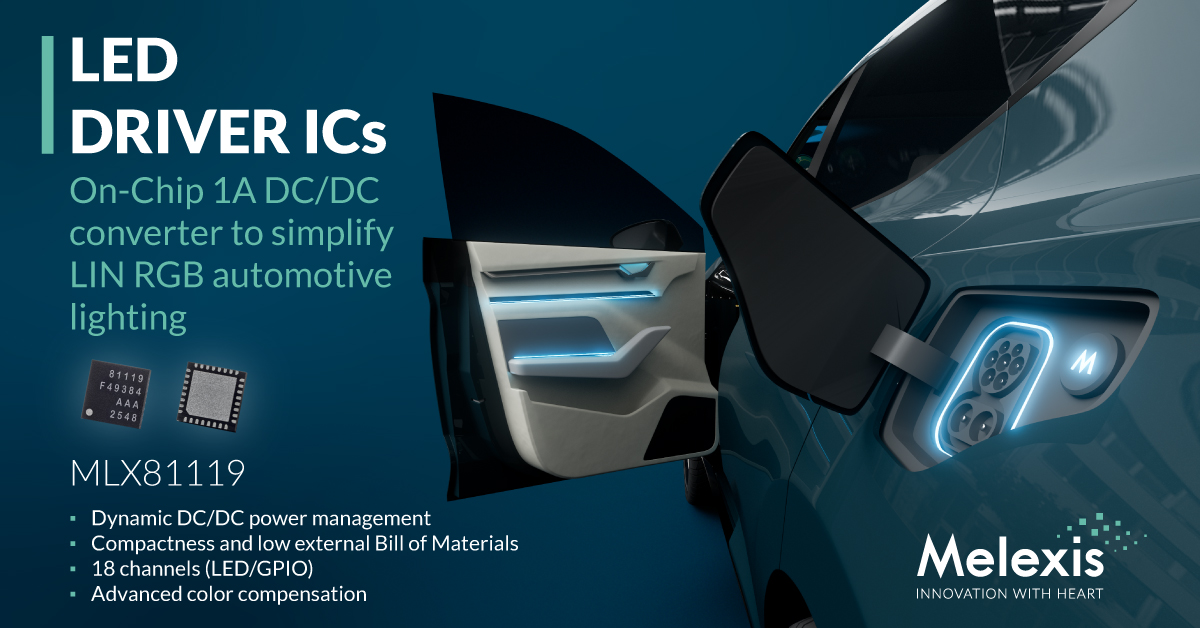
Melexis has introduced the MLX81119, an 18-channel LIN RGB LED controller with an integrated 1A DC/DC converter for automotive interior and exterior lighting systems.
The device generates LED supply voltage locally on-chip, reducing the need for an external DC/DC controller and associated passive components. In densely packaged vehicle lighting modules, that integration can lower power dissipation, simplify layout, reduce thermal stress, and release board area in locations such as door panels, dashboards, centre consoles, and charge-port lighting assemblies.
The MLX81119 provides 18 low-side current sources configurable up to 60mA and can drive up to six RGB LEDs per device. Independent 16-bit PWM control supports smooth colour transitions and lighting animations, while direct and indirect temperature sensing helps maintain colour-point stability across automotive operating conditions.
Its integrated DC/DC converter generates a programmable local LED supply voltage between 2.5V and 6V. Instead of feeding the LED stage from a fixed external rail and dissipating excess voltage as heat, the controller can adapt the LED supply to the active colour mix and load condition, which becomes more valuable as lighting functions spread across more of the vehicle.
The device also includes a complete LIN system with transceiver and protocol handler, supporting LIN 2.x and SAE J2602 compliance. Developed according to ISO 26262, the controller can support ASIL B implementations depending on the wider system safety concept. It is supplied in a 5mm x 5mm QFN32 package and operates from a 5.5V to 28V supply.
Automotive lighting has moved far beyond simple illumination. Ambient lighting, animated exterior signatures, charging indicators, safety cues, and human-machine interface functions are now part of the wider electronics architecture, adding distributed lighting nodes that each bring power, communication, diagnostics, and thermal-management requirements.
That pressure is visible across wider vehicle electronics design. ROHM’s configurable automotive SoC power design reflects the same engineering direction: more of the power-stage burden is being absorbed into compact devices because vehicle platforms have limited tolerance for additional board area, cabling, and heat.
The MLX81119 is therefore more than an LED driver with a higher integration count. It reduces the number of supporting components around a lighting node and gives module designers a cleaner route to manage heat, voltage, diagnostics, and colour control inside smaller assemblies. As automotive lighting becomes a distributed electronics network rather than a decorative feature, that level of integration is becoming central to manufacturable design.