
IN Brief:
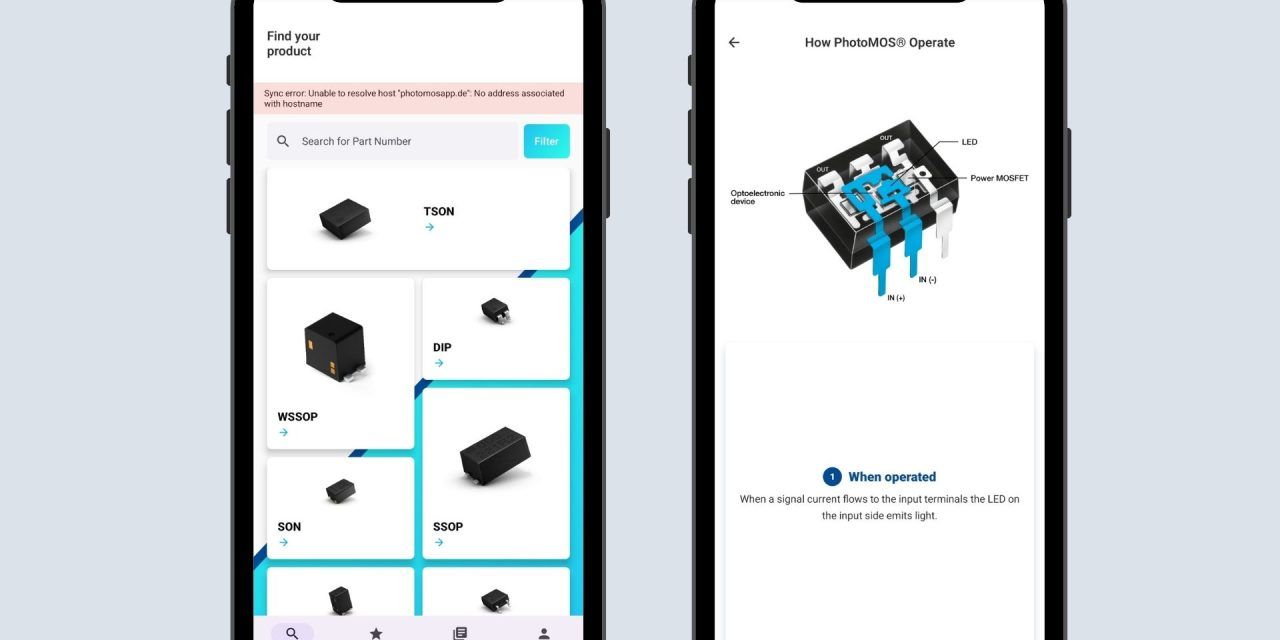
- Panasonic Industry Europe’s PhotoMOS selector app is now available for Android as well as iOS.
- The app gives access to more than 400 photo-coupled MOSFET relay types.
- Functions include device search, favourites, datasheet downloads, sample requests, and MOSpedia design guidance.
Panasonic Industry Europe has made its PhotoMOS selector app available for Android devices, extending access beyond iOS for engineers selecting photo-coupled MOSFET relays.
The app gives access to more than 400 PhotoMOS relay types and is designed to support component selection across a wide range of applications. Users can search for a device matching application requirements, save results as favourites, download datasheets, and request samples directly through the tool.
The integrated MOSpedia section provides guidance on specifications, features, benefits, and design-in questions. Panasonic says the app has already been downloaded more than 4,000 times since launch, and the Android release opens the same selection workflow to a wider base of users.
PhotoMOS relays are used where solid-state switching, galvanic isolation, low leakage, long life, compact size, and silent operation are required. Typical applications include test equipment, industrial controls, measurement systems, battery management, building automation, medical devices, semiconductor equipment, and power monitoring. The selection process can become complicated because electrical ratings, on-resistance, output capacitance, leakage, package size, load type, isolation, and switching behaviour all have to be matched to the circuit.
A selector app does not replace detailed engineering review, but it can reduce early-stage friction. Component families with hundreds of variants can slow design work when developers have to move between catalogues, PDFs, parametric tables, application notes, and sample channels. A mobile tool is useful during concept work, distributor discussions, customer meetings, and design reviews, where a shortlist may need to be assembled quickly before detailed validation begins.
Suppliers are adding more software layers around component families that were once navigated mainly through data sheets and sample requests. Design schedules are under pressure, while qualification constraints, lifecycle expectations, and second-source planning are becoming more demanding. Tools that organise selection criteria and surface application guidance earlier can reduce the risk of choosing a component that later proves difficult to source, package, or validate.
Component access is also becoming more closely tied to selection support. Mouser’s expanded industrial automation range brought together connectivity, power, sensing, control, cable management, and instrumentation around machinery and infrastructure needs. Panasonic’s app sits at a narrower product-family level, but the same design pressure is visible: engineers need faster movement from requirement to credible component shortlist.
Isolation components are also being pulled into higher-voltage and more densely packaged systems. Vishay’s optocoupler for 800V EV systems highlights how isolation devices are now integral to safety, monitoring, and high-voltage architectures. PhotoMOS relays serve different switching functions, but they belong to the same class of component where isolation and reliability have to be specified with care.
The Android release broadens the reach of Panasonic’s selection workflow. Its value will be measured by how quickly the app can narrow a large relay range to realistic candidates while still keeping datasheets, samples, and expert review close to the design process. Convenience is useful in component selection only when it preserves technical discipline.

