IN Brief:
- RZ/G3L and RZ/G3SE use dual- or quad-core Cortex-A55 application processing alongside a 200MHz Cortex-M33.
- Interfaces include PCIe Gen2, dual TSN-capable Gigabit Ethernet, USB, CAN FD, and DDR4 or LPDDR4 memory support.
- Pin compatibility allows one PCB architecture to span graphics-rich HMI equipment and simpler IoT edge or gateway products.
Renesas Electronics has expanded its RZ/G family with the RZ/G3L and RZ/G3SE, two pin-compatible 64-bit microprocessors intended to cover industrial HMI and IoT edge systems using a common board architecture.
Both devices combine dual- or quad-core Arm Cortex-A55 application processors running at up to 1.2GHz with a Cortex-M33 core operating at up to 200MHz. The arrangement allows Linux applications to run on the A55 cluster while lower-level control or real-time functions can be separated onto the microcontroller-class core.
The principal difference between the two devices is their graphics and video capability. RZ/G3L incorporates an Arm Mali-G31 GPU and H.264 video codec for HMI applications requiring more demanding graphics, while RZ/G3SE targets gateways and equipment with simpler display requirements.
Maintaining pin compatibility allows manufacturers to use the same PCB across products with different processing requirements. A richer HMI variant can use the GPU-equipped part while a gateway or control product can move to the simpler processor without redesigning memory, power, and peripheral connections around a different package footprint.
The devices include PCIe Gen2 for system expansion and two Gigabit Ethernet interfaces supporting time-sensitive networking. That gives industrial equipment a route to deterministic or synchronised Ethernet communication while retaining another high-speed interface for peripherals such as communications modules or external accelerators.
USB 2.0, SD interfaces, CAN FD, and other conventional embedded peripherals are also included. External memory support covers DDR4 and LPDDR4, with error correction provided for the DDR interface and on-chip memory.
Security functions include secure boot, secure firmware update, hardware cryptography, a true random-number generator, Arm TrustZone, secure debug, and tamper detection. Those functions support equipment expected to remain connected and field-upgradable over long operating lives, where firmware authenticity and isolation become part of the product architecture rather than optional software features.
Renesas has also focused on standby consumption. The third-generation RZ/G architecture is specified for power consumption in the 1mW class during deep standby while retaining the Linux system in external memory. That allows equipment to reduce power consumption without discarding the operating-system state and following a complete cold boot when it wakes.
The approach suits terminals, gateways, and controllers that spend significant periods waiting for events but must return to operation quickly. It also gives product developers another power-management option between continuously running the application processors and fully shutting down the system.
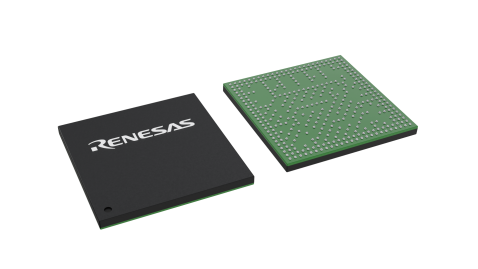
Industrial temperature operation extends from -40°C to +125°C junction temperature. The processors are available in 14mm-square 400-pin and 17mm-square 368-pin LFBGA packages, allowing the family to serve different PCB and interface requirements while retaining the common architecture.
Long-term software maintenance is supported through Renesas’ Verified Linux Package, which is compliant with the Civil Infrastructure Platform. That becomes relevant in industrial equipment with deployment lives substantially longer than those of consumer electronics, where maintaining kernel and security support can become a larger cost than initial software development.
Renesas is supporting the family with development boards, GUI software, operating-system partners, system-on-module suppliers, and an evaluation platform based on a SMARC v2.1 module and carrier board. Both processors entered mass production with the September launch.
Pin compatibility is particularly useful where an equipment supplier maintains several models from the same product design. Board redesign brings new layout, signal-integrity, thermal, EMC, and validation work even when the software function changes only modestly. Keeping the package and peripheral architecture aligned allows more of that engineering to be reused.
RZ/G3L and RZ/G3SE therefore address scaling from both directions: processing capability can be increased for graphics-heavy equipment without forcing every system onto the higher specification, while simpler designs retain the same software and hardware foundation. The commercial advantage will depend on how broadly that common platform can be maintained as customers add their own displays, networking, security, and real-time functions.