IN Brief:
- Vicor is purchasing a 334,000ft² building on 66 acres in Merrimack and 54 acres of land in Hooksett.
- The properties will support ChiP Fab-2 and Fab-3, with a combined planned footprint approaching one million square feet.
- Initial deployment at Fab-2 carries an approximately one-year lead time as the existing Andover fab nears capacity.
Vicor is acquiring two sites in New Hampshire for additional ChiP power-module manufacturing capacity as utilisation at its existing Andover, Massachusetts, fab approaches its limit.
The company is purchasing a 334,000ft² building on 66 acres in Merrimack and a separate 54-acre site in Hooksett. The properties are intended to support ChiP Fab-2 and Fab-3, with Vicor putting the combined planned footprint at nearly one million square feet.
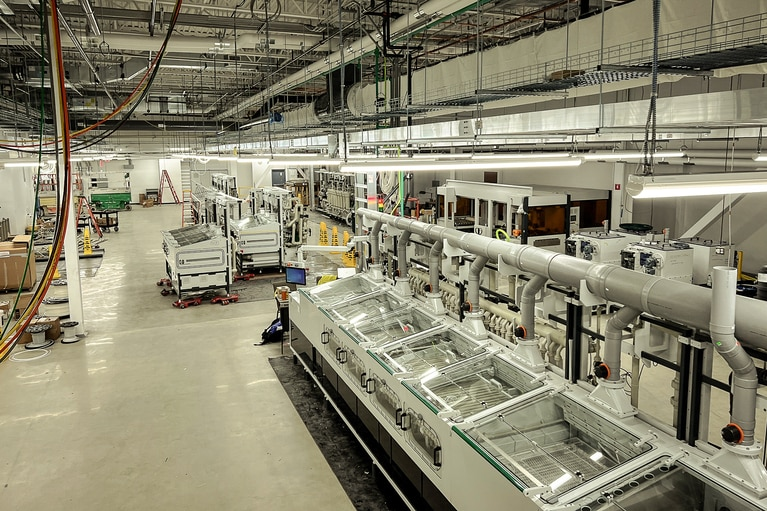
Its existing ChiP Fab-1 occupies 320,000ft² on 16 acres in Andover. Vicor says utilisation is approaching capacity, while initial deployment at Fab-2 carries an approximately one-year lead time.
The expansion is tied to Vicor’s high-density power modules and its Vertical Power Delivery architecture, which the company is targeting at AI accelerators and other high-performance computing equipment. The electrical problem becomes more severe as processor power rises and supply voltages at the point of load remain low.
Delivering a given amount of power at a lower voltage requires more current. Hundreds of amperes flowing through a PCB create resistive losses, voltage drop, substantial copper requirements, and heat, particularly across the final distance between a regulator and an accelerator package.
Vicor’s architecture uses higher-voltage distribution closer to the load before the final conversion stage, reducing the distance over which the highest currents have to travel. Its ChiP packaging is designed to increase power density and place conversion hardware in locations that conventional multiphase regulator arrangements may struggle to occupy.
Higher demand for that architecture translates directly into a manufacturing requirement. The modules need packaging, assembly, process control, automated handling, and electrical testing capacity; increasing accelerator shipments cannot be supported indefinitely by raising utilisation inside an existing factory whose production equipment is already approaching its planned limit.
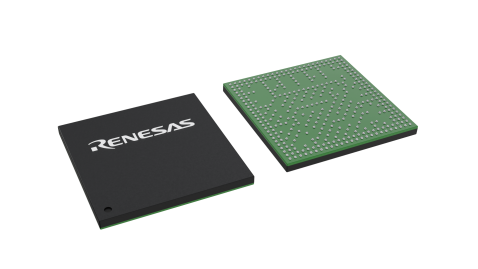
Fab-1 was built around Vicor’s modular power-component manufacturing processes rather than conventional front-end semiconductor wafer fabrication. The ChiP designation refers to the company’s Converter housed in Package platform, which integrates power conversion into compact modules intended to provide predictable electrical and thermal performance.
The Merrimack acquisition includes an existing industrial building, while the Hooksett purchase is land intended for the subsequent Fab-3 build-out. Vicor has not disclosed the eventual equipment configuration, module output, capital cost, or commissioning schedule for the complete expansion, so floor area cannot be translated directly into production volume.
Its announcement does, however, establish the first deployment horizon for Fab-2 at around a year. That is a comparatively near-term capacity measure for power electronics serving an AI hardware market where platform power requirements have been increasing between processor generations.
Additional sites also give Vicor more physical separation between production operations. The company cites supply-chain predictability and US sourcing among the reasons for the expansion, alongside its patent-licensing business for high-density power components and power-distribution architectures.
Power delivery has become a more visible system constraint as accelerator racks have moved into the tens and hundreds of kilowatts. Processor, memory, and networking performance receive most of the attention, but the power architecture has to deliver the required current within strict efficiency, thermal, and space limits before any of that compute capacity can be used.
The production response is therefore increasingly specialised. High-density modules have to combine semiconductor devices, substrates, interconnects, thermal paths, and packaging structures in a repeatable manufacturing process, making capacity expansion dependent on equipment and process capability rather than factory floor area alone.
Vicor has not given a completion date for Fab-3, and the nearly one-million-square-foot figure describes the planned combined footprint rather than installed output. Fab-2 is the nearer operational step, with its one-year lead time beginning as the existing Andover plant nears full utilisation.
The two New Hampshire acquisitions give Vicor the physical space for a much larger US production network. The engineering test will be whether that additional capacity can be brought online quickly enough to track changing power-delivery requirements as AI processors continue to increase both package power and current density.