
IN Brief:
- ROHM has launched R60xxXNx and R60xxWNx 600V Super Junction MOSFET series.
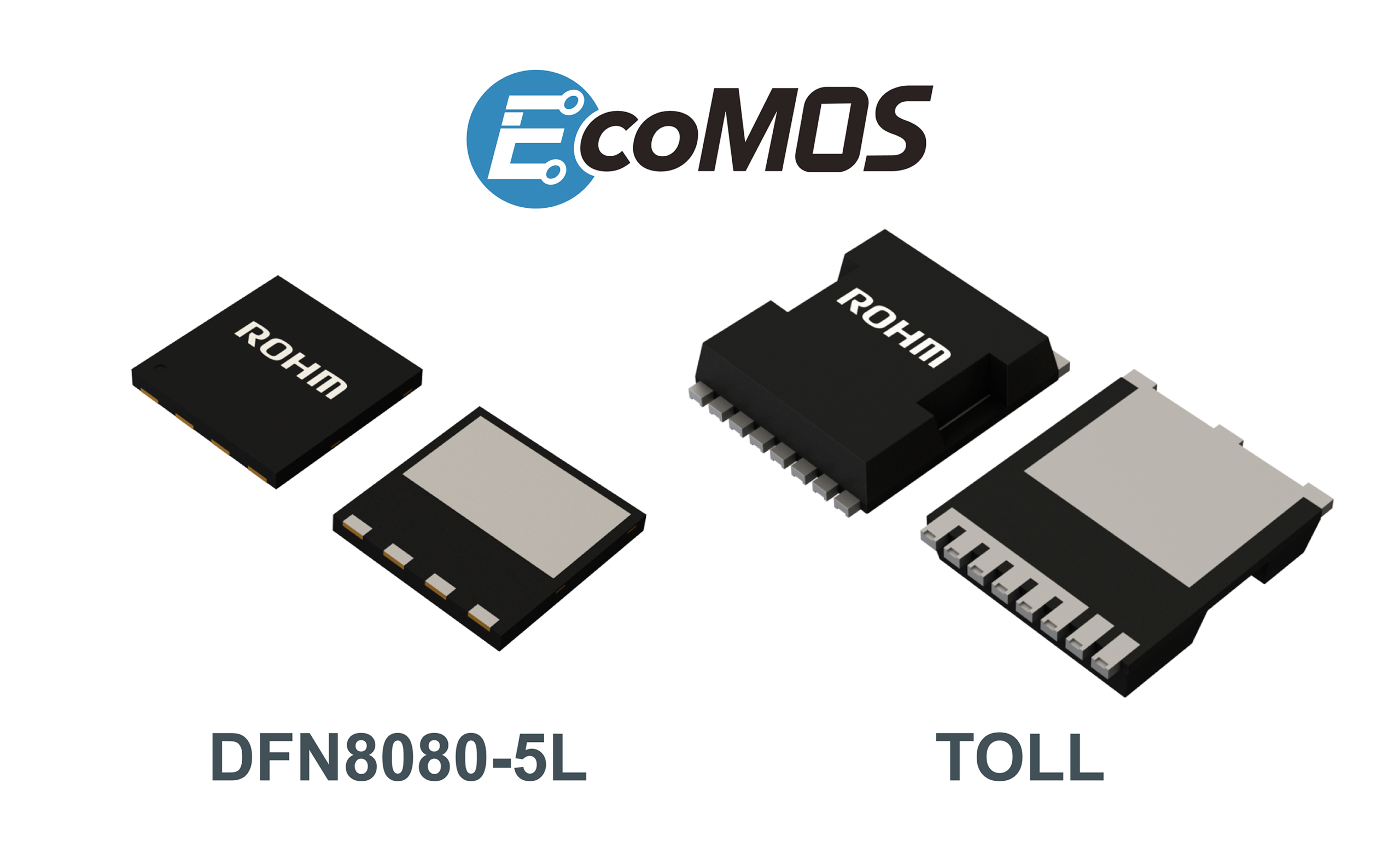
- The devices add DFN8080-5L and TOLL surface-mount package options.
- Target applications include AI server power supplies, data centres, industrial equipment, motors, and inverters.
ROHM has launched new 600V Super Junction MOSFETs in surface-mount packages, expanding its R60xxXNx and R60xxWNx series for high-density power supply designs.
The new devices add DFN8080-5L and TOLL package options to ROHM’s 600V Super Junction MOSFET portfolio. The DFN8080-5L package measures 8.0mm by 8.0mm by 0.85mm, while the TOLL package measures 11.68mm by 9.9mm by 2.3mm. Both are intended for designs that need compact, low-profile power devices with strong thermal performance.
Target applications include power supplies for AI servers and data centres, industrial and consumer equipment using LLC, PFC, and flyback topologies, and motor or inverter applications such as fans and AC servos. Mass production began sequentially in June 2026, with selected TOLL package devices available through online distributors including DigiKey.
The R60xxXNx series covers high-speed switching requirements, while the PrestoMOS R60xxWNx series is intended for applications where high-speed recovery characteristics are required. The lineup includes 21 models in the R60xxXNx series and 11 in the R60xxWNx series, giving designers a choice between compatibility-oriented devices and parts aimed at lower-loss operation.
ROHM has set the gate threshold voltage range at 3V to 5V, matching drive conditions widely used in standard products. Improved admittance characteristics are intended to increase versatility and reduce loss compared with earlier R60xxYNx and PrestoMOS R60xxVNx devices. Market-common footprints are also intended to simplify replacement in existing power supply circuits and support second-source evaluation.
The launch sits within a broader power semiconductor push from the company. ROHM’s top-side cooling SiC package and its work with AIXTRON to scale GaN production both reflect the same pressure for higher efficiency, higher power density, and more difficult thermal management. Microchip’s higher-voltage SiC modules show the same trend at a different voltage and application level.
AI server power supplies are one of the clearest drivers. Data-centre power demand is rising with accelerator deployment, and each conversion stage has to reduce losses while fitting into tighter mechanical and thermal envelopes. Super Junction MOSFETs remain important in AC/DC and high-voltage conversion stages where silicon devices can still offer a strong cost-performance balance.
Surface-mount packaging is part of that shift. Through-hole packages remain useful in many high-power designs, but automated assembly, lower profile, shorter interconnects, and improved board-level integration are increasingly attractive. A compact package is valuable only when heat can be removed effectively, so package thermal design now carries a larger share of the power electronics value proposition.
Second sourcing has become a design requirement rather than a procurement preference. Recent allocation cycles have made engineers and buyers more cautious about single-supplier exposure, package dependency, and long replacement cycles. A MOSFET with a common footprint and familiar drive requirements is easier to evaluate in existing designs, although electrical behaviour still has to be validated under real switching, thermal, EMI, and load conditions.
Power supply designers still need to compare switching loss, conduction loss, reverse recovery behaviour, gate charge, thermal resistance, package parasitics, and layout sensitivity. A nominally compatible MOSFET can change efficiency, EMI behaviour, snubber requirements, or thermal distribution if substituted without careful testing.
ROHM’s new 600V surface-mount devices strengthen its silicon MOSFET position for high-density power supplies while the company continues to expand SiC and GaN activity for higher-performance conversion. The result is a broader power semiconductor portfolio aimed at the practical design space between cost, efficiency, thermal performance, and supply resilience.

