IN Brief:
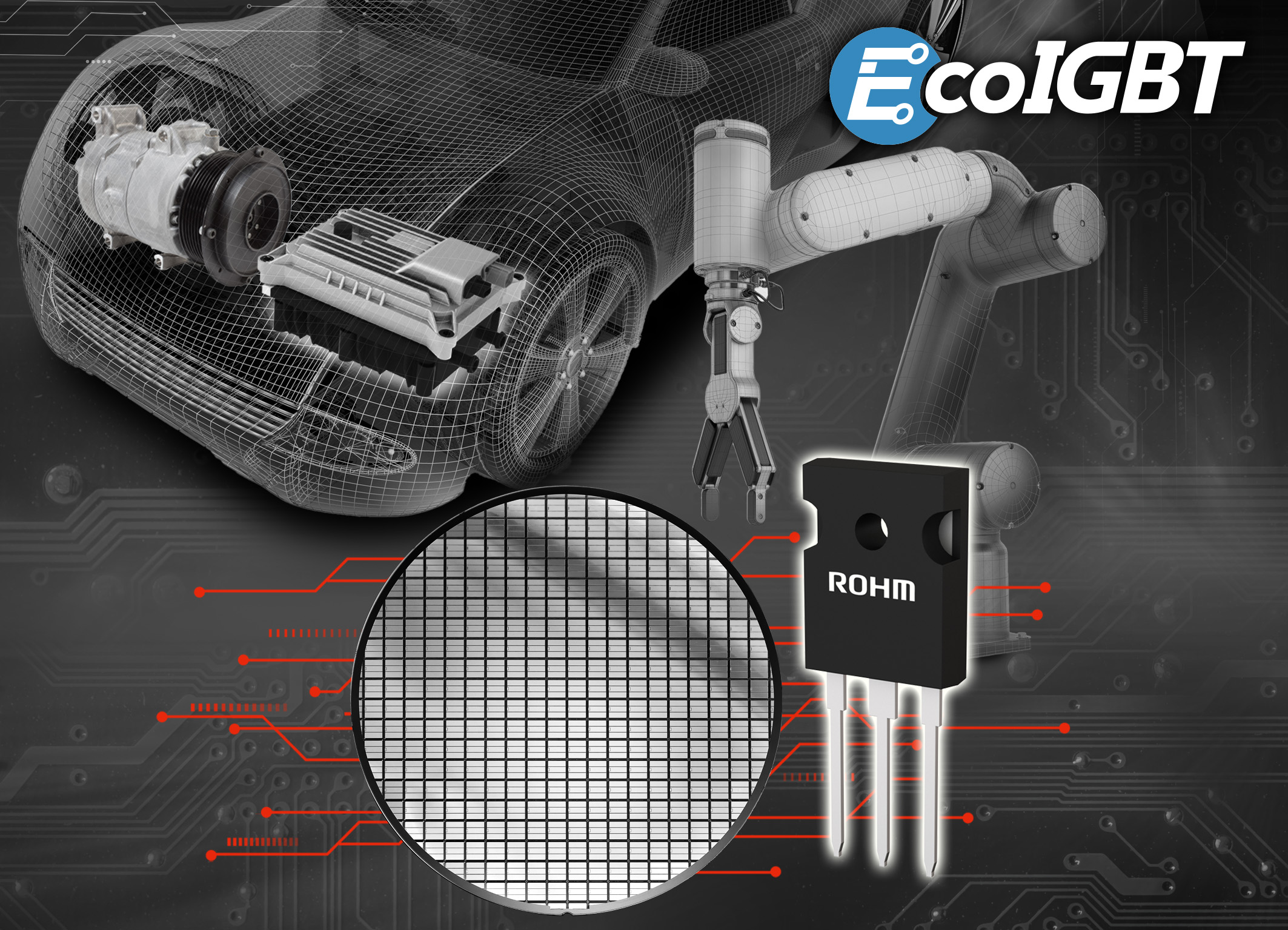
- ROHM's fourth-generation 650V IGBTs target automotive compressors, HV heaters, and industrial inverter applications.
- The family combines VCE(sat) down to 1.55V with a specified 7µs short-circuit withstand time at 25°C.
- Packaged and bare-wafer products are available, with four-lead, TO-263L, and top-side-cooled variants planned or under development.
ROHM has expanded international availability of its fourth-generation 650V automotive IGBTs, bringing packaged and bare-wafer devices to a wider market for electric compressors, high-voltage heaters, and industrial inverter applications. The devices combine reduced conduction loss with short-circuit withstand capability and automotive qualification.
The fourth-generation family uses a redesigned device structure and edge termination intended to increase current density while reducing conduction and switching losses. ROHM specifies a collector-emitter saturation voltage, VCE(sat), of 1.55V for devices in the 650V-class family and a short-circuit withstand time of 7µs at a junction temperature of 25°C.
Those characteristics address a familiar IGBT design trade-off. Reducing conduction loss can make short-circuit survival more difficult, yet inverter and heater circuits need enough withstand time for their protection systems to detect excessive current and interrupt it. A 7µs withstand specification therefore affects the complete protection design, including gate drive, sensing, control logic, and the time required to bring the switching device into a safe state.
ROHM has qualified the automotive devices to AEC-Q101 and is supplying 12 TO-247N packaged products in the RGAxxTS65HR and RGAxxTS65EHR series, alongside 10 SG83xxWN bare-wafer products. A further 12 devices in TO-247-4L packaging are under development. The company also plans TO-263L and top-side-cooled surface-mount versions as it extends the family into more compact power assemblies.
The intended vehicle applications sit in a part of the powertrain where silicon IGBTs remain commercially relevant despite growing use of silicon carbide. SiC has gained ground in high-power traction inverters, particularly on higher-voltage vehicle architectures, but auxiliary systems such as electric compressors and high-voltage coolant or PTC heaters operate under different switching-frequency, power-density, and cost constraints.
A 650V silicon IGBT can therefore remain the more economical choice when the system-level efficiency gain available from SiC does not justify its additional cost. Semiconductor material alone does not determine the optimum switch: gate-drive requirements, thermal design, switching frequency, package parasitics, reliability targets, and the cost of the surrounding power stage all affect the final selection.
Industrial motor drives present the same calculation across a wider range of operating conditions. Motors, compressors, and general-purpose inverters are manufactured at numerous power levels and duty cycles, with component choices shaped by the required switching frequency, cooling arrangement, short-circuit tolerance, package format, and overall drive cost. Incremental improvements in IGBT loss and current density can still support smaller cooling systems or greater output from an existing mechanical envelope.
The availability of bare wafers is also relevant to manufacturers developing their own power modules. Discrete TO-247 devices suit conventional inverter construction, while bare die allow module manufacturers to optimise interconnect, substrate, thermal path, and current sharing around the switching device. The planned top-side-cooled variants extend that packaging flexibility into surface-mount assemblies where heat can be removed through a dedicated upper thermal path.
ROHM is supporting the family with SPICE and PLECS models for circuit simulation. Those tools are important because VCE(sat) alone does not describe switching energy, temperature dependence, diode behaviour, gate-charge requirements, or losses across a complete operating cycle. Engineers still need to model gate resistance, stray inductance, cooling, switching frequency, and protection timing in the intended topology.
The 25 August English-language announcement follows earlier regional disclosures of the same fourth-generation architecture, while ROHM has stated that mass production began in May. The present development is therefore wider international availability rather than the first disclosure of the devices. That distinction avoids treating a regional release cycle as multiple independent product launches.
TO-247N products and selected bare-wafer devices are available, with distribution including DigiKey and Farnell. The next engineering milestones will come from the four-lead TO-247 variants and planned surface-mount packages, where lower device loss has to be translated into improved thermal and electrical performance at assembly level. Silicon carbide may attract the larger headlines in high-voltage traction systems, but silicon IGBTs continue to develop where mature manufacturing, protection margin, and cost remain central to the design.