
IN Brief:
- ROHM has developed the ML7670 receiver and ML7671 transmitter chipset for NFC-based wireless power transfer.
- The chipset targets compact wearables, including smart rings, smart bands, smart pens, and other small battery-powered devices.
- The devices support miniature power-transfer designs as wearable electronics move beyond watch-sized formats.
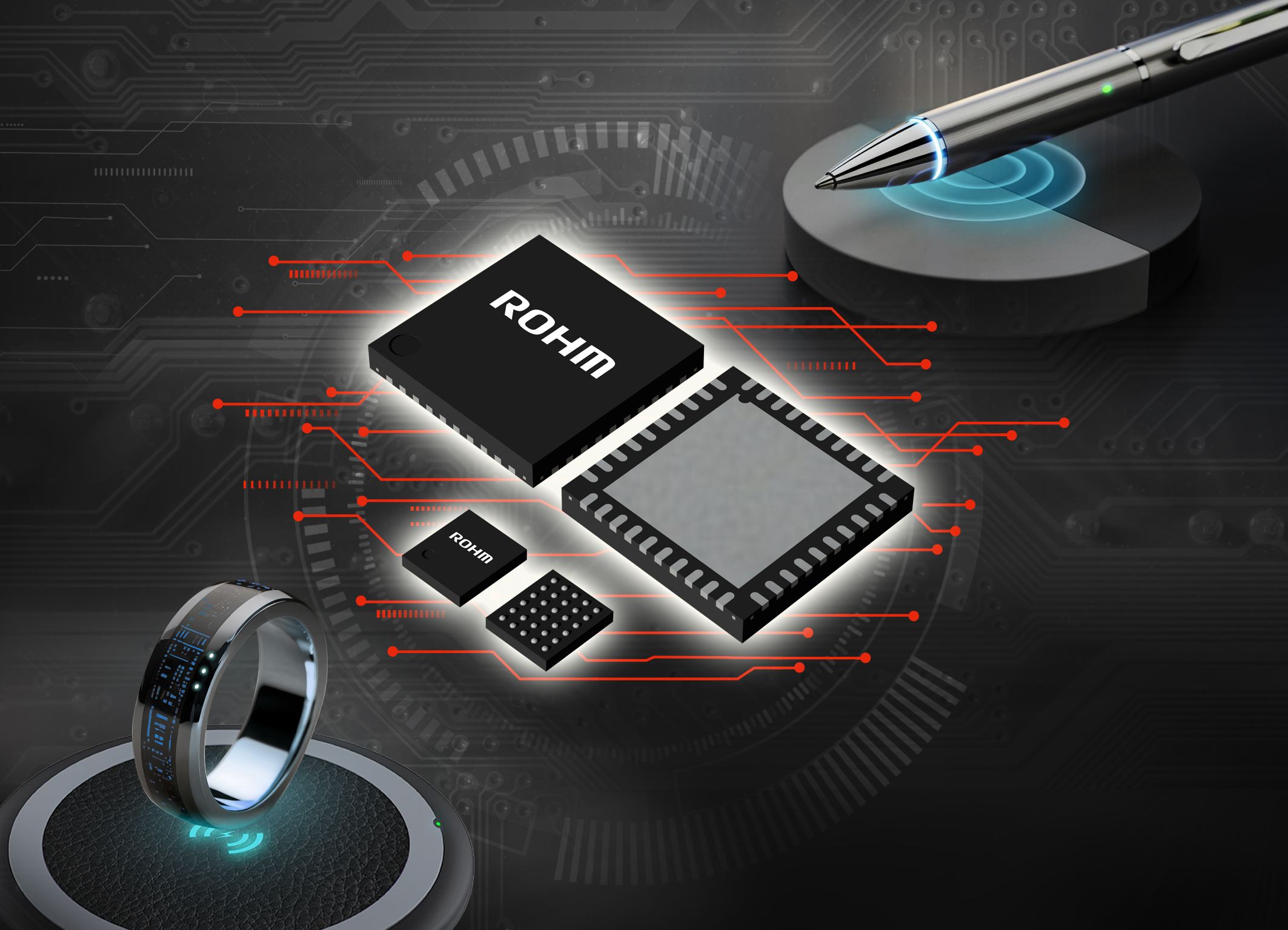
ROHM has developed an ultra-compact wireless power supply IC chipset for small wearable devices, combining the ML7670 receiver and ML7671 transmitter in a Near Field Communication-compatible charging solution.
The chipset is aimed at compact products such as smart rings, smart bands, smart pens, and other peripherals where conventional wired charging is difficult and Qi-style wireless charging is constrained by coil size. ROHM has specified maximum power transfer at 250mW, placing the chipset below its earlier 1W ML7660/ML7661 devices and closer to the requirements of ring-shaped and miniature wearable devices.
The ML7670 receiver IC is supplied in a 2.28 × 2.56 × 0.48mm 30-pin WL-CSP package, while the ML7671 transmitter uses a 6.0 × 6.0 × 0.8mm 40-pin WQFN package. ROHM has integrated peripheral components including switching MOSFETs required to supply power to the charging IC, reducing the number of external components and the required mounting area.
The receiver achieves a maximum power transfer efficiency of 45% in the 250mW low-output range. ROHM has also embedded the firmware required for wireless power delivery within the IC, removing the need for a host microcontroller for power-transfer control. The system is compliant with NFC Forum WLC 2.0, allowing power transfer while maintaining compatibility with the broader NFC wireless power ecosystem.
The chipset is already in mass production and has been adopted in SOXAI RING 2, a sleep-monitoring ring from Japanese wearable developer SOXAI. Evaluation boards and reference designs are available to support integration.
Very small wearables impose tight mechanical and electrical constraints. A smartwatch has enough surface area and battery volume to support established charging architectures. A smart ring has far less space for the coil, battery, control electronics, sealing, and mechanical structure. The product still has to remain comfortable, durable, and resistant to daily wear.
NFC-based charging addresses part of that constraint by operating at 13.56MHz, allowing antenna miniaturisation compared with lower-frequency power-transfer approaches. The available power level is lower, placing more pressure on efficiency, thermal behaviour, alignment tolerance, and system-level power budgeting.
The removal of a host MCU for wireless power control simplifies the board architecture in a device category where every square millimetre is contested. Reducing external MOSFETs and control components can also improve manufacturability, reliability, and assembly yield, particularly in compact products with curved or unconventional mechanical formats.
Wearable electronics are moving from wrist-worn devices into rings, patches, earbuds, pens, and sensorised accessories. These products demand persistent sensing while leaving little room for power management circuitry. Charging becomes part of the user-experience problem, but it is rooted in electronics design: moving enough energy into a tiny sealed device without adding connectors, large coils, excess heat, or a bulky charging accessory.
As wearable devices become smaller and more specialised, power-transfer ICs will increasingly define what form factors are practical. ROHM’s ML7670/ML7671 chipset approaches charging from the constraints of miniature devices rather than adapting a larger wireless power architecture downward.

