IN Brief:
- Rutronik is supplying TDK Micronas HAL 13xy factory-programmable 3D Hall-effect switch sensors.
- The family supports speed and direction sensing with quadrature outputs independent of air gap and pole spacing.
- Compact motor, actuator, robotics, and automotive designs are increasing demand for flexible magnetic sensing.
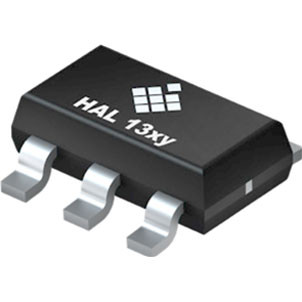
Rutronik is now supplying the TDK Micronas HAL 13xy family of factory-programmable 3D Hall-effect switch sensors for compact motor-control and encoder applications.
The devices capture speed and position data in systems where mechanical tolerances, magnet distance, and installation space can vary. Target applications include power seats, tailgate drives, window lifters, steering-column adjustment, valve-position sensing, robotics, smart-home actuators, and industrial automation equipment.
The HAL 13xy family uses TDK Micronas 3D Hall technology to measure orthogonal magnetic field components. Integrated quadrature outputs provide a 90° phase shift, with the phase relationship independent of air gap and magnet pole spacing. This gives designers more freedom in sensor and magnet placement compared with conventional Hall switch implementations.
The devices operate from 3V to 24V and are supplied in a compact five-pin SOT23 package. Protection and reliability features include continuous built-in self-test, short-circuit protection, thermal protection, reverse-voltage protection up to -18V, 40V load-dump robustness, AEC-Q100 qualification, and SEooC ASIL-B readiness under ISO 26262.
Compact electromechanical systems are carrying more sensing and control functions while available packaging volume continues to shrink. Vehicles, industrial machines, robots, and small actuators all need reliable position and speed feedback across tolerance stack-ups, vibration, temperature variation, wiring constraints, and EMC exposure.
Magnetic sensing is increasingly tied to mechanical design strategy. A sensor that requires a tightly controlled air gap or narrow magnet placement window can force additional housing complexity, calibration effort, and production control. Preserving phase relationship across installation variation reduces that sensitivity, particularly where a motor or actuator platform must support several product variants.
Distributed sensing is expanding in parallel across industrial systems, with LoRa design resources for industrial IoT showing how more field devices are being connected for monitoring and control. HAL 13xy sits closer to the actuator and motor-control layer, but the same move towards richer machine data is pulling sensing functions into smaller, more qualified devices.
Functional safety is also becoming harder to separate from everyday sensor selection. As more actuation functions are electronically controlled, sensor faults can alter system behaviour rather than simply remove a monitoring signal. Built-in self-test and ASIL-oriented development support provide a route to more structured diagnostics in automotive, robotic, and industrial designs.
The automotive sensor layer is moving in a similar direction at higher data rates, with radar semiconductor production showing how sensing functions are being integrated into more capable device platforms. HAL 13xy addresses lower-bandwidth motion and position sensing, but the underlying trend is consistent: sensing is becoming more integrated, better qualified, and more tightly linked to system behaviour.
In compact motor control, many design limits come from installation detail rather than control algorithms. Wiring, magnet geometry, EMC, temperature drift, and mechanical tolerance determine whether a design remains repeatable in production. The HAL 13xy family gives engineers another qualified option for capturing speed and direction data where the sensor must work inside tight mechanical and electrical boundaries.