IN Brief:
- Same Sky introduced 18 CMM MEMS microphone models.
- Available options include analogue/PDM outputs, top/bottom ports and very low current.
- Selection depends on acoustic sensitivity, SNR, placement and integration constraints.
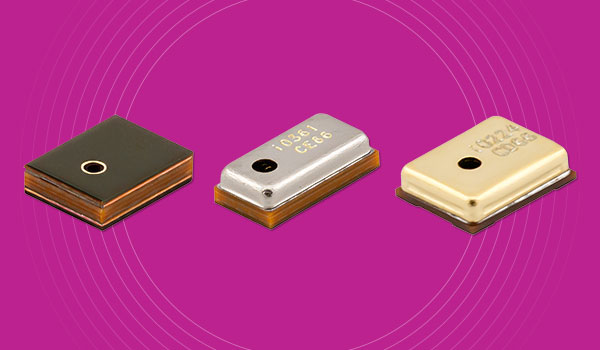
Same Sky has added 18 models to its CMM microelectromechanical-system microphone portfolio, expanding the combinations of package dimensions, acoustic performance and electronic output available to equipment designers. The family includes analogue-output variants and digital pulse-density-modulation devices, with top-port and bottom-port package arrangements. The smallest stated package measures 2.75 by 1.85 by 0.90 millimetres. The manufacturer lists selected devices with current consumption down to 80 microamps, but not every variant shares that value or the other extremes of the published specifications.
MEMS microphones integrate a miniature sensing structure with electronic circuitry that converts changes in sound pressure into a usable signal. Compared with traditional electret constructions, the integration can support compact surface-mount assembly and automated production. Designers still have to choose between electrical and acoustic trade-offs. A microphone that fits the board may prove unsuitable if the desired response is changed by enclosure geometry, an improperly aligned acoustic port or vibrations transmitted through the housing.
The product range spans sensitivity values from minus 42 to minus 26 decibels and manufacturer-reported signal-to-noise ratios between 57 and 67dBA. These figures characterise different versions and conditions, rather than a single component that offers every best-case specification. A higher signal-to-noise ratio can be attractive for voice pickup in a quiet environment, while a specific application may prioritise power consumption or tolerance. Engineers need to match sensitivity to the front-end gain and available headroom to avoid clipping at high sound levels.
Digital PDM output shifts part of the signal-processing arrangement to a digital interface, with subsequent filtering and decimation usually carried out elsewhere in the system. This can simplify some analogue connections but introduces requirements for clocking, software support and power management. Analogue microphones leave the designer to consider biasing, low-noise amplification and analogue-to-digital conversion. Neither format is inherently superior for every product: the choice depends on processor interfaces, board layout, electromagnetic noise and firmware architecture.
Top-port and bottom-port choices influence how sound reaches the microphone. A bottom-port design requires a correctly positioned opening and careful management of contamination, while top-port devices place different constraints on the enclosure and mounting location. Acoustic gaskets and meshes can protect openings, but they also affect response and may introduce leakage paths if poorly installed. Testing the complete enclosure is essential because manufacturer’s acoustic measurements typically describe controlled fixture conditions rather than the finished product.
The devices are compatible with reflow solder assembly, which supports standard PCB production workflows. Assembly teams still need the specified temperature profile and handling precautions to avoid damaging the sensing membrane or obstructing its port. Product developers should also test mechanical shock, temperature variation and exposure to dust or moisture appropriate to the intended device. In wearables and smart-home applications, standby current and wake-up behaviour may have more influence on battery life than the current during a short audio recording.
Audio applications can demand different forms of software processing. Voice interfaces often use filtering, echo cancellation and automatic gain control, while environmental acoustic sensing may require stable sensitivity and carefully characterised frequency response. Microphone choice influences these algorithms because clipping or poor signal-to-noise performance cannot always be recovered digitally.
Multi-microphone arrays introduce additional matching and timing requirements, and different device tolerances can affect directional processing. Engineers should validate the exact CMM variant in their finished acoustic enclosure rather than assume that all 18 newly offered models behave interchangeably. Evaluation teams may therefore need more than one prototype variant before selecting a microphone that works consistently in the final housing and power-management design.
Same Sky lists immediate availability or distributor lead times depending on model and inventory, with selected pricing starting at $0.45 per piece in 100-unit quantities. Those terms are volume- and variant-dependent and do not describe an assured long-term bill-of-materials cost. The expansion provides more choices for matching microphone hardware to a compact design, while acoustic validation, interface compatibility and supply continuity remain the criteria for selecting a specific CMM part.