IN Brief:
- Toshiba has launched the TPM1R408RH 80V N-channel power MOSFET.
- The device is designed for switched-mode power supplies in AI data centres, communications base stations, and industrial equipment.
- Power conversion efficiency, thermal performance, and EMI control are becoming central design constraints in high-density infrastructure.
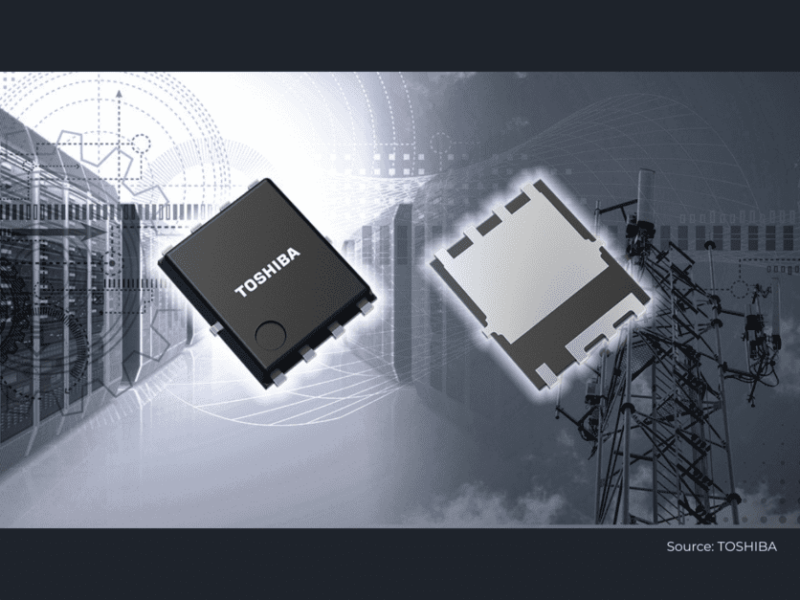
Toshiba Electronic Devices & Storage has introduced the TPM1R408RH, an 80V N-channel power MOSFET designed for switched-mode power supplies used in AI data centres, communications base stations, and industrial equipment.
The device is built on Toshiba’s U-MOS11-H process and is housed in the company’s SOP Advance(E) package. It supports a drain-source voltage of 80V, continuous drain current of up to 288A at a case temperature of 25°C, and a maximum channel temperature of 175°C.
Toshiba lists maximum drain-source on-resistance at 1.4mΩ. Its figure of merit, calculated as RDS(on) × Qg, is lower than the previous-generation 80V part, improving the conduction and switching-loss trade-off in high-density converter designs. The device is also designed to suppress switching spike voltage between drain and source, helping reduce EMI pressure in switched-mode power supplies.
The package is part of the electrical design rather than a secondary mechanical choice. SOP Advance(E) offers lower package resistance and improved thermal resistance compared with Toshiba’s SOP Advance(N) package. Those characteristics affect current handling, heat removal, layout density, and the amount of margin needed around high-current switching devices.
AI infrastructure is sharpening power design constraints across the rack and board. Power density is increasing, but converter losses cannot rise proportionally because every additional watt of heat competes with processors, memory, accelerators, and networking silicon for cooling capacity. MOSFET selection now has to balance conduction loss, gate charge, switching behaviour, package parasitics, thermal impedance, and EMI performance inside tight mechanical envelopes.
800VDC auxiliary PSU designs for AI data-centre architectures have already shown how electrical distribution is changing as rack power rises. Toshiba’s 80V MOSFET sits at a different voltage node, but both developments are tied to the same engineering shift: power conversion is being redesigned around density, efficiency, deployability, and thermal control.
The new device also extends Toshiba’s recent work around industrial power rails. Expanded MOSFET ranges for 48V systems have targeted PLCs, servo drives, servers, inverters, and LED lighting. The TPM1R408RH moves that focus towards higher-current switched-mode conversion for infrastructure loads, where board-level layout and thermal behaviour often decide whether headline device specifications can be realised in practice.
Low on-resistance alone does not guarantee an efficient converter. Gate drive losses, switching transition speed, reverse recovery behaviour in the surrounding circuit, package inductance, and PCB layout can all erode efficiency or create additional EMI filtering requirements. A device that offers lower RDS(on) without a usable switching profile can simply move the problem elsewhere in the power stage.
Simulation support is becoming more valuable as power-supply development cycles tighten. Toshiba provides SPICE models, including fast functional models and higher-accuracy transient models, as well as browser-based circuit evaluation. These tools help designers test device behaviour across operating points before committing to layout and thermal design.
The TPM1R408RH is a component-level launch, but it sits within a system-level race to increase compute capacity without allowing power and cooling overheads to dominate infrastructure cost. MOSFETs with lower losses, credible package performance, and usable modelling support will remain central to that transition as AI, communications, and industrial systems continue to draw more current from smaller power footprints.