IN Brief:
- A Royal Air Force Typhoon test and evaluation aircraft has fired an APKWS-guided 70 mm rocket during UK trials run from Warton, Lancashire.
- The programme is aimed at proving a lower-cost precision option for counter-UAS work and other short-range engagements.
- Further trials are expected to move from a ground target to air-to-air targets as integration work develops.
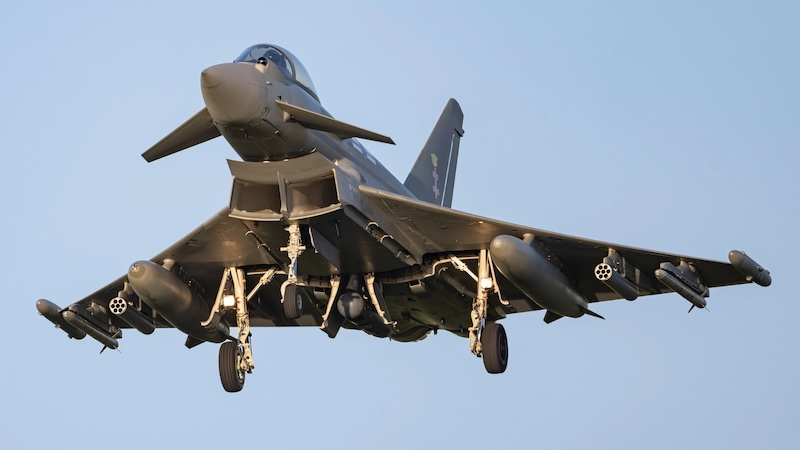
BAE Systems has completed a live firing of the Advanced Precision Kill Weapon System, or APKWS, from a Eurofighter Typhoon, marking a significant step in the effort to give the aircraft a lower-cost response to small uncrewed air threats.
The trial was carried out from the company’s flight test development centre at Warton, Lancashire, using a Royal Air Force test and evaluation aircraft to strike a ground-based target at a UK military range. While the immediate event was a single firing, the engineering value sits in the integration work around it: weapon carriage, release behaviour, guidance, stores management, mission-system interfaces, and the data needed to judge how the system performs from a fast-jet launch profile rather than from the slower aircraft types more commonly associated with 70 mm guided rockets.
APKWS is built around a laser-guidance section that converts standard 2.75-inch rockets into precision weapons. On Typhoon, that creates a different weapons proposition from the aircraft’s existing missile inventory. The fighter already fields high-end air-to-air and strike weapons, but the rise of cheap uncrewed systems has shifted attention toward magazine depth and engagement cost as much as outright kinematic performance. In practical terms, air forces are being pushed to find ways of defeating low-cost aerial threats without treating every intercept as a premium missile event.
That is where the Typhoon trial becomes more than a narrow weapons test. If the aircraft can take APKWS into a credible counter-UAS role, operators gain a more layered effect chain between guns at one end and larger air-to-air missiles at the other. It also gives the Typhoon another route to adapt to the changing threat picture without waiting on an entirely new munition. BAE Systems had already indicated at DSEI 2025 that it was studying a range of lower-cost counter-UAS weapon options for the platform, and the latest firing suggests that work is now moving from concept framing into harder integration evidence.
The wider industrial point is that low-cost intercept is no longer just a ground-based air-defence discussion. It is becoming an aircraft integration question, a mission-software question, and a stocking question. The demand signal comes from repeated operational examples in which relatively cheap drones have forced the use of far more expensive defensive weapons. For platform integrators and subsystem suppliers, that changes the emphasis from adding one more weapon to proving how an aircraft can carry, cue, and sustain a greater number of affordable engagements.
BAE Systems has indicated that the next stage of work is expected to move to air-to-air targets. That will matter because the programme now needs to show not simply that Typhoon can launch APKWS safely, but that the weapon can be integrated into a usable counter-UAS engagement chain at speed, with the sensing, targeting, and software maturity needed for operational relevance. If that follows, the result could be one of the more commercially and tactically interesting Typhoon upgrade paths now in view.