
IN Brief:
- Marine DC architectures are scaling up fast, and battery fault energy scales with them.
- The Switch’s new ECL targets microsecond fault current limiting at the battery interface.
- Direct-to-DC battery connections could simplify hybrids, if protection stays selective.
Large battery banks have stopped being a side-show in marine electrification. On hybrid ferries, offshore vessels, and increasingly complex powertrain architectures, batteries now sit close to the heart of propulsion and hotel load strategies, sharing a common DC backbone with drives, converters, and generation.
That shift brings an awkward electrical reality with it: a fault in a high-energy battery installation can collapse a shared DC link quickly enough to trip healthy equipment, turning what should be a contained event into a vessel-level disruption. Conventional protection approaches built around millisecond-scale responses are poorly matched to a distribution topology where DC-link voltage stability and ride-through are engineered requirements, not nice-to-haves.
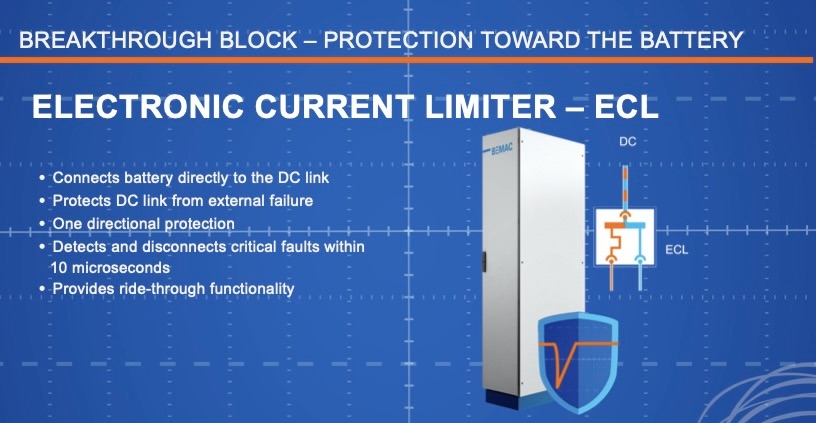
The Switch, the Finnish marine power electronics specialist, is addressing that problem with an Electronic Current Limiter (ECL) designed to sit between batteries and the DC-Hub. The company says the device limits fault current under abnormal conditions before it propagates into the wider DC system, acting at microsecond speed to preserve DC-link voltage and ride-through capability.
“DC systems don’t give you time to react,” says Paul Atherton, Product Line Director, Power Electronics at The Switch. “If you want predictable behaviour during a fault, protection has to act immediately. The ECL gives us that level of control on the battery interface.”
The ECL is positioned as the missing piece in a layered, semiconductor-based protection architecture that The Switch has been building around DC distribution. Electronic DC Breakers (EDCBs) are integrated inside inverter modules to isolate internal faults quickly, while Electronic Bus Links (EBLs) provide selective separation between DC-Hubs so sections can share energy under normal operation but decouple instantly during a serious event. Battery Short-Circuit Limiters (BSCLs) target the short-circuit energy stored in large battery systems by preventing that energy from being dumped into the DC system during a fault.
The ECL’s focus is narrower, but increasingly practical: battery-side faults in configurations where batteries are connected directly to the DC link. In those architectures, the battery interface stops being a peripheral connection and starts behaving like a high-energy fault source coupled into the same electrical backbone as everything else.
“Each device has a specific role, but the objective is always the same,” Atherton says. “Contain the fault at the source and keep the DC link stable.”
The design motivation is straightforward. Allowing batteries to connect directly to a DC link can reduce conversion stages and simplify system architecture, which tends to help footprint and efficiency in a space- and weight-constrained platform. The trade-off is that you have to be confident the system will behave predictably during the ugliest electrical events, because a shared DC link offers limited tolerance for voltage collapse.
The Switch has not detailed ratings, delivery schedules, or first-installation programmes for the ECL. For system integrators and shipowners, the commercial question will be less about the headline response time and more about selectivity, integration effort, and how cleanly fault behaviour can be proven across a full vessel power plant, including batteries, converters, and the distribution backbone.

