
IN Brief:
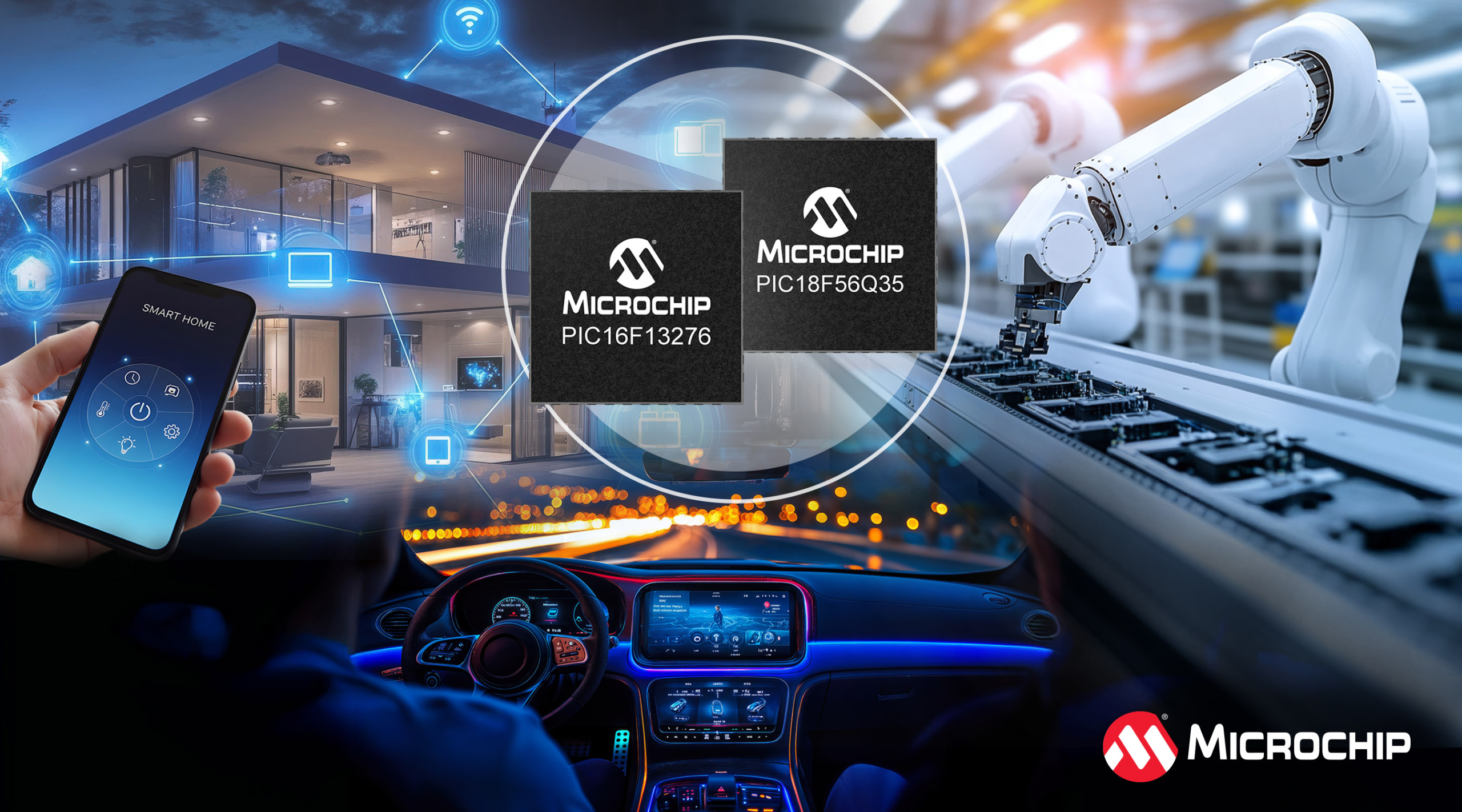
- Microchip has expanded its CLB-based PIC MCU portfolio with PIC16F13276 and PIC18-Q35 devices.
- The parts combine MCU functions with CPLD-like programmable logic and hardware timing analysis support.
- Deterministic behaviour is becoming more valuable as embedded designs absorb more control, protection, and interface tasks on a single board.
Microchip has expanded its Configurable Logic Block-based MCU portfolio with the PIC16F13276 and PIC18-Q35 families, combining low-power microcontroller operation with CPLD-like programmable logic in a single device for timing-critical embedded designs.
The company’s CLB architecture allows logic functions to be implemented in dedicated hardware rather than being handled entirely in software, with the aim of reducing latency, lowering power consumption, and delivering more predictable behaviour. The PIC16F13276 family provides 32 logic elements, while the PIC18-Q35 family offers 128, giving designers the option to place deterministic logic alongside embedded control without moving to a separate CPLD-plus-MCU architecture.
Microchip says the new families can automatically load the logic configuration at power-up or reset so the CLB can initialise independently of the CPU, supporting predictable startup behaviour in designs where functional safety or strict timing is important. The devices are also being positioned as drop-in-compatible options for existing PIC16 and PIC18 users, lowering the adoption barrier for teams that want hardware-based timing paths without redesigning around a different platform.
The software side has been developed in parallel. Microchip’s enhanced CLB Configuration tool is now available in Visual Studio Code and is intended to let developers build logic through a graphical interface with timing analysis, simulation, and hardware debug support. That eases one of the longstanding frictions in mixed logic-and-MCU development, where the hardware can be attractive but the workflow can quickly become awkward.
Many embedded systems still rely on software to solve timing problems that hardware handles more cleanly. That can work, but it increases jitter, consumes CPU cycles, and creates awkward edge cases around interrupt load, startup sequence, and fault response. At the other end of the scale, adding a separate programmable logic device improves determinism but increases cost, board space, and integration effort. Devices that merge the two functions retain a clear role wherever the timing problem is real but the overhead of a larger FPGA or CPLD platform is difficult to justify.
Industrial automation, motor control, and automotive support electronics remain natural targets. These designs often need precise signal handling, interlock logic, pulse generation, or response paths that must behave consistently under changing software load. As more embedded platforms absorb communications, diagnostics, and update features, keeping certain timing paths in dedicated hardware becomes a practical way to stop the software model from becoming fragile.
The MCU market is also shifting back toward more application-specific integration. For a time, many vendors pushed increasingly general-purpose compute into microcontrollers and left much of the rest to software abstraction. That remains viable in large parts of the market, but it does not always suit systems where determinism, startup behaviour, or safety-related timing cannot be left to scheduling discipline alone.
Microchip is not trying to turn a low-end MCU into a miniature FPGA. The company is offering enough programmable logic to solve recurring hardware-timing tasks without crossing into a different class of device complexity. That will appeal to teams that want tighter, more repeatable timing behaviour without carrying the cost, tools, or architectural overhead of a separate logic device.
Embedded design increasingly revolves around what the system can guarantee under load, not simply what it can do in principle. In that environment, deterministic logic remains valuable, and integrating it more closely with the MCU reflects a practical change in design priorities.

