
IN Brief:
- Macnica ATD Europe has acquired Danish semiconductor representative and design-in partner Indesmatech.
- The acquisition expands coverage across Denmark, Sweden, Finland, the UK, Poland, and Germany-linked operations.
- Semiconductor distribution is moving closer to architecture support, lifecycle planning, and early design decisions.
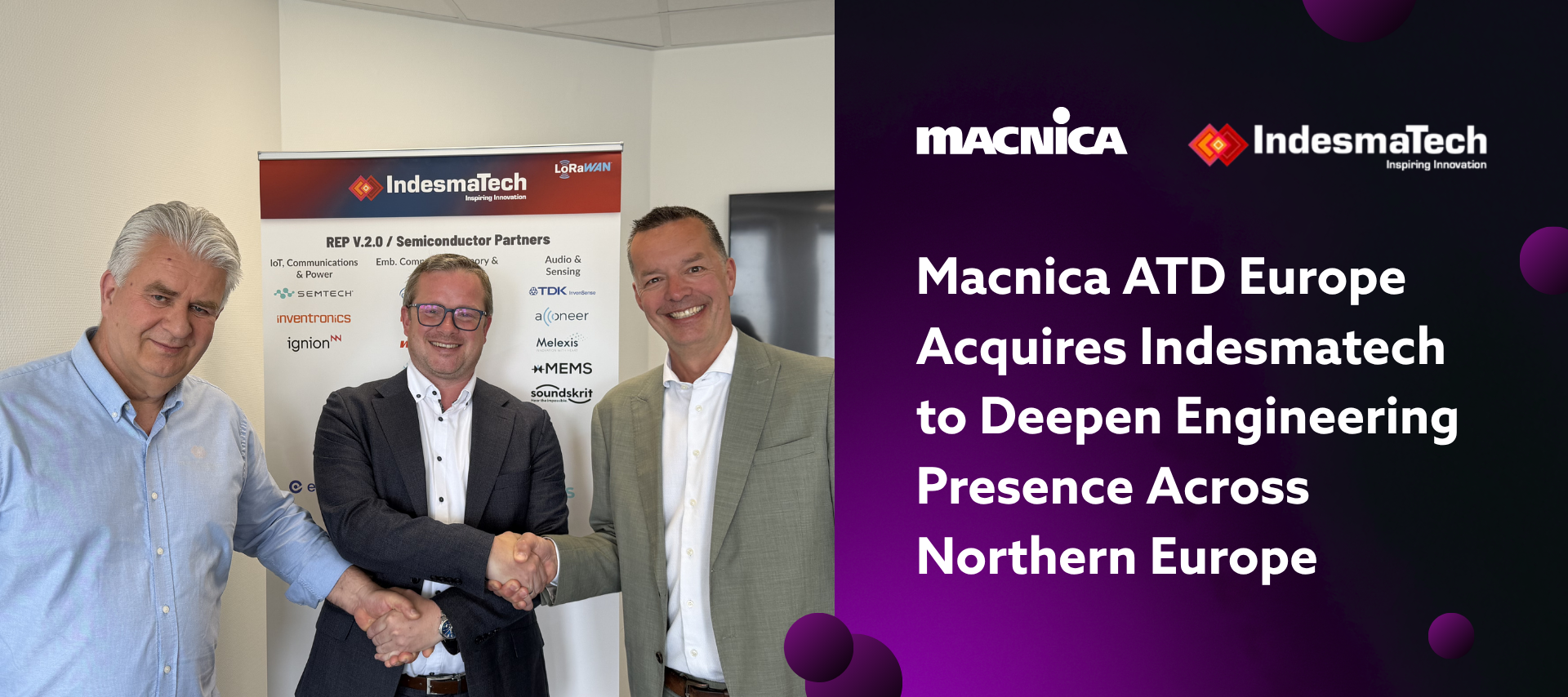
Macnica ATD Europe has acquired Indesmatech, a Danish semiconductor representative and design-in partner, strengthening its engineering and commercial presence across Scandinavia and Northern Europe.
Indesmatech is headquartered in Herlev, Denmark, and was founded in 2014 by Søren Manicus and Rune Domsten. The company specialises in advanced semiconductor representation, design-in support, consulting, and point click buying services. Its technology focus areas include IoT, communications and power, embedded computing, memory and ASIC, and audio and sensing applications.
The acquisition adds established coverage in Denmark, Sweden, Finland, the UK, and Poland, with partner cooperation in Germany. Macnica ATD Europe already operates across France, Germany, and the UK, and forms part of Macnica Holdings, the Japanese semiconductor distribution and engineering services group.
Macnica ATD Europe combines semiconductor distribution with architecture-driven system support, while Indesmatech brings a project-led model built around early technology selection and implementation support. Indesmatech’s “REP 2.0” approach combines marketing, design support, production and supply chain management, direct pricing, and project CTO support.
The acquisition comes as semiconductor distribution becomes more closely tied to engineering support. Component access remains important, but design teams now face a broader set of constraints around integration complexity, security requirements, product-lifecycle risk, software readiness, and supply continuity. In that environment, technical support before the bill of materials is fixed can shape the architecture of the final product.
Embedded computing, sensing, edge AI, IoT, power electronics, and custom ASIC projects all require decisions that go beyond component selection. Engineers need confidence in evaluation hardware, software stacks, interface support, thermal behaviour, compliance routes, and long-term availability. A distributor or representative company with application engineering depth can influence platform decisions long before purchasing teams enter the process.
For design teams in Northern Europe, the combined business widens access to supplier portfolios and application engineering resources. Regional support is particularly valuable in low- and mid-volume industrial electronics, where projects may not carry the purchasing leverage of high-volume consumer programmes but still require complex technical support. Supplier responsiveness, lifecycle stability, and practical design-in assistance can determine whether a device reaches production without late-stage redesign.
The deal also sits within a more competitive European semiconductor environment. Industrial systems are becoming more software-defined, more connected, and more dependent on mixed-signal interfaces. Security requirements are tightening, and product lifetimes remain far longer than those seen in many high-volume electronics markets. Those pressures are increasing demand for partners that can support the full path from early device selection to production continuity.
Indesmatech’s activity in audio, sensing, IoT, embedded computing, and ASICs gives Macnica ATD Europe a stronger position in markets where hardware architecture and supplier relationships are deeply connected. The acquisition expands reach, but it also consolidates technical influence around the early stages of electronic design.
The boundary between distribution, representation, and engineering consultancy continues to narrow. As electronics projects become more application-specific, access to components is only one part of the channel equation. Design-in capability, regional knowledge, and long-term technical support are becoming the areas where semiconductor partners compete most directly.

