
IN Brief:
- ScioSense’s UFC23 targets smart water, heat, gas, and leak-detection meters.
- The device uses a pure front-end architecture, leaving flow calculation to the host microcontroller.
- Low standby and operating currents support longer field life in battery-powered metering platforms.
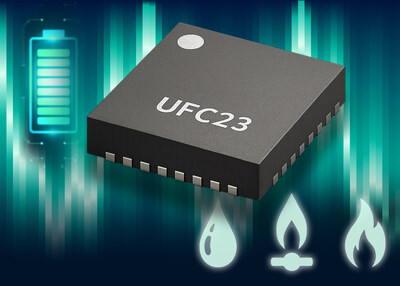
ScioSense has launched the UFC23, a fourth-generation ultrasonic flow converter for smart water, heat, gas, and leak-detection meters.
Built as a pure analogue front-end, the device removes the on-chip CPU used in earlier flow converters and leaves flow calculation to the host microcontroller. That architecture gives meter manufacturers more control over metering algorithms, communications, firmware management, security, and system-level power handling, while keeping the ultrasonic measurement chain in a dedicated front-end device.
In a typical DN15 water meter setup, the UFC23 provides single-shot standard deviation of 35ps and offset stability of ±7ps with 128-sample averaging. Offset drift is below 10ps across 0°C to 50°C, supporting the stability required for high-resolution flow measurement across changing operating conditions.
Power consumption has been kept low for long-life field equipment, with typical standby current of 0.8µA and operating current as low as 6.6µA at an 8Hz sample rate. For battery-powered meters deployed in utility networks, that combination of timing precision and current control is central to reducing service visits and extending installation life.
The UFC23 integrates ultrasonic transducer drive, receive signal capture, and time-of-flight extraction. It supports 3.3V single-ended drive for water applications and full-bridge drive for gas applications, allowing the same converter family to be used across several metering designs. A programmable gain amplifier with higher gain and bandwidth is included for weak receive signals, while the programmable ultrasonic burst generator operates up to 4.4MHz using an external reference of up to 20MHz.
To improve measurement handling, the converter can monitor the amplitude of up to three received waves and use extended pulse-width measurement for first-hit detection. A batch mode allows the sensor to collect up to 12 measurement bundles before waking the host controller, reducing MCU wake cycles and lowering overall system energy use.
The device also supports temperature measurement with external platinum sensors, extending its use into heat meters and hot-water systems as well as cold-water and gas applications. It operates from a 2.5V to 3.6V supply, covers a -40°C to 85°C temperature range, and is supplied in a QFN32 package.
Smart metering designs are increasingly being built around host controllers that manage more than flow calculation. Wireless connectivity, tamper detection, encrypted communications, remote update paths, and local diagnostics are now part of the platform architecture. In that environment, separating precise ultrasonic signal conversion from application processing can make it easier to reuse hardware across meter families while keeping software development under the control of the meter manufacturer.
Ultrasonic metering also continues to gain ground where mechanical wear, low-flow accuracy, and remote monitoring are design constraints. Without a mechanical measurement element, meters can be made more compact and less vulnerable to wear, while the electronic measurement path creates room for richer diagnostics and data-led maintenance.
Samples of the UFC23 are available now, with evaluation kits available through selected distributors. Its reuse across water, heat, gas, water heater, pump control, and smart faucet designs gives ScioSense a component-level platform for metering products moving towards lower-power and more software-defined architectures.

