
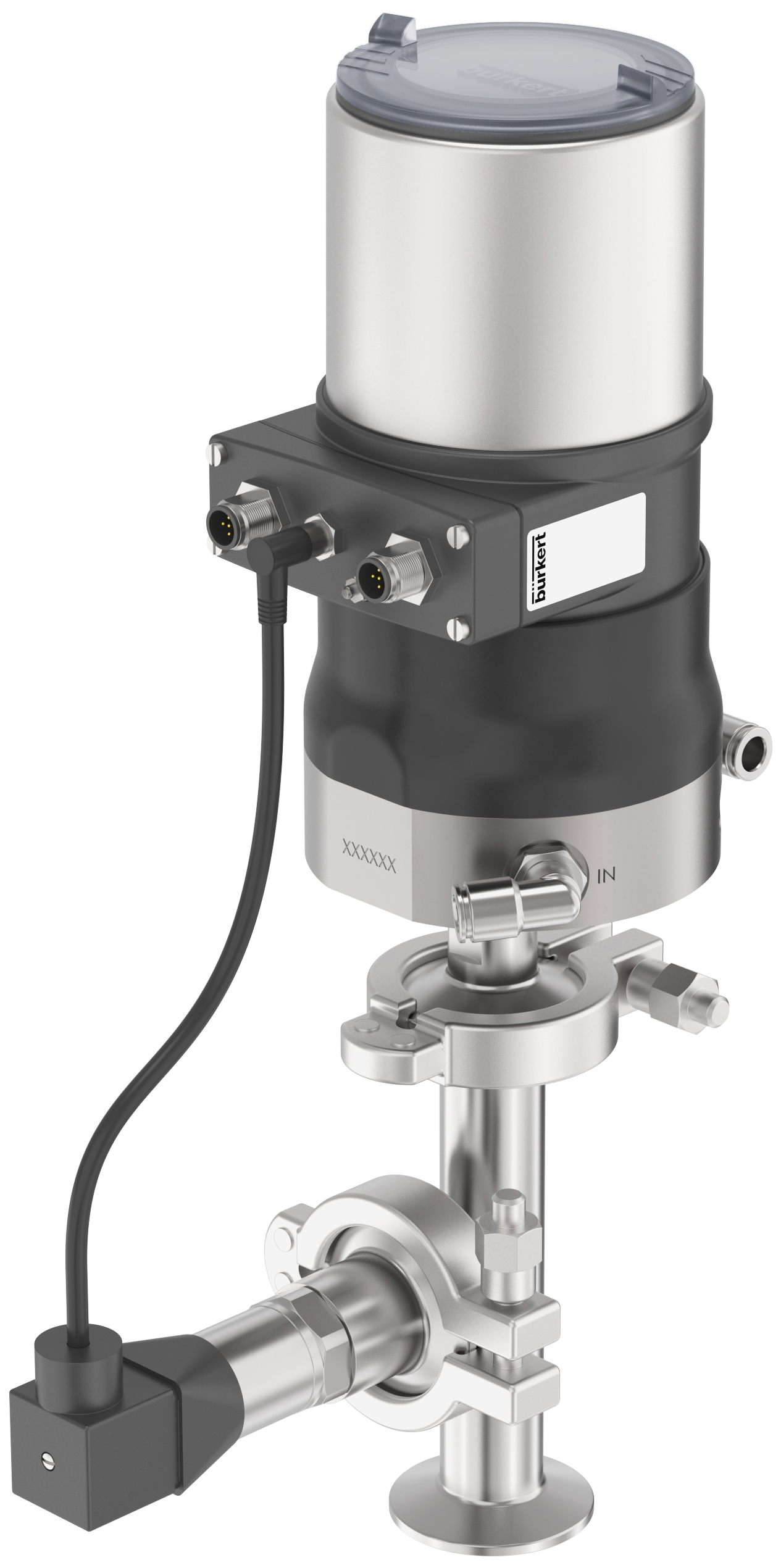
IN Brief:
- Bürkert’s Type 8880 system reduces hygienic gas-pressure control response below 200 ms.
- The system combines two control valves and a pressure transmitter in a closed control loop.
- It targets tank filling, emptying, fermentation, inert gas storage, CIP, and SIP environments.
Bürkert has released the Type 8880 compact pressure-control system for hygienic gas-pressure regulation in food and beverage, pharmaceutical, and biopharmaceutical production.
The system maintains constant tank pressure during filling, emptying, fermentation, and inert gas storage. By combining two control valves with a pressure transmitter in a closed control loop, the Type 8880 reduces response time to less than 200 ms, making it significantly faster than conventional installations based on separate valves, sensors, and control devices.
Tank headspace pressure can affect product quality and process repeatability in hygienic production. Fermentation processes may release CO₂ while gases such as nitrogen or oxygen are added, and carbonated water production relies on maintaining defined CO₂ levels in storage tanks. When pressure drifts, the process can move out of specification before a slower control loop has restored balance.
Conventional pressure-control arrangements often rely on multiple discrete devices working through a separate controller. Each element adds its own response behaviour, while signal processing and communication between components can introduce additional delay. In dynamic filling, emptying, and fermentation operations, that delay can allow pressure excursions to develop quickly.
The Type 8880 has also been developed for hygienic cleaning environments. Proportional valves can suffer wear when exposed to aggressive Clean-In-Place media, especially where cleaning chemicals attack lubricants or seals. Bürkert has developed versions for CIP and Steam-In-Place use, with options including self-draining construction, electropolished surfaces, FDA approval, and dead-space-reduced designs.
Pressure control in hygienic production increasingly sits within a wider move towards compact, application-specific mechatronic modules. Instead of building a loop from separate field devices, manufacturers are asking for integrated assemblies that combine sensing, actuation, control, cleanability, and serviceability in a defined package.
That same pattern can be seen across industrial sensing and flow-control electronics. ScioSense’s ultrasonic flow converter for smart meters brought measurement and signal processing closer together in utility applications, while hygienic process systems are now applying the same logic to tank pressure, gas dosing, and automated cleaning.
Pharmaceutical and biopharmaceutical production places particular pressure on control-loop consistency. Batch values are high, validation requirements are strict, and pressure excursions can disturb sensitive processes. A faster integrated control loop can reduce exposure to drift during filling, emptying, or fermentation, while hygienic construction reduces the maintenance burden created by aggressive cleaning cycles.
Food and beverage manufacturers face a parallel challenge at higher throughput. Automated tank farms, dosing systems, and filling lines need pressure control that supports repeatability without relying on manual adjustment or frequent component replacement. By combining valves and pressure measurement in one compact assembly, the Type 8880 is designed for production environments where pressure stability, hygiene, and maintenance access have to be engineered together.

