IN Brief:
- Infineon has added two devices to its CoolGaN BDS 40 V G3 bidirectional switch family.
- The devices provide bidirectional blocking for compact power paths, load switching, USB protection, and power multiplexing.
- The launch moves GaN further into low-voltage power-path control as well as high-density conversion.
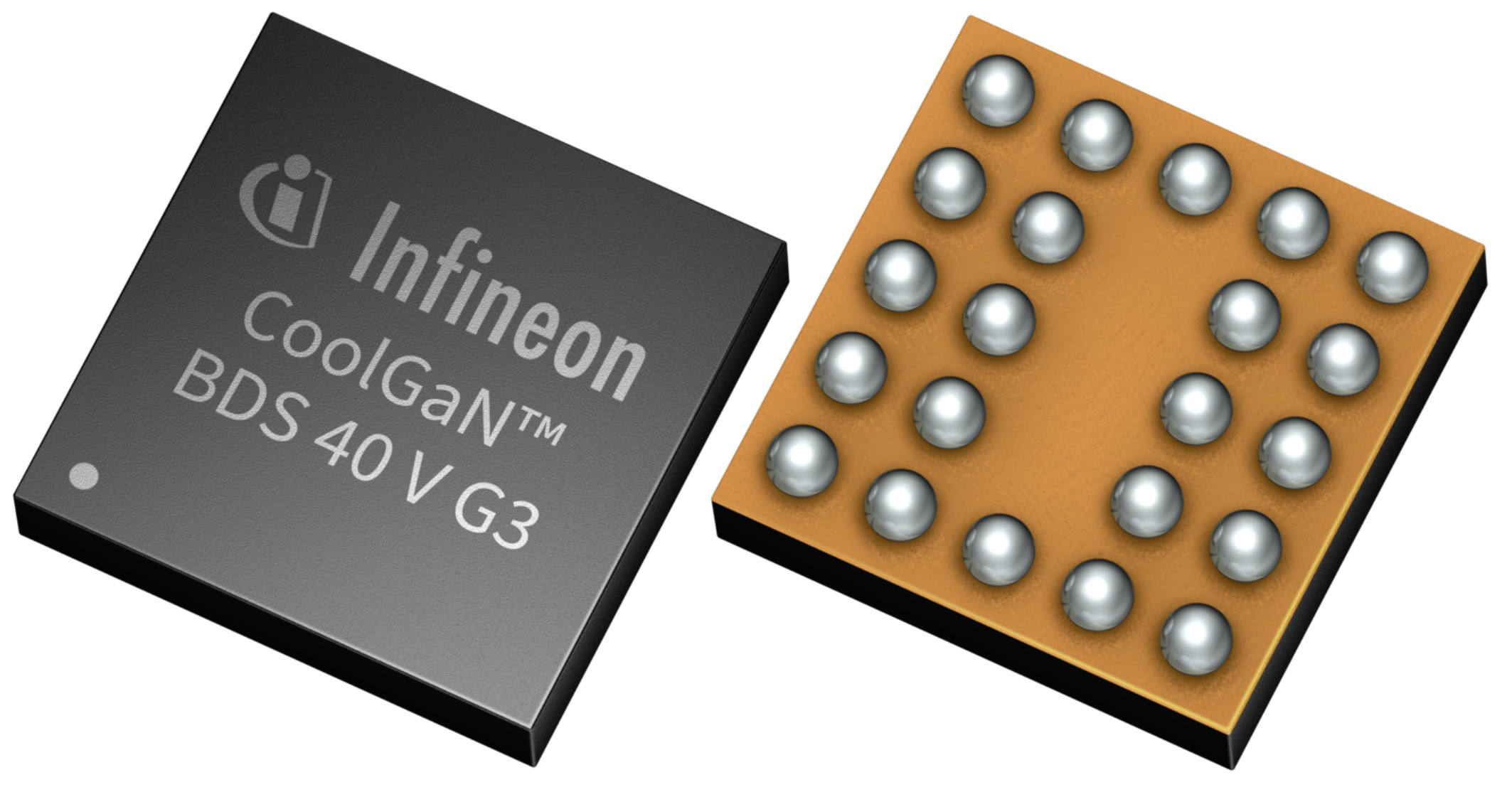
Infineon Technologies has expanded its CoolGaN BDS 40 V G3 bidirectional switch family with two new devices aimed at compact power-path, load-switching, and power-multiplexing designs.
The IGK048B041S and IGK120B041S join the existing IGK080B041S, extending the 40 V CoolGaN BDS family across a broader range of compact switching requirements. The devices use monolithic gallium nitride technology and provide bidirectional voltage and current blocking, allowing current control in both directions without the body-diode behaviour associated with conventional silicon MOSFET approaches.
Bidirectional blocking is valuable in power-path architectures where reverse current must be prevented from reaching sensitive downstream electronics. Target applications include USB overvoltage protection, load switching, and power multiplexing in multi-rail designs, particularly where board area, component count, leakage, and switching losses are tightly constrained.
Although GaN has often been associated with high-density adapters, fast chargers, and high-voltage conversion, low-voltage bidirectional switching addresses a different part of the power design problem. Instead of chasing only converter efficiency, the aim is to replace back-to-back silicon MOSFET configurations in circuits where reverse-current protection and compact layout carry equal weight.
Infineon specifies PCB footprint reduction of up to 82% and a halving of component count compared with conventional implementations. In dense embedded and portable systems, that can free routing space for thermal spreading, connectors, antennas, memory, shielding, or additional sensing. Power-path devices often sit close to processors, batteries, chargers, external ports, and protection circuitry, making package behaviour and layout efficiency as important as headline electrical ratings.
The expansion also arrives as GaN supply and intellectual property become more closely watched across the electronics market. Infineon’s progress in a recent ITC GaN patent ruling and wider distribution activity around EPC GaN devices through Mouser show how quickly the technology is moving from specialist adoption into mainstream design-in decisions.
For engineers, the practical question is where GaN delivers enough system benefit to justify qualification effort, sourcing decisions, and layout learning. Bidirectional switches provide a clear route where the silicon alternative requires multiple devices or compromised reverse-current protection. A monolithic bidirectional switch can simplify the schematic, reduce parasitic effects from discrete back-to-back MOSFETs, and make protection behaviour easier to characterise.
Low-voltage power-path control is also becoming more demanding as products handle more charging modes, external power sources, battery states, and rail-switching scenarios. USB-C, multi-battery systems, portable industrial equipment, and compact edge devices all require protection and routing decisions that must be fast, efficient, and robust against fault conditions.
GaN’s wider adoption will still depend on packaging, ESD performance, thermal design, reliability data, and availability across production volumes. As the technology moves closer to processors, batteries, and external connectors, it has to meet the reliability expectations of high-volume electronics while preserving the density and switching advantages that make it attractive. Infineon’s latest CoolGaN BDS additions extend that argument into the low-voltage power-path circuits where board area and protection behaviour are often decisive.