IN Brief:
- Wolfspeed has introduced 3.3 kV SiC MOSFET power modules in two industry-standard footprints.
- The families target AI data centres, renewable infrastructure, grid-scale storage, wind, solar, and solid-state transformer systems.
- The launch supports 2 kV-plus DC-link architectures and denser grid-facing power conversion.
Wolfspeed has introduced two 3.3 kV silicon carbide power module families designed for AI data-centre power, renewable energy infrastructure, grid-scale storage, wind, solar, and high-voltage conversion systems.
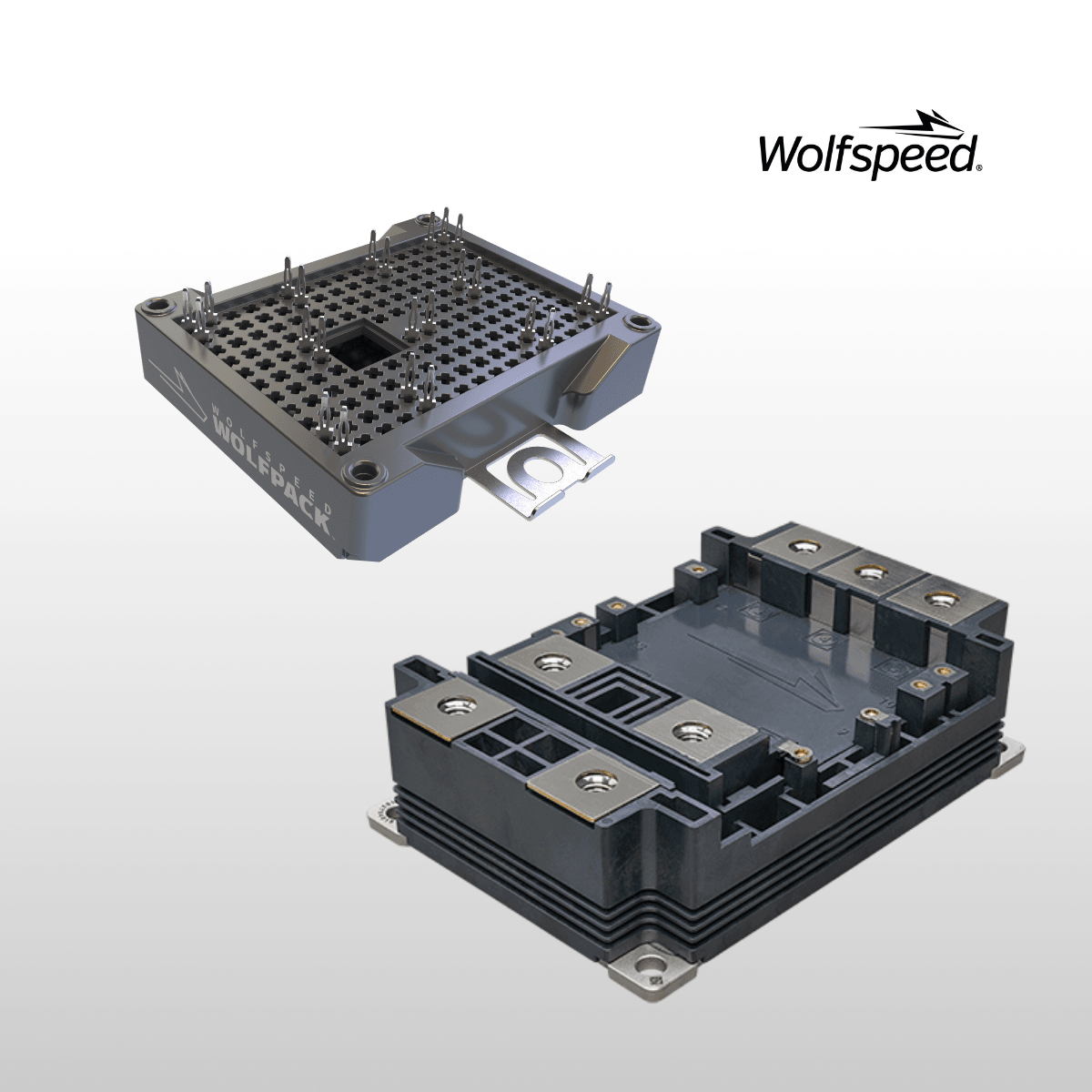
The launch includes high-power half-bridge baseplate modules and scalable full-bridge baseplate-less modules in industry-standard footprints. The devices are designed to support 2 kV and higher DC-link architectures, with module options suited to established grid-scale converter topologies as well as newer modular power architectures.
The high-power half-bridge baseplate SiC module, based on the LM platform, is intended for applications above 800 A and is optimised for demanding converter topologies in solar, grid-scale energy storage, and wind-power infrastructure. The full-bridge baseplate-less module, part of the Wolfspeed WolfPACK family, supports modular configurations including multi-level, series-stacked, and parallel converter designs.
Guy Moxey, vice president of Wolfspeed’s Industrial & Energy business, said: “The release of this 3.3 kV MOSFET voltage node in two complementary footprints was a strategic decision. We understand the urgency our customers are facing to scale power infrastructure, and these two families enable both established grid-scale players and emerging players with modular architectures to move quickly.”
The 3.3 kV node supports a shift in high-voltage power architecture. As system voltages increase, designers can reduce current for a given power level, improving efficiency and potentially reducing conductor size, thermal stress, and conversion-stage complexity. Wolfspeed’s two module families are designed to help engineers reduce power stages and move to two-level topologies in 2 kV-plus DC-link systems.
SiC suppliers are moving quickly into higher-voltage infrastructure markets, with Infineon’s 2300 V SiC module expansion and Microchip’s ruggedised mSiC modules showing the same drive toward higher power density, harsher duty cycles, and grid-scale reliability. Wolfspeed’s 3.3 kV launch pushes further into applications where higher DC-link voltage can reshape converter design.
AI data centres are adding urgency to that transition. Compute clusters are increasing rack power density and placing strain on conventional power distribution. Grid connection, transformer capacity, UPS architecture, and conversion efficiency are all becoming limiting factors. SiC-based solid-state transformers and high-voltage DC distribution are gaining attention as ways to reduce footprint, improve efficiency, and make power delivery more responsive.
Packaging reliability remains central to the engineering case. Wolfspeed specifies sintered die attach and epoxy encapsulant material for the WolfPACK module to improve power cycling compared with standard silicon gel encapsulated modules. The baseplate module uses sintered die attach and a copper die-top system. Those choices are important in infrastructure systems expected to operate continuously for years under variable thermal and electrical loading.
Renewable energy and storage applications place similar demands on module lifetime. Wind, solar, and grid-scale battery converters must handle long duty cycles, outdoor thermal variation, high fault energy, and maintenance constraints. As converter voltages rise, insulation coordination, partial discharge performance, thermal spreading, and layout become more difficult to treat separately from the semiconductor selection.
Samples of the full-bridge WolfPACK IBB020A33GM4 and IBB020A33GM4T, and the HAB900C33LM4 baseplate module, are available for selected customers. Wolfspeed plans to demonstrate the families at PCIM Europe, where high-voltage SiC, data-centre power, and grid-facing conversion are expected to be defining subjects across the exhibition floor.