IN Brief:
- AlixLabs has introduced Sax Forma, a beta APS equipment platform for semiconductor scaling.
- Atomic pitch splitting uses atomic layer etching to increase feature density without extra lithography steps.
- European semiconductor equipment companies are targeting cost, complexity, and sustainability pressures in advanced patterning.
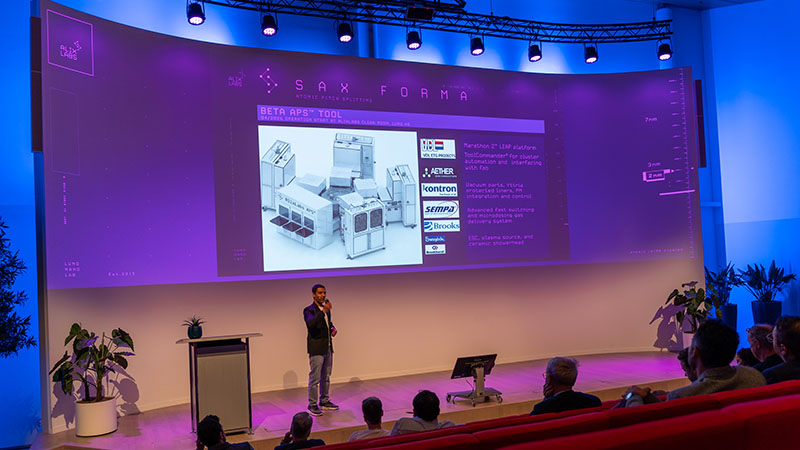
AlixLabs has launched Sax Forma, its first commercially available atomic pitch splitting equipment platform for advanced semiconductor manufacturing flows.
The Lund-based company’s system brings atomic pitch splitting into customer evaluation, process integration, and production-like validation. A follow-on gamma version is planned for 2028, giving the company a route from beta equipment into more mature fab deployment.
Atomic pitch splitting uses atomic layer etching to increase feature density without adding further lithography exposures. The process is designed to work downstream of established lithography routes, including DUV, EUV, and nanoimprint lithography, by applying a controlled pitch-splitting step after the initial pattern has been created.
The approach allows line density to be doubled, and potentially quadrupled, through controlled layer-by-layer material removal. Rather than relying solely on additional exposure steps, the process uses the surface topology of existing nanoscale features as part of the patterning route.
Sax Forma is being industrialised with support from VDL ETG Projects, which is working on system integration and manufacturing scale-up. That connection is significant because a process concept only becomes commercially useful when it can be engineered into stable equipment that fits cleanroom operations, service models, process control, and customer qualification cycles.
Semiconductor scaling is becoming more equipment-intensive and more expensive. EUV lithography has enabled leading-edge logic to continue shrinking, but it has also increased capital concentration and placed even greater value on the process steps around each exposure. High-NA EUV will extend capability further while raising cost and integration demands.
Complementary patterning technologies are gaining attention where finer features can be achieved through etch-based processing after a less aggressive exposure. Such approaches do not remove the need for lithography precision, but they can change the economics and complexity of selected layers, particularly where repeated multi-patterning steps add process time, defect risk, and environmental burden.
Advanced manufacturing is also being shaped by process-control investment. Nearfield Instruments has raised major funding to scale semiconductor metrology, strengthening a Dutch equipment base already connected to ASML, ASM International, and other specialist process companies. AlixLabs operates in a different part of the tool chain, but the same manufacturing pressure applies: smaller features require tighter control, fewer defects, and more economical process flows.
Lithography alternatives and extensions are also receiving renewed scrutiny. Nikon has been preparing a lower-cost ArF immersion lithography platform, underlining continued demand for DUV capacity even as EUV dominates discussion around advanced nodes. Semiconductor manufacturing will continue to rely on a mix of lithography, etch, deposition, metrology, and computational control across different layers and device classes.
Sax Forma’s commercial prospects will depend on process windows, defectivity, throughput, tool matching, contamination control, and integration with customer flows. Fabs are conservative by design, and any new process step has to survive statistical process control, maintenance planning, yield ramp, and production support before it becomes routine.
The potential gain is still substantial. If atomic pitch splitting can reduce multi-patterning complexity while maintaining precision and lowering process burden, it could become attractive for manufacturers facing cost and sustainability pressure at advanced dimensions. Semiconductor scaling now depends on process combinations rather than single-tool breakthroughs, and AlixLabs is moving APS into the equipment phase where that proposition can be tested on the fab floor.